
The Math of Loss Chasing: Why Recovery Bets Always Fail

the author
ProvablySmart Research Desk
date post
Aug 28, 2026

Share


Loss chasing — increasing bet sizes after a loss to try to recover previous losses — is one of the most persistent fallacies in gambling. Its mathematical structure guarantees failure in the long run, regardless of short-term wins. This article walks through the precise probability models that demonstrate why recovery bets always fail, with data that any reader can verify using provably fair tools. The analysis uses 2026 figures and standard casino game parameters.
The Martingale Example: A Concrete Model
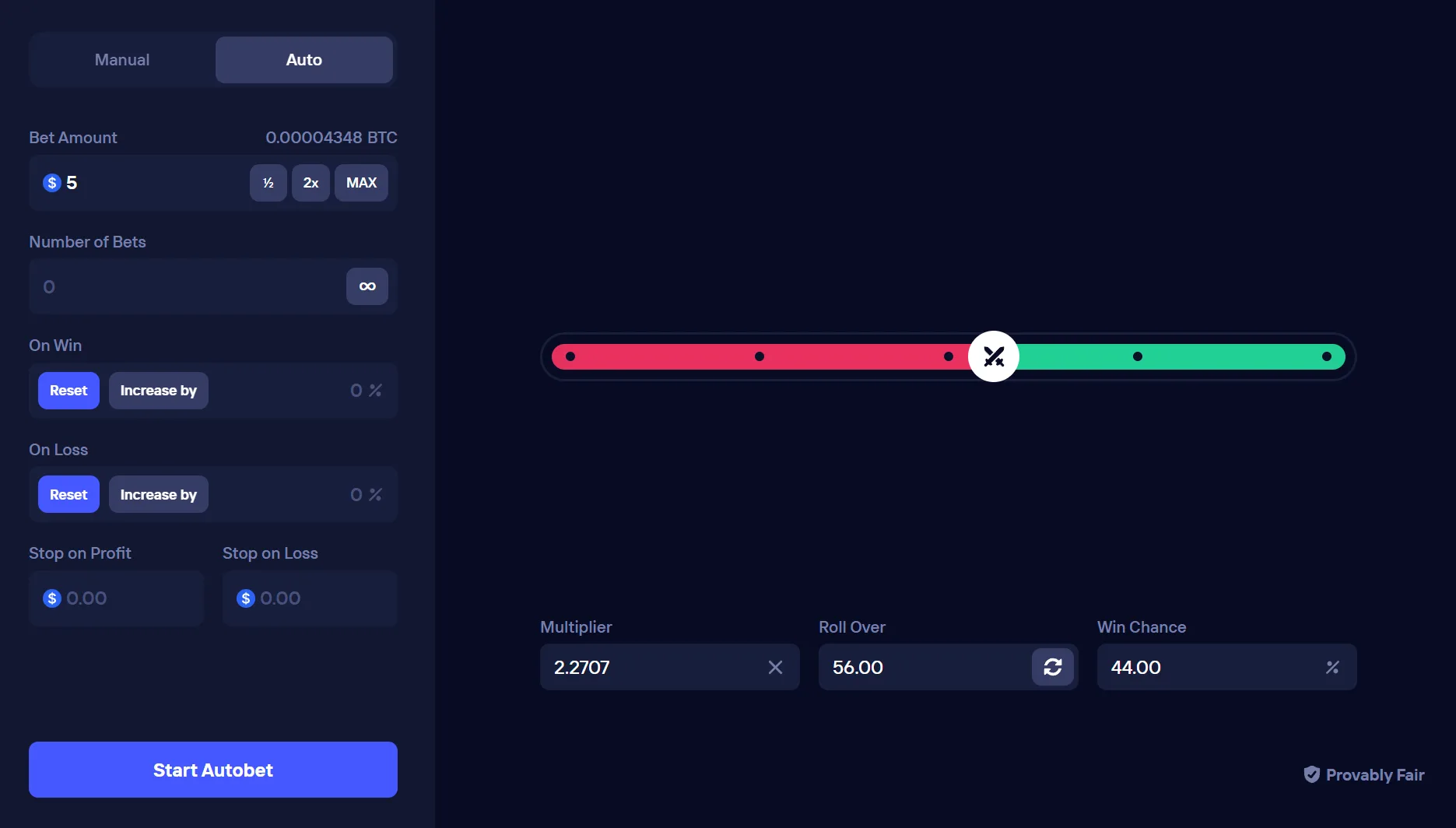
The most common loss-chasing strategy is the Martingale system. In its simplest form, on a binary outcome (e.g., red/black in roulette or a dice roll under/over), the player doubles their bet after each loss, resetting to the base bet after a win. The theory: one win recovers all previous losses plus a small profit. The reality is constrained by two factors: the house edge and the player’s bankroll.
Probability of a Losing Streak
Consider a game with a 49.5% chance of winning (e.g., a provably fair dice game with a 1% house edge). The probability of losing a single bet is 0.505. For a streak of ( n ) consecutive losses, the probability is ( 0.505^n ). The table below shows the probabilities for various streak lengths:
| Losses in a row | Probability | Approximate odds (1 in X) |
|---|---|---|
| 5 | 0.505^5 ≈ 0.0328 | 30.5 |
| 7 | 0.505^7 ≈ 0.00835 | 120 |
| 10 | 0.505^10 ≈ 0.00106 | 943 |
| 12 | 0.505^12 ≈ 0.000269 | 3,720 |
| 15 | 0.505^15 ≈ 0.0000342 | 29,200 |
A streak of 10 losses occurs roughly once every 943 bets. With a base bet of $1, the 10th bet would be $512 (2^9), and the player would have already lost $511. The 11th bet would be $1,024, requiring a total bankroll of $2,047 to survive the streak. Most players do not have such a bankroll relative to their base bet.
Expected Value of a Martingale Sequence
Each individual bet has a negative expected value (EV). For a bet of $B with a win probability ( p ) and payout of 1:1 (on a fair bet would be 0 EV), the EV per bet is ( B times (2p – 1) ). For ( p = 0.495 ), EV per $1 bet is -$0.01. The Martingale does not change the per-bet EV; it only redistributes the sequence of outcomes. The cumulative EV over ( n ) bets is simply the sum of each bet’s EV, which is negative. Over a large number of sequences, the total loss approaches the house edge multiplied by the total amount wagered. The system does not alter the mathematics of the game.
Negative Expectation Compounding
How Does This Compare to 0% House Edge Protocols?
Audited 100% RTP
Instead of standard 1.00% to 4.00% casino house margins, compare with mathematically verified 100% RTP Originals (0.00% House Edge) on Duel Casino:

Loss chasing amplifies the effect of negative expectation because the losing bets are larger. Suppose a player loses 5 bets in a row with a Martingale: $1, $2, $4, $8, $16 — total loss $31. The next bet is $32. If the player wins, they recover $31 and gain $1 profit. But the expected value of that $32 bet is -$0.32 (at 1% house edge). The profit from a win is fixed, but the expected loss scales with the bet size. The system is designed to produce small frequent wins and rare large losses, but the expected value of the whole sequence is still negative. Over many sessions, the rare large losses more than offset the small gains.
Finite Bankroll vs. Infinite Series
A key mathematical reality: the Martingale system requires an infinite bankroll to guarantee eventual recovery (assuming no table limits). In practice, every player has a finite bankroll. The probability of ruin — hitting a losing streak that exceeds the bankroll — is always positive. For a bankroll of ( K ) base bets, the maximum number of consecutive losses that can be survived is ( lfloor log_2(K+1) rfloor ). For a bankroll of 100 base bets, that’s only 6 losses (2^6 – 1 = 63, 2^7 – 1 = 127 > 100). The probability of a 7-loss streak in our example is 0.505^7 ≈ 0.00835, or about 1 in 120 sequences. On average, ruin occurs every 120 attempts. The house edge ensures that the player’s expected time to ruin is even shorter because the edge accelerates the drain.
This is not speculation; it is a direct consequence of the negative expectation and the geometric series of bets. Every provably fair casino publishes its RTP (Return to Player) and seed generation methods. For example, many dice games show a 99% RTP, meaning a 1% house edge. Over any large number of bets, the player’s actual return will converge to that RTP. The Martingale does not change the underlying RTP — it only changes the variance. Players who chase losses are effectively betting larger amounts at the same negative EV, which increases the speed of expected loss.
The Gambler’s Fallacy: Independence of Events
Loss chasing relies on the mistaken belief that a loss makes a win more likely on the next bet. All casino games with independent outcomes (dice, roulette, slot spins) are memoryless. The probability of a win on any given bet is fixed, regardless of past results. The sequence of outcomes is a Bernoulli process. The probability of a win after 10 consecutive losses is still 0.495 (or whatever the game’s win probability is). The expected value of the next bet remains negative. There is no ‘due’ outcome. Verifiable provably fair systems allow players to check the hash of the seed before betting and compute the outcome after the fact, confirming that results are independent and unpredictable. For a detailed guide on how to verify these seeds, see our guides on provably fair verification.
Why Recovery Bets Always Fail: Summary
The mathematical reasons are simple and irrefutable:
- Each bet has a negative expected value, so any sequence of bets also has negative expected value.
- Loss chasing increases bet sizes, which increases the absolute amount wagered and thus the expected loss.
- Finite bankrolls guarantee that a long enough losing streak will cause ruin with probability 1 over infinite time.
- Past outcomes do not influence future ones; the house edge does not disappear after a streak.
These conclusions hold for all games with a negative expectation, including those offered at provably fair casinos. To see how specific casinos implement these mechanics and verify their RTP, consult our casino reviews. For effective bankroll management that avoids loss chasing, refer to our bankroll management page.
The only way to overcome the house edge is to have a positive expectation bet, which does not exist in standard casino games. Loss chasing is not a strategy; it is a mathematical certainty of loss.
FAQ
Is there any loss-chasing strategy that can overcome the house edge?
No. All loss-chasing strategies, including Martingale, Fibonacci, and d’Alembert, are subject to the negative expected value of the underlying bets. While they can produce short-term wins, the long-term expected loss is equal to the house edge multiplied by the total amount wagered. The strategies merely change the distribution of wins and losses without altering the underlying EV.
Can you beat the Martingale with a very large bankroll?
No. A larger bankroll extends the time until ruin, but the probability of eventual ruin remains 1 if the game continues indefinitely. Moreover, casino table limits and the exponential growth of bets (doubling after each loss) make it impossible to sustain a Martingale for long. The expected value of the series is still negative, so the average loss grows with the bankroll.
How can I verify that a casino’s games are fair and not rigged against loss chasing?
Use provably fair verification. Most reputable crypto casinos provide a server seed, client seed, and a nonce. You can compute the outcome of each round using these seeds and check that the result matches the displayed outcome. The probability of each outcome is predetermined by the game’s RTP, which is usually published. For step-by-step instructions, see our news articles on provably fair verification. Always verify the fairness of any game before betting real funds.