Loss Rebates: The Math Behind Percentage-Back Promotions

the author
ProvablySmart Research Desk
date post
Aug 28, 2026

Share


A loss rebate sounds like a simple proposition: if you lose, the casino returns a percentage. The marketing copy calls it cash back, but actual value depends on terms that are easy to miss. In 2026, most rebates are calculated on net losses over a period, paid as bonus funds, and capped. For a technical player, the question is whether the terms transform a negative-expectation game into a positive one. This article walks through the math and the verification steps you can apply before playing.
What a Loss Rebate Actually Returns

A loss rebate is defined by three parameters: the percentage R, the period, and the loss definition. The percentage may be 5%, 10%, or more. The period is usually a day, week, or month. The loss definition can be ‘net loss after all bets and bonuses’, or it can exclude certain games.
- Cash rebate: If the rebate is paid in withdrawable currency, it is a direct reduction of the loss. One dollar of rebate is worth one dollar.
- Bonus rebate: If the rebate is paid into a bonus balance, its value is lower. The size of the drop depends on wagering requirements and game contribution rates.
- Net-loss vs per-bet: Most rebates apply to the total session result. A ‘per-bet insurance’ rebate applies to each losing bet and is easier to evaluate.
The Break-Even Math for Per-Bet Rebates
How Does This Compare to 0% House Edge Protocols?
Audited 100% RTP
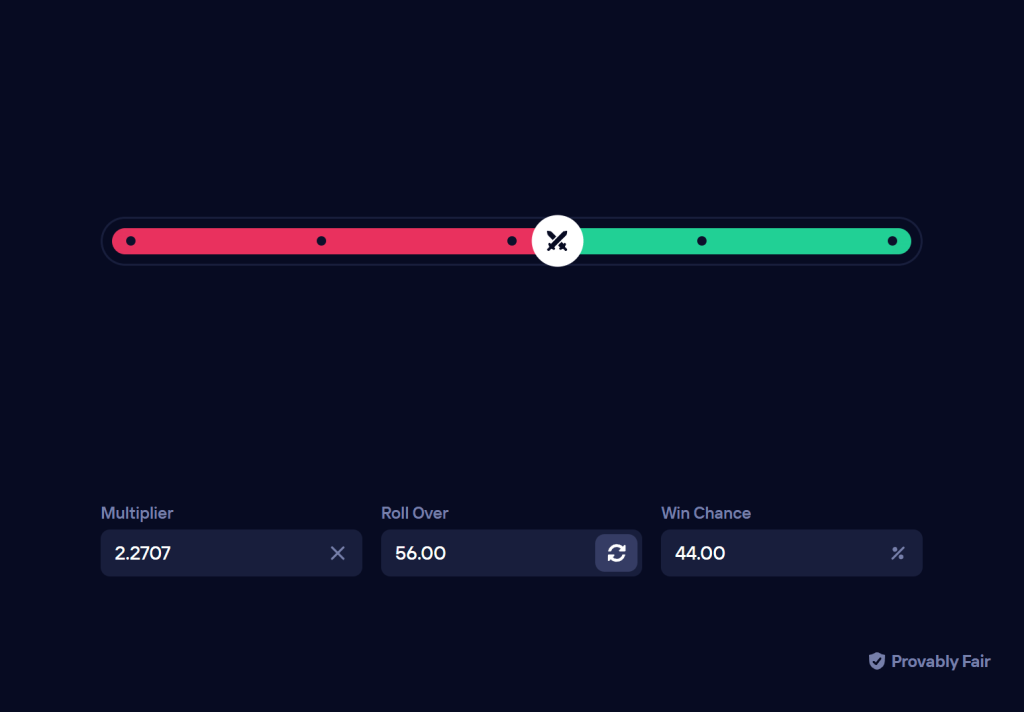
Instead of standard 1.00% to 4.00% casino house margins, compare with mathematically verified 100% RTP Originals (0.00% House Edge) on Duel Casino:
Suppose a game offers even-money payouts with a house edge H. Let q be the probability of losing. Since the game is even money, q = (1+H)/2 and p = (1-H)/2. If the operator returns a fraction R of every losing bet, the expected value of one unit wagered is:
EV = p – q(1 – R) = -H + (1+H)R/2.
Set EV to zero to find the break-even rebate rate:
R* = 2H / (1 + H).
For a game with a 2% house edge, R* is 3.92%. A 5% rebate would be positive on a per-bet basis. The table below shows break-even values for common house edges.
| House edge H | Break-even rebate R* |
|---|---|
| 1% | 1.98% |
| 2% | 3.92% |
| 5% | 9.52% |
| 10% | 18.18% |
Per-bet rebates are rare in 2026. Most promotions use net-loss accounting, which prevents you from applying this single-bet formula directly. The formula shows why operators who offer per-bet rebates impose low caps or exclude high-house-edge games.
Net-Loss Rebates Create a Put Option
For a net-loss rebate, the rebate is paid only when the total profit P for the period is negative. The value equation is:
EV = E[P] + R * E[max(0, -P)]
E[P] is the expected profit without the rebate, equal to -H times total wagered. The second term is the expected value of the rebate itself. It behaves like a put option on your bankroll: it has value only when P is negative, and its payout scales with the size of that negative result.
Because the second term depends on the distribution of P, a nominal rebate is worth different amounts on different games. A high-variance game tends to increase the value of the put-like term compared with a low-variance game, all else equal. You can verify this with a simulation: input the game RTP, bet size, number of bets, and rebate rate. Use the simulation’s distribution to calculate E[max(0, -P)] directly. Do not use the break-even table above for a net-loss rebate.
Wagering Requirements and the Conversion Factor
Suppose the operator credits the rebate as a bonus with a wagering requirement W. The bonus amount B is not withdrawable until you wager B times W. Let rtp be the expected return of the allowed games. The expected cash remaining after meeting the requirement is:
Expected cash = B * (1 – (1 – rtp) * W)
If rtp = 96%, W = 20, the expected conversion factor is 1 – 0.04 * 20 = 0.20. A $100 bonus is worth $20 in expected cash. A 10% loss rebate then has an expected value of 2% of the original loss, not 10%. This is the most common reason a headline rebate does not match its realized value.
For a full guide to wagering contributions and game weighting, see our guide to casino bonus math.
What to Check Before You Accept
Before treating a rebate as an edge, verify the operator’s terms. The following points determine the true value:
- Payment form: cash or bonus. If bonus, find the wagering requirement and allowed games.
- Net loss definition: Does the operator deduct all winnings from the loss calculation? Are deposits and withdrawals excluded?
- Cap: ‘10% up to $500’ means the effective rate is lower for losses above $5,000.
- Time window: A daily rebate compounds differently from a weekly one. If the period resets before you can build a loss, the put value shrinks.
- Excluded games: Roulette and blackjack may be excluded or contribute 0% to wagering.
- Provably fair verification: Check seed hashes, server seed reveal, and client seed for each outcome. The published RTP should match a large sample of the algorithm.
Each operator documents these details differently. In our casino reviews, we flag the key terms, but you should open the actual T&C before accepting any promotion.
Bankroll Management and Loss Rebates
A loss rebate reduces the cost of losing, but it does not eliminate risk. If you increase your bet size because a 10% rebate is active, you also increase the probability of a losing session large enough to hit a cap. Rebate harvesting works only when the house edge is low, the wagering requirement is absent, and the rebate is paid as cash. For most promotions, run the simulation before deciding whether the volatility is justified.
For a methodical approach to staking under these conditions, see our bankroll management guide. Bet size should remain a function of your bankroll, not a function of a rebate headline.
FAQ
Does a 10% loss rebate mean I only lose 90% of my losses?
Only if the rebate is paid as withdrawable cash with no wagering requirement and no cap, and only for the exact period where the net loss is calculated. When the rebate is paid as bonus funds, a 20x wagering requirement at 96% RTP reduces a 10% rebate to roughly 2% expected value. Multiply the rebate percentage by the bonus conversion factor.
Can I collect a loss rebate without gambling by stopping after a loss?
No. The rebate is calculated over the whole period, so you cannot retroactively apply it to a historical loss. Some players try to stop at a loss and trigger a rebate, but operators counter with minimum wagering volumes, excluded games, and maximum rebate caps. The mathematical edge from such strategies depends on those limits, so you must model them exactly.
How can I verify a provably fair game contributes the correct loss to a rebate?
Every round uses a client seed, server seed, nonce, and a published hash. You can verify each outcome after the server seed is revealed. The rebate itself should appear in your transaction history: sum all stakes and returns over the period and compare the result with the reported net loss.