Litecoin’s Quiet Comeback as a Casino Payment Rail

the author
ProvablySmart Research Desk
date post
Aug 28, 2026
Share


Litecoin (LTC) is rarely discussed in terms of innovation. It does not host programmable contracts, its blocks arrive every 2.5 minutes rather than instantaneously, and its price movements tend to track Bitcoin with a lag. Those characteristics, which once made it look uninteresting, are precisely why it has returned to relevance as a casino payment rail in 2026.
A fall from attention, and the reasons that matter

BTC

ETH

SOL

XRP

USDT

LTC
For most of the post-2020 cycle, crypto casinos gravitated to networks with more active marketing: Ethereum L1 and its L2s, Solana, and, most significantly, stablecoins like USDT and USDC. These rails offered either smart contract functionality or the appearance of price stability.
But that shift introduced a category of risk that Litecoin never carried. A stablecoin held in a casino balance is a promise from an issuer. If that issuer’s redemption process freezes assets, or its compliance posture changes, the player’s balance is no longer a bearer asset. LTC settles as a digital bearer asset with no central issuer and no contract that can be paused.
For casinos, the relevant comparison is not technical sophistication, but settlement certainty. Litecoin has maintained continuous chain production since its 2011 launch, and that record is verifiable through any public block explorer.
What changed by 2026
How Does This Compare to 0% House Edge Protocols?
Audited 100% RTP
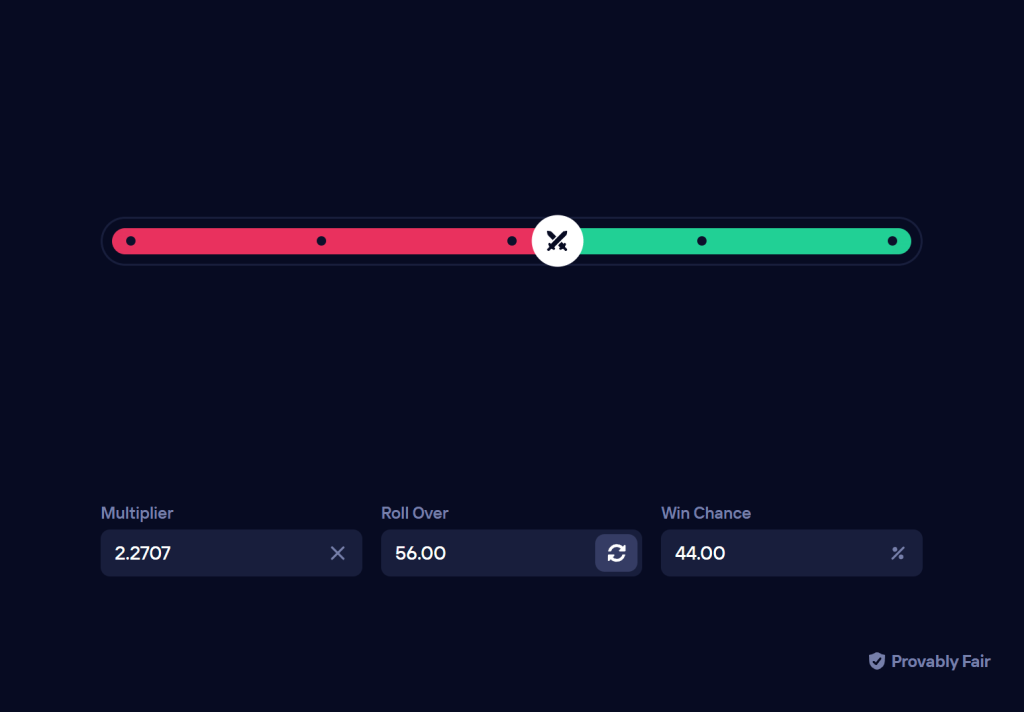
Instead of standard 1.00% to 4.00% casino house margins, compare with mathematically verified 100% RTP Originals (0.00% House Edge) on Duel Casino:

Three developments in the current cycle altered the cost-benefit calculation for LTC:
- Fee normalization: On Ethereum L1, a simple USDT transfer still costs between a few dollars and tens of dollars depending on demand. On Litecoin, median transaction fees in 2026 are typically a few thousandths of an LTC, or a few cents in fiat terms. The difference matters for casinos processing thousands of withdrawals per day.
- L2 fragmentation: Ethereum L2s solved fees but added bridge risk and a fragmented liquidity landscape. A casino that accepts “ETH” must decide which canonical L2, which bridge, and which token list to trust. LTC avoids that entire category of support tickets.
- Continued network operation: No fork has captured material hashrate or user base since the network’s early years. Protocol upgrades have remained backward-compatible, and the next block reward halving is scheduled algorithmically, giving operators a known security-budget trajectory.
Verifiable metrics: what to check before depositing
The table below lists typical magnitudes for major casino payment rails as of 2026. Do not treat the figures as real-time market data; open the relevant block explorer and verify current values before making a deposit or setting cashier policy.
| Rail | Block time | Typical fee per tx | Finality heuristic |
|---|---|---|---|
| Bitcoin | 10 min | $1–$10 | 6 confirmations (~60 min) |
| Litecoin | 2.5 min | $0.01–$0.10 | 6 confirmations (~15 min) |
| Ethereum L1 | 12 s | $1–$20 | 15 confirmations, fee-dependent |
| Solana | 400 ms | minimal | No PoW finality; casino-defined |
| XRP Ledger | 3–5 s | minimal | Validator consensus, 1–2 ledgers |
Litecoin’s advantage is not speed. A 2.5-minute block time is slower than several competitors. But its confirmation logic is structurally identical to Bitcoin’s, meaning a chain of proof-of-work blocks. A 6-confirmation LTC deposit therefore has the same economic double-spend resistance as a 6-confirmation Bitcoin deposit, reached in a quarter of the time.
What to check at any LTC casino
If you are evaluating a casino that accepts LTC, and our casino reviews cover which operators actually process LTC cleanly, the following checks are the ones that matter.
- Deposit confirmations: Does the casino credit after 1 confirmation or 6? For small amounts, 1-conf is a calculated risk. Check whether that policy is disclosed in the cashier before you send funds.
- Fee on payouts: Some casinos deduct a fixed network fee from your withdrawal. Because LTC fees are low, a fixed $1 deduction reveals a markup. Read the terms.
- Provable fairness integration: Provably fair is honest only if the house seeds are mixed with client seeds at bet time. LTC’s block hashes are sometimes used as an entropy source. Verify that the casino documents its seed selection logic; the provably fair guides provide a baseline.
- MWEB handling: MimbleWimble Extension Blocks are enabled on LTC. If the casino uses MWEB addresses, privacy and compliance considerations change materially. Most casinos, however, use transparent LTC addresses for auditability. If you see an MWEB address in a casino’s withdrawal policy, ask what their AML procedure is.
Reorg risk and the security math
Casino operators who accept LTC need to quantify reorg risk. The cost of a double-spend attack on LTC depends primarily on network hashrate and the availability of hashpower rental markets. There are no exact public numbers for rental liquidity, but the following structural facts hold:
- LTC shares the Scrypt proof-of-work algorithm with Dogecoin, and merged mining links the two chains’ security budgets. This raises total hashrate but also introduces a coordination surface that must be monitored.
- An attacker needs both time and hashpower to bury a fork. Casino deposits should be treated as pending until the casino’s stated confirmation threshold is met, not before.
- You cannot verify in advance that an attack is impossible; you can only verify after the fact that the canonical chain remained unchanged. Block explorers and indexers preserve that record.
Positioning LTC in your bankroll
From a bankroll management perspective, LTC occupies a middle position. It is more volatile than a stablecoin, and therefore a deposit in LTC carries price risk that a USDT deposit does not. But it is also a non-custodial asset that your casino operator or exchange cannot freeze. For players who intend to gamble rather than trade, this trade-off is often acceptable.
The quiet comeback, in short, is a rational response to the weaknesses of other rails. When stablecoin issuers face compliance pressure, when L2 bridges fail, and when L1 fees spike, Litecoin keeps producing a block every 150 seconds, with minimal fees and no smart-contract state to manipulate.
For the latest coverage of which payment methods casinos are adding or removing, see our news section. The general pattern in 2026 is not a single best rail; it is that casinos are increasing the number of rails they offer, and LTC is the default “reliable lower-tier” option in that lineup.
FAQ
Is Litecoin faster than Bitcoin for casino transactions?
Block interval wise, yes: LTC produces a block every 2.5 minutes, versus 10 minutes for BTC. In practice, a casino can credit an LTC deposit after 1 confirmation (approximately 2.5 minutes) for small amounts, or after 6 confirmations (approximately 15 minutes) for larger amounts. The comparable 6-confirmation wait on Bitcoin is roughly 60 minutes, though some casinos reduce that to 2–3 confirmations at higher risk.
Does Litecoin have privacy features that affect provably fair games?
LTC includes optional MimbleWimble Extension Blocks (MWEB), which hide amounts and can obscure transaction links. However, MWEB is not activated by default in standard wallets, and casinos almost never accept deposits through MWEB because the lack of transparency conflicts with KYC/AML obligations and accounting needs. In practice, players should assume that casino LTC transactions are transparent and traceable on the public chain.
Should I use Litecoin or USDT for casino bankroll management?
The choice is between network independence and price stability. USDT pegs your bankroll in fiat terms, so your gambling budget moves only with your wins and losses. LTC introduces exchange-rate drift: a 5 percent LTC move is roughly a 5 percent change in your effective bankroll. If you want clean PnL math, use stablecoins for accounting and LTC as a settlement layer when transferring between exchange and casino. If cross-border friction or freeze risk is your primary concern, LTC has the edge.