Level-Up Bonuses: EV Analysis of Gamified Loyalty Ladders

the author
ProvablySmart Research Desk
date post
Aug 28, 2026

Share


Gamified loyalty ladders are increasingly common in crypto casinos, using tiered progression systems to reward players with level-up bonuses upon reaching milestones. These bonuses often appear as free spins, deposit matches, or no-deposit chips granted when a player accumulates a certain number of points. For the skeptical player, the key question is whether the expected value (EV) of these bonuses justifies the wagering needed to climb the ladder. This article provides a framework for calculating EV, highlights pitfalls in the terms, and explains what you can verify for yourself using transparent casino systems.
How Gamified Loyalty Ladders Structure Bonuses

Most ladder systems operate on a point-based mechanic. Players earn points based on wager amounts, game type, and sometimes the size of the bet. Points accumulate toward a fixed threshold; upon reaching it, the player unlocks a bonus. Common structures include:
- Fixed thresholds: e.g., 1,000 points unlocks a $10 freebet; 10,000 points unlocks $100.
- Multiplied rewards: each tier offers a larger bonus, often with a higher wagering requirement.
- Milestone free spins: awarded at specific point counts, sometimes with a time limit to claim.
The bonus itself is usually subject to wagering requirements (playthrough), maximum bet limits, and game weightings. Some ladders also include cashback elements or reload percentages. The crucial variable is the net EV after accounting for the cost of meeting the tier’s requirements.
Verifying the Bonus Terms
To perform an accurate EV calculation, you must first extract the exact terms from the casino’s promotions page. Key data points include:
- Wagering requirement multiplier (e.g., 35x bonus amount)
- Game contribution percentages (slots typically 100%, table games 10-20%)
- Maximum cashout from bonus funds
- Expiration period of the bonus and of the points
- Whether the bonus is sticky (must be wagered, cannot withdraw before meeting playthrough)
You can cross-reference these terms with the operator’s provably fair system—if they provide seed hashes for the RNG used in games, you can in principle verify that game outcomes are fair. However, bonus EV calculations rely on the house edge of the games you will play, not the RNG integrity per se. For a reliable EV, use the game’s theoretical RTP (return to player) from the casino’s game listing, which should be verifiable through the provider’s published returns.
Expected Value Calculation Methodology
How Does This Compare to 0% House Edge Protocols?
Audited 100% RTP
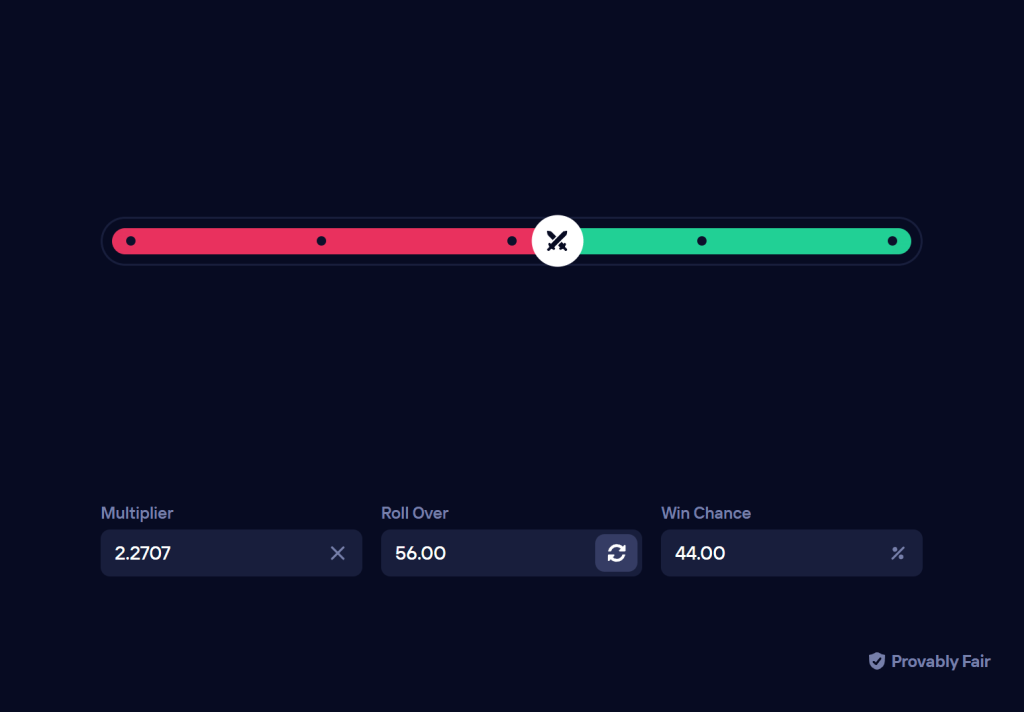
Instead of standard 1.00% to 4.00% casino house margins, compare with mathematically verified 100% RTP Originals (0.00% House Edge) on Duel Casino:
The EV of a level-up bonus can be decomposed into two components: the value of the bonus itself and the cost of the wagering requirement. The generic formula for a cash bonus is:
EV = (Bonus amount × 1) – (Wagering requirement × House edge)
This assumes you play the wagering requirement on a single game with a known house edge. For a game with 96% RTP (house edge 4%), wagering $1000 costs $40 in expected loss. If the bonus is $50, then EV = $50 – $40 = $10.
For free spins, the EV is simpler: sum of the expected value per spin (bet size × RTP) multiplied by number of spins. However, winnings from free spins are often credited as bonus money, which then carries its own wagering requirement. The full EV chain becomes:
EV = (Free spin winnings expected value) × (1 - wager req multiplier × house edge) – (any additional wagering on those winnings)
In practice, many operators apply a single playthrough to both the deposit and bonus (if any) or to the bonus alone. Always check the exact wording.
Example EV for a Hypothetical Tier-4 Bonus
Consider a casino that offers a tier-4 level-up bonus: 50 free spins worth $0.20 each (total face value $10) on a slot with 96% RTP. The free spin winnings are added as bonus money with a 30x wagering requirement, and winnings from the bonus spins are uncapped up to $50 maximum cashout. Expected free spin value: 50 × ($0.20 × 0.96) = $9.60. After meeting 30x playthrough on that $9.60, expected loss = $9.60 × 30 × (1 – 0.96) = $9.60 × 30 × 0.04 = $11.52. EV = $9.60 – $11.52 = -$1.92. This is a negative EV bonus—the wagering requirement more than consumes the free spin value.
Now compare a tier-5 bonus that offers a $50 cash bonus with 10x wagering, playable on a 98% RTP blackjack variant (house edge 2%). EV = $50 – ($500 × 0.02) = $50 – $10 = $40 positive. The difference shows that tier level alone does not determine EV; the combination of wagering terms and game choice does.
Comparing Ladder Structures Across Operators
Because loyalty programs vary widely, you should not assume that a higher tier always yields higher EV. The table below shows three fictional operators’ ladder structures at tier 4 (mid-range) and tier 6 (high). Use this as a template: when evaluating a real casino, fill in their terms and calculate.
| Operator | Tier | Bonus Type | Bonus Amount | Playthrough | Game RTP Used | Calculated EV |
|---|---|---|---|---|---|---|
| Operator A | 4 | Free spins (50) | $10 face value | 30x on winnings | 96% slots | -$1.92 |
| Operator B | 4 | Cash bonus | $25 | 15x | 97% slots | +$13.75 |
| Operator C | 4 | Cashback (20% of losses) | Varies | No wagering | N/A | Variable but positive if loss occurs |
| Operator A | 6 | Cash bonus | $200 | 35x | 96% slots | +$20 |
| Operator B | 6 | Free spins (200) | $40 face value | 25x on winnings | 96% slots | +$0.40 |
| Operator C | 6 | Deposit match 100% up to $500 | $500 | 10x (deposit + bonus) | 98% blackjack | +$340 |
Operator C’s tier 6 appears most valuable, but note the cashback tier 4 may have low or negative EV if you don’t incur losses. Always recalculate using the actual RTP of the game you intend to play.
Caveats and Hidden Costs
Several factors can erode EV that are not always obvious from the bonus description:
- Maximum bet limits: If the bonus terms restrict bet size to $5, your effective wagering speed drops, increasing time cost (opportunity cost) but not directly affecting theoretical EV. However, if you are forced to use high-house-edge games due to bet limits, EV falls.
- Game weighting: Some casinos apply lower contribution to table games (e.g., 10%) when calculating wagering progress. This effectively multiplies the house edge you face. For example, a 10% contribution on a 2% house edge game means you need to wager 10x the amount, raising the effective house edge to 20% for the wagering requirement.
- Expiration of points: If you do not reach the next tier within a certain period (e.g., 30 days), accumulated points may reset. This can turn a seemingly positive EV bonus into a loss if you cannot achieve the tier in time. Check the loyalty program rules.
- Maximum cashout: A cap on winnings from bonus funds (e.g., 5x bonus amount) truncates the positive tail of the EV distribution. In high-variance games, this can reduce actual EV even if the average is positive. Monte Carlo simulation is the most accurate way to assess such caps.
Conclusion: Using EV to Rank Ladder Offers
Calculating EV for level-up bonuses is a systematic process: extract terms, choose a game with a known RTP (preferably one with low house edge and high contribution), compute expected loss from wagering, and subtract from bonus value. The tier number alone is a poor indicator of value; a high-tier bonus with strict playthrough may be worse than a mid-tier cash bonus with low wagering. For a comprehensive comparison of casino loyalty programs, refer to our casino reviews which detail bonus terms and provably fair verification options. For a step-by-step guide to calculating EV, see our bonus EV guide. Additionally, managing your bankroll while grinding loyalty points is covered in our bankroll management article. Stay updated on regulatory changes affecting bonus structures via our news section.
FAQ
What is expected value in the context of level-up bonuses?
Expected value (EV) is the average amount you can expect to profit or lose from a bonus after accounting for wagering requirements and the house edge of the games you play. A positive EV bonus is theoretically profitable over many repetitions; a negative EV bonus is a net cost to you even if you win occasionally. To calculate EV, you need the bonus amount, wagering multiplier, and RTP of the chosen game.
How can I verify the EV of a level-up bonus before opting in?
First, read the full bonus terms from the casino’s promotions page. Look for the playthrough multiplier, game contribution percentages, and any maximum cashout. Then, select a game from the casino’s library that is allowed for wagering and has a known RTP—you can often find RTP values in the game info or from the provider’s website. Use the formula: EV = Bonus value – (Wagering requirement × House edge). You can also simulate using a spreadsheet with the game’s variance, but the EV calculation captures the long-term average.
Do higher-tier loyalty bonuses always offer better expected value?
No. A higher tier typically comes with a larger nominal bonus, but it may also have a higher wagering requirement or tighter terms (e.g., lower game contributions, stricter max bet limits). Always calculate EV per tier. It is possible that a mid-tier bonus with low playthrough yields higher EV than a top-tier bonus with 40x wagering. Always compare using the methodology described above.