Hi-Lo Verification: Why Shoe Composition Decides Whether the Math Works

the author
ProvablySmart Research Desk
date post
Aug 28, 2026

Share


The Hi-Lo count is a rule for converting observed cards into a conditional estimate of the remaining shoe. That estimate is only valid if the shoe is a real finite set of cards consumed without replacement and reshuffled only at a declared boundary. In an online game, the count cannot be used to infer an edge unless you can verify shoe composition from the seed, nonce, and round history. This article lays out the exact verification points that determine whether the Hi-Lo math applies.
The Hi-Lo System Is a Shoe-Composition Estimator

Hi-Lo assigns a point value to each rank.
- 2 through 6: +1
- 7 through 9: 0
- 10, J, Q, K, A: -1
The running count is the sum of tags for all cards already seen. It is normalized by the number of decks remaining to produce a true count. The advantage shift is often approximated as +0.5% per true-count unit. The approximation depends on one fact: every card dealt is removed from a known finite pool. If the pool is not known, or if cards are returned to the pool between hands, the running count is not a sufficient statistic for shoe composition, and the edge estimate is empty.
The point is not that Hi-Lo tags are arbitrary. They are tuned to the effect of each rank on blackjack hands. But the tag system operates on deck cardinality. A legitimate Hi-Lo calculation must know how many decks remain, which in turn requires that the initial shoe was composed of exactly N standard decks and that the deck count is exposed by the platform.
Verification Point 1: Cards Must Be Dealt Without Replacement
How Does This Compare to 0% House Edge Protocols?
Audited 100% RTP
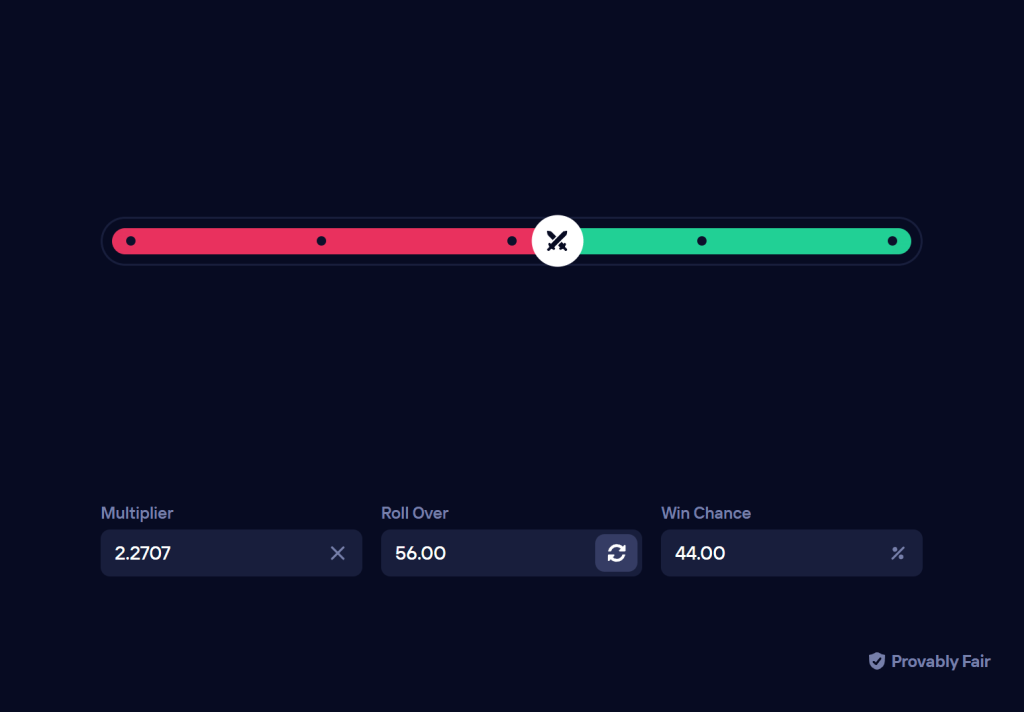
Instead of standard 1.00% to 4.00% casino house margins, compare with mathematically verified 100% RTP Originals (0.00% House Edge) on Duel Casino:

In a live blackjack shoe, a card that appears in one round cannot appear in a later round until a reshuffle. Online implementations sometimes avoid this by generating a new random hand state for each round. That is mathematically equivalent to shuffling a fresh shoe before every hand. Under that rule, the expected composition of the remaining shoe is always identical to the full deck distribution, and the true count is zero in expectation.
Verification therefore begins with a simple question: does the game expose a shoe ID or shoe container that persists across multiple rounds? Without that container, there is no object for the count to describe. The round-to-round card history must be read from the same shuffle output. If the platform publishes a fresh server seed per hand, you are not playing from a shoe; you are playing from a fresh deck each hand, and any Hi-Lo strategy is ungrounded.
Verification Point 2: The Shuffle Must Be Reproducible from Seeds
A verifiable shoe shuffle should work like this:
- The game combines a server seed, client seed, and nonce for the shoe.
- A deterministic shuffle algorithm, usually Fisher-Yates, permutes the card list of N*52 cards.
- The resulting full card order is committed to before play through a SHA-256 hash.
- After the shoe is finished, you can replay the shuffle from the same inputs and compare the generated card order to the cards you were dealt.
There are two things to verify. First, the hash must have been published before the first hand; otherwise the casino could choose a convenient shuffle after seeing outcomes. Second, the replay must be bit-for-bit reproducible. The output may be represented as card indices, Unicode card symbols, or rank/suit pairs; the exact representation must be documented so a third party can independently verify. If the platform’s verification tool is a black box that only prints a green checkmark, you do not actually have a verification path.
If the operator publishes commitments on-chain, that is an additional timestamp you can cross-check. The hash alone is not proof, but a pre-shoe commitment provides a public timestamp that prevents retroactive seed changes. Treat on-chain data as one layer of audit, not a substitute for replaying the shuffle yourself.
Verification Point 3: Penetration and Reshuffle Boundaries Must Be Declared
The true count formula divides running count by the estimated number of remaining decks. That requires two pieces of information:
- where the shuffle will occur, also called penetration
- whether a mid-shoe reseed can happen before that point
If penetration varies from shoe to shoe based on a hidden condition, the denominator is unknowable. In an extreme case, the game might reshuffle immediately whenever the running count is positive, eliminating the player’s advantage without being visible in any single hand. A clean implementation declares the cut-card position as part of the shoe metadata and reshuffles at exactly that point, no earlier. Check the shoe’s final round and count how many cards were consumed; the number should match the declared penetration plus the final round’s draws.
What Provably Fair Usually Does Not Cover
Standard provable-fairness systems prove that individual random outcomes are generated from seeds. That is a weaker property than the one Hi-Lo needs. A single blackjack hand could be generated from a shuffled full shoe and still be provably fair because the seed produced a random hand. But the hand is not conditionally dependent on previous hands, so the running count is discarded.
This is why checking a game’s fairness page is not sufficient. You must inspect the game-specific log format. Does each round reference the same shoe seed? Does the round include the remaining shoe state or at least enough data to derive the exact cards removed? If the verification UI shows a new seed for every round, there is no shoe-level composition to exploit. The count is then an elaborate way to estimate nothing.
RTP Math Is Conditional on the Shuffle Distribution
All edge calculations for card counting assume the shuffle is uniformly random over all possible permutations of the shoe. A PRNG that is biased, or a shuffle routine that is not actually Fisher-Yates, changes the distribution of remaining-card subsets. The Hi-Lo tags are not protected against that failure. A counting edge computed under a fair shuffle can be reduced or reversed by a defective shuffle.
Before placing a spread, you should check the game’s published rules on deck count, reshuffle point, minimum bet, and maximum bet. All of those feed into the threshold true count at which a bet becomes positive EV. For a practical framework for sizing bets from a verified edge, see our bankroll-management guide; it treats the count as a noisy signal, which is the correct mindset.
The same logic applies to RTP. The advertised RTP is usually the house edge under basic strategy against a full shoe. It is not the edge you obtain from a Hi-Lo spread. You can model the exact RTP by simulating your betting table with the actual shoe rules. For a checklist of which rule parameters to record, the verification guides cover table-game seed structures. As of 2026, the minimum a credible online blackjack game should expose is a full shoe list, a fixed penetration point, and a seed history that spans multiple rounds.
A Practical Verification Checklist
| Item | Why Hi-Lo Needs It | What to Check |
|---|---|---|
| Deck count | Maps running count to true count | Game rules must state a fixed number of decks, such as 6 or 8. |
| Shoe persistence | Cards are removed without replacement | The same shoe seed is used across multiple rounds. |
| Shuffle determinism | Allows replay of the full card order | Recompute Fisher-Yates from seeds and compare it with deal output. |
| Penetration | Determines the remaining-deck denominator | Reshuffle occurs at a declared card count. |
| No mid-shoe reseed | Prevents count reset or selective reshuffle | The round log shows no new shoe seed before the declared reshuffle. |
If any item in the table is missing or undocumented, the correct default assumption is that the shoe is not verifiable. The Hi-Lo math may still describe the game in an abstract sense, but you cannot act on it because you cannot confirm the composition at the moment you place a bet. For operators, check whether the game is listed in our casino reviews as publishing shoe-level game logs; that is a meaningful signal, but you are still expected to run the verification yourself.
The verification burden is not optional. A card counter in a physical casino can see the discard tray. An online player has no discard tray; the seeds, hashes, and hand history are the only equivalent. If those data sources do not prove a finite, persistent, penetration-limited shoe, the count is not bad math in the sense of an imperfect strategy. It is math applied to a state that does not exist.
FAQ
What exactly is a shoe in an online blackjack game?
A shoe is a finite list of cards generated from the deck count and a shuffle seed. It must persist across multiple rounds, with each dealt card removed from the list until a declared reshuffle. If every round is generated from a fresh seed, there is no shoe in the compositional sense.
How can I tell whether a casino reshuffles every hand?
Look at the round log for the seed or nonce used in each hand. If the server seed changes for every round, the shoe has been replaced. If the same shoe seed persists for many rounds, find the round where the seed changes and compare it with the declared cut-card position. That comparison tells you whether reshuffles happen at fixed boundaries.
Does a positive running count guarantee a profitable bet?
No. The running count must be converted to a true count using the number of remaining decks, and the edge must exceed the spread cost and variance. Verification ensures the composition is real; it does not remove negative-variance risk. Use bankroll sizing that survives long losing stretches.