A $500 Gambling Bankroll: Unit Sizes, Session Plans, Stop Rules

the author
ProvablySmart Research Desk
date post
Aug 28, 2026
Share


A $500 gambling bankroll is a finite test. In 2026, a bankroll of that size can absorb variance only if the bets are sized in single-digit units and the session structure is fixed. This article defines unit sizes, session plans, and stop rules that can be verified with arithmetic before you stake a cent. None of what follows improves the house edge; it simply controls how many bets your $500 can survive.
Unit Sizing: Start With the Round, Not the Balance
The unit is the smallest amount you are willing to lose on one wager. Your bankroll is the total amount set aside for gambling. The ratio between them determines how many losses you can absorb.
Unit size = bankroll / number of units you want to budget. For $500, the common choices break down as follows:
| Unit size | Bankroll units | Session bankroll at 20 units | Best fit |
|---|---|---|---|
| $5 | 100 | $100 | Low-variance blackjack, baccarat, roulette outside bets |
| $10 | 50 | $200 | Flat-betting a single game with moderate variance |
| $25 | 20 | $500 | High-variance slots or single-session tournament play |
The $25 row is important. At that unit size, your entire bankroll is one session bankroll. Playing 20 units means the whole $500 is exposed in one sitting. That is not bankroll management; it is a single bet selection. If you want to keep a safe cushion, choose a unit that leaves at least five sessions of 20 units, which means a unit size no larger than $5.
Flat Betting Is the Baseline
Flat betting means every wager is exactly one unit, regardless of wins or losses. In a game with a fixed house edge, flat betting does not change the expected value per bet. It does, however, make the survival math clear. With 100 units, a 20-unit losing streak costs 20% of the bankroll; a 50-unit losing streak costs 50%. You can simulate this against any published RTP to see how often it happens over a given number of rounds.
Session Plans: Put a Fence Around Each Sit-Down
How Does This Compare to 0% House Edge Protocols?
Audited 100% RTP
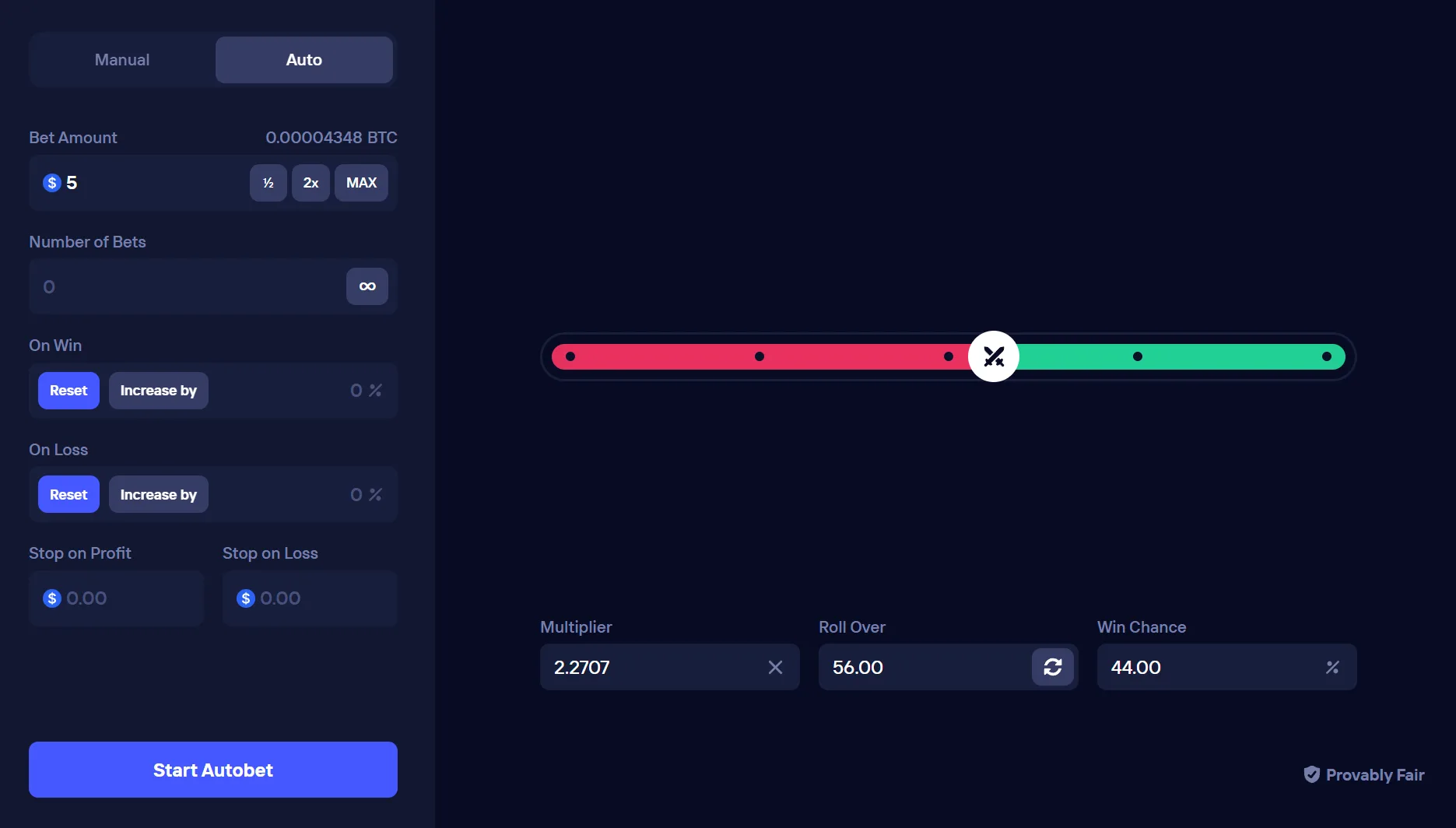
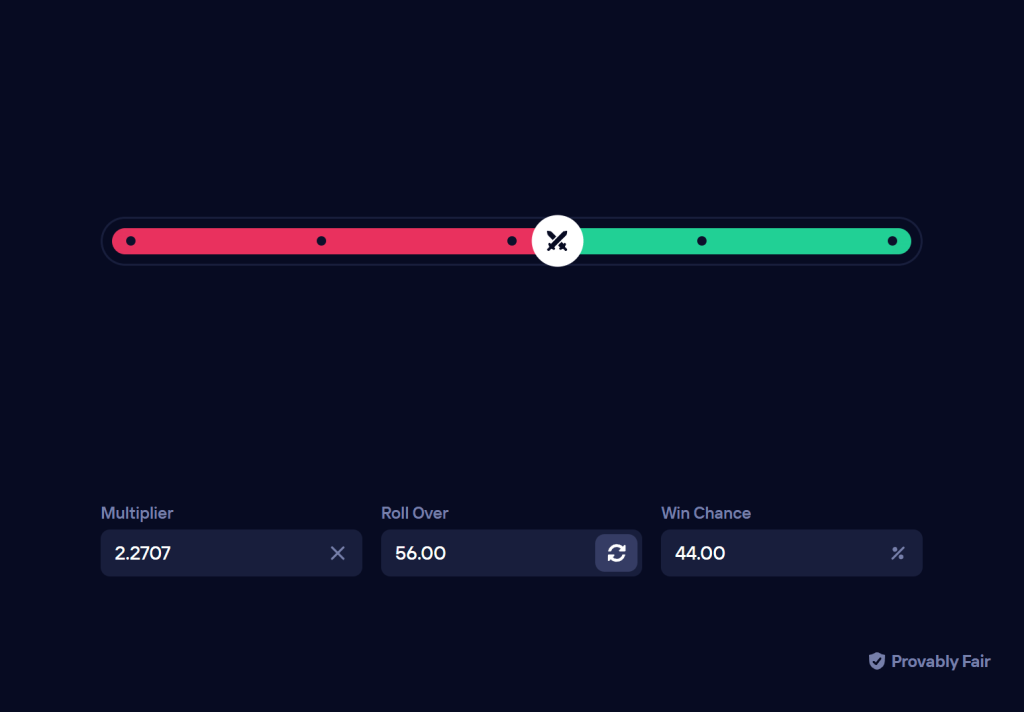
Instead of standard 1.00% to 4.00% casino house margins, compare with mathematically verified 100% RTP Originals (0.00% House Edge) on Duel Casino:

A session bankroll is the amount you allow yourself to lose before leaving the game. It should be smaller than the total bankroll. For a $500 account, the most direct session plan is to separate the bankroll into session blocks.
- Conservative: 10 units per session. At $5, that is $50 per session. Ten losing sessions would consume the bankroll.
- Standard: 20 units per session. At $5, that is $100 per session. Five losing sessions would consume the bankroll.
- Aggressive: 50 units per session. At $5, that is $250 per session. Two consecutive losing sessions would consume the bankroll.
Aggressive sessions are not recommended for a $500 bankroll. The point of a bankroll is to survive more than one bad day. Store the unused session money in a separate balance or wallet so the loss stop is not just a button you can ignore.
Stop Rules: Write Them Before You Start
Stop rules are not a source of edge. They are constraints that prevent a fixed bankroll from being converted into a larger wager. The three numbers that matter are the loss stop, the win stop, and the time stop.
Fixed Loss Stop
Set the loss stop at a fixed number of units before the first bet. For a $5 unit, a 20-unit loss stop means you stop after losing $100 in a session. At that point, leave the game. Do not switch to another game to chase the same $100.
Fixed Win Stop
A win stop at +20 units means that when the session profit reaches $100, you stop. This will not increase your expected value. It only prevents a winning session from continuing until the profit is gone. If you want to play again, start a new session with the same unit size and the same stop rules.
Time Stop
For games with high hit frequency and high variance, set a time stop. One hour or 200 rounds, whichever comes first, is a defensible default. Time stops matter because an hour of quick bets can produce hundreds of small losses that feel like one session but add up to many units.
No Escalation After Losses
When a session reaches the loss stop, the next session starts with the same unit size as before. If you double the unit size to recover a loss, you are no longer working with a $500 bankroll; you are working with a new, larger unit denominator. The stop rule for that new denominator is different, and the old bankroll math no longer applies.
What to Check Before You Deposit
All of these numbers are useful only if the casino allows you to verify the underlying game data. In 2026, verification is a practical exercise, not a marketing claim. Before depositing, check at least four things:
- Published RTP or house edge for the exact game you intend to play. EV per bet is the bet amount multiplied by the house edge. A 4% house edge means an expected loss of $0.20 per $5 bet, not per hour.
- Provably fair seeds and hash verification for the rounds you play. The server seed, client seed, and nonce should let you reconstruct the result. The guides section on this site explains the standard procedure.
- Game history and exportable session logs. You should be able to see each bet, the stake, and the result. If the casino cannot provide this, your stop rules are the only audit trail.
- Withdrawal rules and wagering requirements. A bonus that locks your funds for 30x wagering changes the real value of the bankroll. Check the casino reviews comparison before picking a site.
If you need a wider framework for session sizing and loss limits, read the bankroll management guide before applying these numbers to a different starting balance.
FAQ
What is the best unit size for a $500 bankroll?
For a $500 bankroll, $5 is the safest baseline because it leaves 100 units. $10 per unit creates 50 units and is acceptable for low-frequency games with a small house edge. $25 per unit leaves 20 units and should be treated as a single-session limit, not a long-term bankroll structure.
Should I use a win limit when I am ahead?
A win limit is not mathematically necessary, but it is behaviorally useful. If you set a win stop at +20 units, you lock in a profit and remove the risk of giving it back in the same session. It does not change the house edge, so it should be treated as a discipline rule, not an advantage.
How do I recover a $500 bankroll after a losing streak?
Only by bringing in new funds or treating the balance as a reduced bankroll. If you have lost 100 units, the original plan is over. Raising your unit size to recover is equivalent to starting a new, smaller plan with a larger risk per bet. The correct recovery is a larger bankroll, not a larger unit.