The Gambler’s Fallacy Meets Hash Chains: Independence Explained

the author
ProvablySmart Research Desk
date post
Aug 28, 2026

Share


In 2026 many provably fair games use hash chains as an audit mechanism. The provably fair guides on this site explain the basic architecture. This article looks at the statistical side: why a hash chain does not make future outcomes dependent on past ones, and why the gambler’s fallacy remains false even when the underlying generator is deterministic.
What the gambler’s fallacy assumes

The gambler’s fallacy is an error in conditional probability. Two events are independent if the probability of A given B equals the probability of A alone. In European roulette, the probability of red is 18/37 on every spin. It is 18/37 after one red, after ten reds, and after a table has been showing black for an hour. The wheel does not retain a balance of outcomes that need to be corrected.
This applies to slots and dice games as well. Unless the game has explicit state, such as cards being dealt from a decreasing shoe, each round is a new draw from the same distribution. The house edge is built into that distribution. A losing session does not make the next session more favorable. A winning session does not make the next one less favorable.
People often use “regression to the mean” as if it were a repayment mechanism. It is not. A sequence of losses does not cause future wins. The long-run average eventually gets close to the true average because every new round uses the same probabilities, not because the game compensates for history.
How a hash chain produces outcomes
How Does This Compare to 0% House Edge Protocols?
Audited 100% RTP
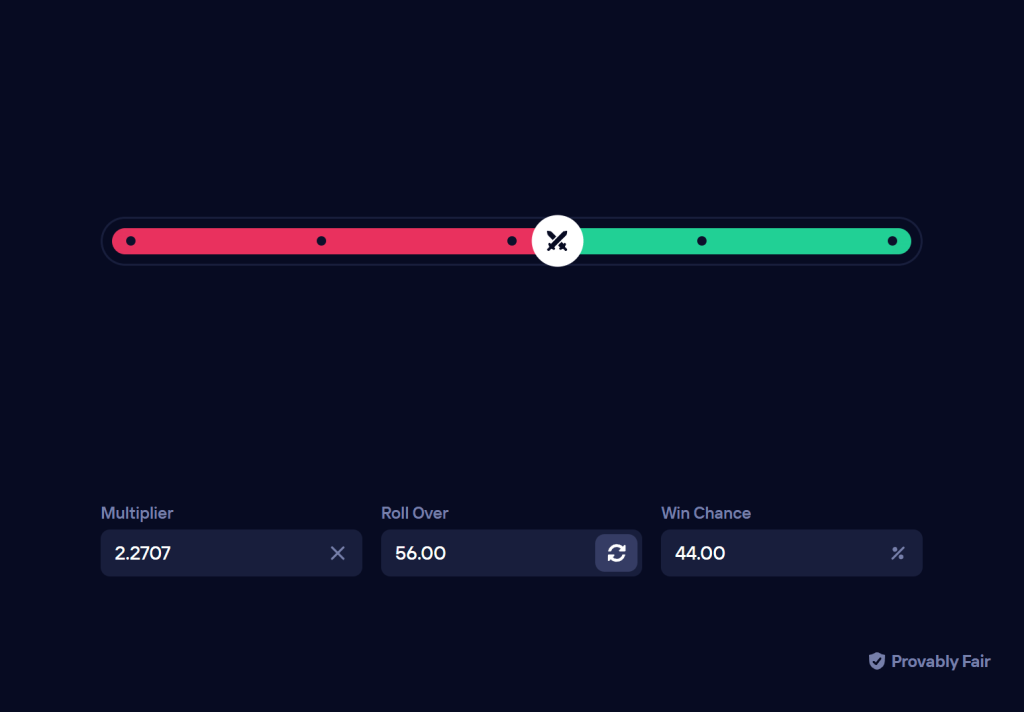
Instead of standard 1.00% to 4.00% casino house margins, compare with mathematically verified 100% RTP Originals (0.00% House Edge) on Duel Casino:

A hash chain is a commitment scheme. The details vary, but the standard idea can be checked in four steps:
- An operator generates a chain of seeds linked by a cryptographic hash function.
- The final value in the chain is published before any round is played.
- Each game round uses one seed from that chain, plus a client seed and a unique nonce, as input to the outcome function.
- After a seed is fully used, the operator reveals it. You can hash that seed and compare it with the previous commitment.
The chain proves that the operator did not swap a seed after observing results. It does not create a feedback loop between results. In a sound implementation, the outcome of round n is not an input to round n+1. The client seed and nonce are the inputs that advance the game. Past outputs do not feed into the next computation.
This may sound contradictory because the system is deterministic. If you know the current server seed, the client seed, the nonce, and the exact function, you can compute every remaining outcome in that seed cycle. That does not make the outcomes dependent in the statistical sense. It makes them unknown to anyone who does not know the hidden seed.
The distribution of hash outputs is what the verification argument rests on. A cryptographic hash such as SHA-256 is designed so that different inputs, even inputs with only a small change such as incrementing the nonce, produce outputs that are indistinguishable from uniform. Under that assumption, the next outcome is independent of the prior observed sequence. Independence is a property of the probability model, not a property of whether the code is deterministic.
Common gambler’s fallacy claims
| Claim | What the math says |
|---|---|
| After ten reds, black is more likely | P(black) is unchanged; each spin has the same distribution |
| The game is cold, so a payout is due | RTP is a long-run property; it does not schedule a payout |
| Hash chains make results non-random | Hash chains make results verifiable; randomness comes from the hidden seed and the hash function |
| Higher stakes after losses will force a win | Stake size does not alter the probability or the expected value of the next round |
What you can verify yourself
The gambler’s fallacy is about beliefs; the cure is reproducible evidence. For any game that claims provable fairness, you should be able to check at least four items:
- Was the current server seed committed to as a hash before the cycle began?
- Is the outcome formula documented in enough detail to recompute a result?
- After rotation, does the revealed seed hash to the published commitment?
- Does the result on your bet history match the value you compute from the seed, client seed, and nonce?
If an operator cannot or will not provide those details, treat “provably fair” as marketing, not as a protocol. The casino reviews on this site are a starting point for seeing which operators publish enough data to make such checks possible.
You can also run simple statistical tests on your own sample. A chi-square test compares observed outcome frequencies with expected frequencies from the stated RTP. A runs test checks whether streaks are more or less common than expected in an independent sequence. Keep in mind that if you scan hundreds of samples and only report one low p-value, that low p-value will appear by design. Decide on the sample, the test, and the threshold before you look at the data.
RTP and bankroll consequences
Return to player describes expected value over a large number of bets. A game with 97% RTP returns 97 units per 100 wagered on average. It does not return 97 units per 100 spins, and it does not become more likely to pay after a long dry run. The house edge is a fixed price per unit of turnover, not a force that is enforced round by round.
This is why stake progression systems fail logically. Increasing stakes after losses because a win is “due” is an application of the gambler’s fallacy; it increases the size of the loss when the streak continues. The only practical controls are the amount risked, the session limit, and the stake schedule chosen before play. Our bankroll management guidance describes how to set those limits without relying on false beliefs about game memory.
FAQ
Does a hash chain mean future results depend on past results?
No. In a properly specified game, each result is computed from a seed, a client seed, and a unique nonce. The previous result is not an input to the next computation. The hash function is expected to behave like a random oracle, so the next output is indistinguishable from uniform, conditional on the hidden seed and the protocol state.
If the entire sequence is deterministic, why can’t I predict it?
Because the current server seed is kept secret during play. The published hash only proves the seed existed in advance. After the seed is revealed, you can verify past outcomes, but you cannot use that knowledge to re-bet the rounds. Past outcomes still tell you nothing about the next seed that has not been revealed.
Does martingale or another progression system work after a streak?
No. A progression changes stake size but not the probability of each round. It increases the size of losses when the streak continues. If a game has stated RTP, the expected loss per unit wagered is fixed before any streak begins. A budgeted session bankroll is a more rational control.