
Why Flat Betting Beats Martingale: The Bankruptcy Math

the author
ProvablySmart Research Desk
date post
Aug 28, 2026

Share


Martingale is the most persistent betting fallacy in casino gambling. The strategy is simple: double your stake after every loss, and the next win recovers all previous losses plus one unit. The proposition appears mathematically airtight on paper. It fails in practice because the bettor has finite capital. The bankruptcy math is not a rare tail event; it is a certainty over a sufficiently long session. Flat betting, despite being unglamorous, has the same negative expected value per unit wagered with a risk profile that can be quantified and controlled. This article walks through the arithmetic you can verify yourself.
The Martingale Sequence: Arithmetic Growth of Exposure
A standard Martingale on an even-money bet starts with one unit. After each loss, the stake doubles. If the first win occurs on bet number k, the total amount staked is u(2k − 1), where u is the base unit. The final winning bet is u2k−1, which recovers all prior losses plus u. The table below shows the cumulative loss before each bet.
| Losses in a row | Next bet | Total staked so far | Loss if this bet loses |
|---|---|---|---|
| 1 | 2 | 3 | 3 |
| 2 | 4 | 7 | 7 |
| 3 | 8 | 15 | 15 |
| 4 | 16 | 31 | 31 |
| 5 | 32 | 63 | 63 |
| 6 | 64 | 127 | 127 |
| 7 | 128 | 255 | 255 |
| 8 | 256 | 511 | 511 |
| 9 | 512 | 1023 | 1023 |
The exposure grows exponentially. A bankroll of 511 units allows nine consecutive losing bets before the stake for the tenth bet would be 512 units, which no longer exists in the bankroll. In other words, nine losses in a row ruin a 511-unit Martingale bankroll.
Probability of a Fatal Losing Streak
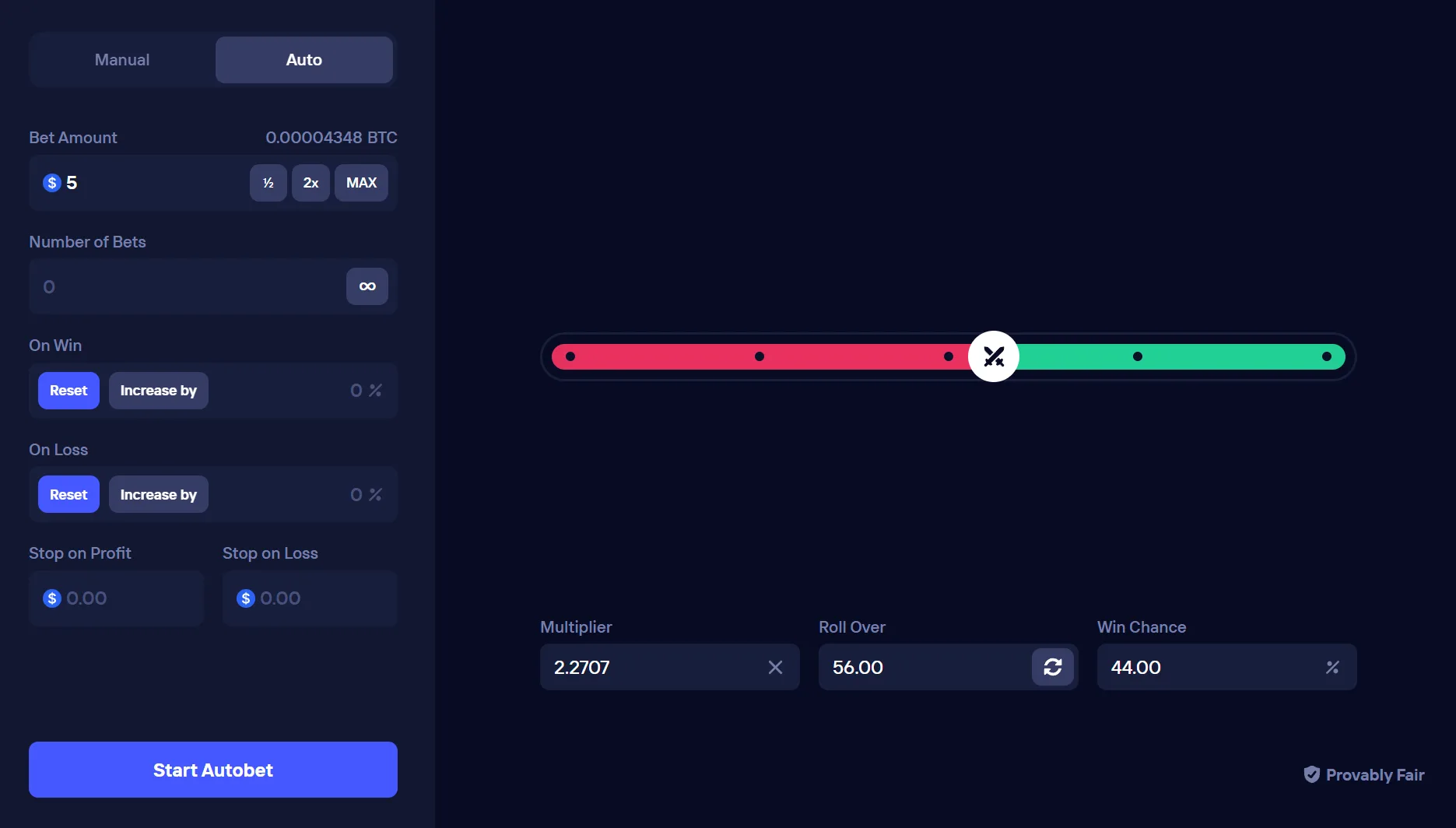
How Does This Compare to 0% House Edge Protocols?
Audited 100% RTP
Instead of standard 1.00% to 4.00% casino house margins, compare with mathematically verified 100% RTP Originals (0.00% House Edge) on Duel Casino:

Assume an even-money bet that wins with probability p = 0.5 in a fair coin flip. In a casino game such as single-zero roulette, p = 18/37 ≈ 0.4865, and the losing probability q = 19/37 ≈ 0.5135. The probability of losing n consecutive bets is qn. For the fair-coin case, the probability of a nine-loss streak is:
(0.5)9 = 1/512 ≈ 0.1953%
For single-zero roulette, the probability is:
(19/37)9 ≈ 0.248%
One session of Martingale has a low chance of bankruptcy. That is exactly the trap. In 1,000 independent Martingale sessions with a fair coin, the probability of at least one nine-loss streak is:
1 − (511/512)1000 ≈ 85.9%
With a house edge, the chance is higher. You can verify these numbers with any binomial calculator or a short Python script. The relevant variable is not the probability of a single loss streak; it is the probability that a fatal streak occurs before the accumulated small wins exceed the eventual large loss.
The Expected Value of a Martingale Session
Consider a Martingale session that ends after the first win. In the fair-coin case, the session wins 1 unit with probability 511/512 and loses 511 units with probability 1/512. The expected value is:
(511/512) × (+1) + (1/512) × (−511) = 0
Fair coin, zero expected value. In single-zero roulette with q = 19/37, the session expected value is:
(1 − q9) × (+1) + q9 × (−511) ≈ −0.27 units
The negative expected value is roughly equal to the house edge of 1/37 applied to the average total amount wagered during the session. The Martingale did not, and cannot, change the casino’s long-term edge. It only concentrates losses into rare, severe events.
Flat Betting: Same Expected Loss, Lower Variance
Flat betting means staking the same unit amount every round. Over N even-money bets in single-zero roulette, the expected net result is:
N × [ (18/37) × (+1) + (19/37) × (−1) ] = −N/37
After 512 flat bets of one unit, the expected loss is 512/37 ≈ 13.84 units. The probability of losing everything is negligible if the bankroll is, say, 50 units and you stop after a fixed number of bets. This is the key property: variance grows with the square root of the number of bets, not exponentially with a losing streak.
The comparison with Martingale over a similar betting horizon is stark. The table below shows the range of plausible outcomes after 512 decisions under flat betting versus 512 Martingale sessions, using the same 1-unit base bet and a 511-unit bankroll.
| Strategy | Typical best outcome | Typical worst outcome | Expected result (European roulette) |
|---|---|---|---|
| Flat 1 unit, 512 bets | Roughly −5 units | Roughly −25 units | −13.8 units |
| Martingale, 512 sessions | +511 units (no fatal streak) | −511 units (one fatal streak) | ≈ −0.27 × 512 ≈ −138 units wagered as sessions |
The Martingale best case is high, but the worst case wipes out the bankroll and loses the accumulated profit from hundreds of successful sessions. Flat betting has no session bankruptcy at all under a proper stop-loss, and its downside is bounded by the number of bets you choose to make.
Why Bankruptcy Is Inevitable With Martingale
The probability of a losing streak of length n approaches 1 as the number of attempts grows. For a bankroll of size B and a base unit u, the maximum number of consecutive losses you can survive is n where:
B < u(2n − 1)
No finite bankroll can cover an arbitrary run of losses because the required stake doubles without bound. Increasing the bankroll from 511 to 1,023 units only delays ruin by one loss in the streak. The probability of a ten-loss streak is roughly half that of a nine-loss streak in a fair game, but the loss when it occurs is twice as large. The product remains the same, and the house edge guarantees the net negative expectation.
If table limits are enforced, Martingale hits a wall even earlier. Most real casinos cap maximum bets, which is effectively an exogenous bankruptcy boundary. On a provably fair crypto casino, the game’s multipliers and bet limits are visible in the game rules and sometimes in the public server seed data. You can verify the limits before playing; see our casino reviews where we document game limits and provable fairness details.
What You Can Check Yourself
The mathematics here does not depend on any specific gambling operator. You can reproduce it with a simple simulation:
- Record your own seed pairs in any provably fair game and verify that each result is derived from the committed seed.
- Run a Monte Carlo simulation: choose a bankroll, simulate Martingale until bankruptcy or 10,000 rounds, and compute the final balance.
- Repeat the same simulation with flat betting under the same house edge.
In every simulation, flat betting produces lower standard deviation and no catastrophic single-streak loss. Its expected loss per unit wagered is exactly the house edge, which is the same for both strategies. The difference is that Martingale multiplies the effective amount wagered by about n per session, accelerating the house edge to move against you. Our guide to bankroll management explains why risk of ruin, not expected value alone, should determine your stake sizing. Flat betting is the baseline strategy against which all momentum-based systems should be measured.
Conclusion: Flat Betting Is the Rational Default
Martingale offers a high probability of a small gain and a low probability of a catastrophic loss. Flat betting offers the same negative expected value, but with a loss distribution that is predictable and capped by your own stop-loss. The bankruptcy math is not subtle: exponential exposure eventually outruns any finite bankroll, and the house edge ensures that even a perfect simulation will converge to the theoretical loss. If you are evaluating a betting system, ask whether it survives a simulation of 100,000 rounds. Martingale will not. Flat betting will, at a steady negative rate equal to the house edge. That is not a bug; it is the cost of playing. For a broader framework on evaluating casino games by their mathematics, see our guides section. For updates on house edge and game-rule changes, check the news archive, where we publish verifiable calculations rather than promotional claims.
FAQ
Can a larger bankroll make Martingale safe?
No. Increasing the bankroll only increases the length of the losing streak needed to bankrupt you. Doubling the bankroll adds exactly one loss to the required streak, while the eventual loss also doubles. Over a sufficient number of rounds, the probability of that longer streak approaches 1. There is no finite bankroll that converts a negative-expectation game into a positive one.
Does flat betting have a positive expected value?
No. Flat betting on any casino game with a house edge has a negative expected value. Its advantage is that the loss rate per unit wagered is the same as Martingale, but the variance is far lower, and the risk of ruin over a fixed number of bets is calculable and small.
What if I use Martingale on a provably fair game with no house edge?
In a perfectly fair game, Martingale has zero expected value, not positive. Flat betting also has zero expected value in that hypothetical case. The only difference is that Martingale adds severe variance and a positive probability of ruin on every session. A fair game with no house edge still does not make Martingale profitable; it makes it a zero-sum variance expansion tool. Real casinos, including crypto casinos, apply a house edge in the game rules, which turns Martingale’s expected value negative.