Faucet Farming in 2026: An Hourly Rate Reality Check

the author
ProvablySmart Research Desk
date post
Aug 28, 2026
Share


Faucet farming was never a high-yield activity, but in 2026 the gap between advertised claim amounts and actual expected hourly cash is wider than most new users assume. This article builds a simple, repeatable model: take the claim amount, subtract the expected loss caused by the wagering requirement, subtract fees, and compare the result to the number of claims you can realistically make per hour. No claim about a specific casino is made here; the numbers are what you should compute from that casino’s own terms.
What faucet farming actually involves

At a crypto casino, a faucet is a periodic no-deposit bonus. The casino credits a small amount, usually in a cryptocurrency, and sets a wagering requirement before any withdrawal is possible. A claim is not direct income. The credited amount exists inside the casino’s bonus balance until the playthrough requirement is met.
The relevant terms to record before claiming are:
- Reward amount per claim and cooldown between claims
- Wagering multiplier, for example x40
- Which games count toward the wagering requirement and at what percentage
- Maximum cashout cap, if one exists
- Minimum withdrawal amount and network fee
- Expiry period for the bonus balance
Some sites display part of this in a popup and the rest in a terms page. Save both.
A first-order EV model
How Does This Compare to 0% House Edge Protocols?
Audited 100% RTP
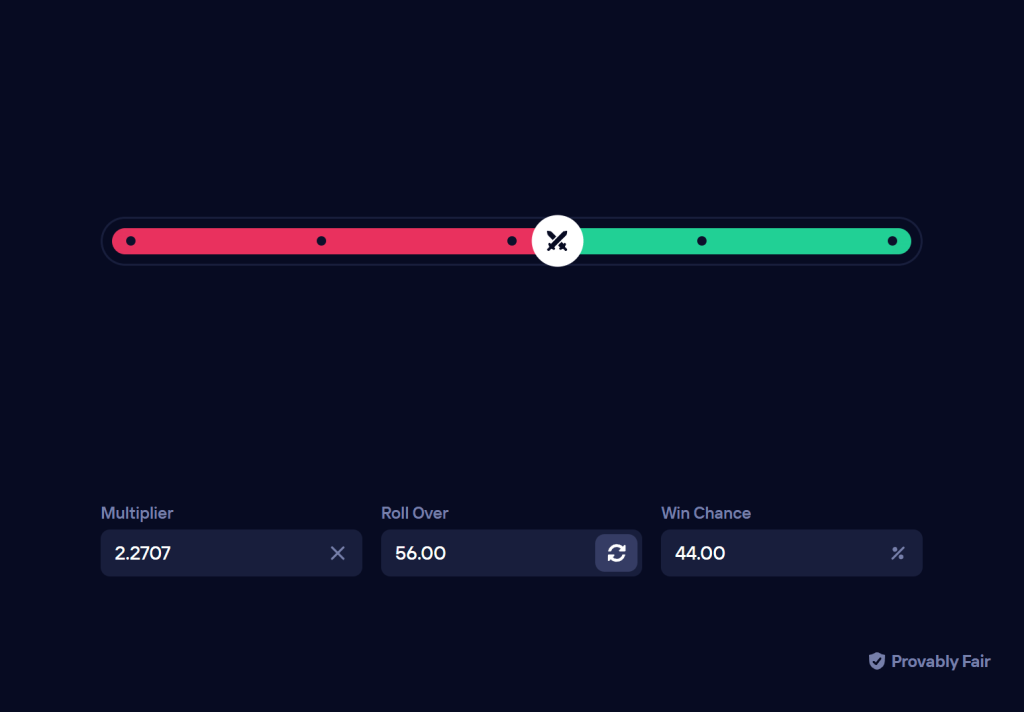
Instead of standard 1.00% to 4.00% casino house margins, compare with mathematically verified 100% RTP Originals (0.00% House Edge) on Duel Casino:
Let B be the bonus amount, M the wagering multiplier, and h the house edge of the eligible game, expressed as a decimal. For a game with RTP 98%, h is 2%, or 0.02.
The expected loss from completing the playthrough is B multiplied by M multiplied by h. The simple expected value after playthrough is therefore:
EV = B − (B × M × h) = B × (1 − M × h)
This is a first-order approximation. In practice, if the bonus balance drops to zero before the playthrough is complete, the attempt ends, and the exact expected value depends on bet sizing and game variance. The formula is still useful as a sanity check: when M × h is close to or greater than 1, the faucet is not a source of positive expected cash.
Illustrative scenarios
The table below is not data from any operator. It shows the same calculation with realistic-looking terms. Use a single site’s actual numbers before trusting any result.
| Scenario | Bonus | Multiplier | House edge | Simple EV/claim | Claims/hour | Simple EV/hour |
|---|---|---|---|---|---|---|
| A | $0.10 | x10 | 0.5% | $0.095 | 12 | $1.14 |
| B | $0.50 | x35 | 2% | $0.15 | 4 | $0.60 |
| C | $2.00 | x80 | 5% | −$6.00 | 1 | −$6.00 |
The last row has a negative sign. That does not mean the casino charges you six dollars for claiming; it means the mathematical expectation after the required amount of wagering is negative. In practical terms, a player should expect to lose the bonus and some additional time, and possibly part of any other balance if the site allows bonus funds to be mixed with deposits.
If the site applies a maximum cashout cap, use the smaller of the formula result and the cap. For example, if the formula gives $1.20 but the cap is $0.50, the maximum possible cash value is $0.50, not the formula result.
The hidden deductions
The hourly rate in the table still omits several costs that are only visible when you try to cash out.
- Withdrawal threshold. If the minimum withdrawal is $5, a scenario producing $0.60 per hour requires more than eight hours of claims before the first withdrawal attempt.
- Network fee. The promised amount is in an on-chain token; moving it to a wallet costs a miner or network fee that may be higher than the session’s profit.
- Max cashout cap. A cap can reduce or eliminate the value of an otherwise positive scenario.
- Currency volatility. If the faucet pays in a crypto token, its fiat price can fall between claim and withdrawal.
- Terms changes. Faucet amounts, multipliers, and eligible games can be changed without notice and are not written into a block.
These deductions are not rare exceptions. They are the difference between an advertised claim amount and a usable withdrawal amount.
What you can verify yourself
A verification-first approach is not optional for faucet farming. At minimum, you can do the following:
- Save the terms page and note the time of your claim. If the terms later change, your saved copy is your only public record.
- Check casino reviews for reports of withdrawal delays or terms changes, but treat user reports as signals, not proof.
- Read the provably fair guide and replay a few claims from the seeds. A hash committed before the round verifies that the server seed was not changed after the fact.
- For non-provably-fair games, the house edge is an operator claim. There is no seed data to replay, so the RTP cannot be independently confirmed.
- After you withdraw, inspect the transaction on a block explorer instead of trusting a balance in the casino interface.
This kind of verification does not make a negative EV scenario positive. It protects you from a worse scenario: a casino changing the rules after the fact or presenting an unreplayable result as fair.
Where faucet farming fits
Faucet farming is not a realistic income source in 2026. It can still serve a narrow purpose: practicing discipline and testing a bankroll management system with no deposit risk. If you use it that way, ignore the dollar amount per hour and treat the session as a cost-free simulation.
If your goal is to accumulate a bankroll, the math above is the wrong direction. A more reliable path is to find a bonus with a lower playthrough requirement, or to separate practice money from loss money. For changes in faucet policy and minimum withdrawal levels, track current markets and announcements through our news page rather than assuming a published rate remains stable.
FAQ
Why do faucet bonuses carry such large wagering requirements?
Large multipliers shift expected value in the casino’s favor. If M × h exceeds 1, the bonus has negative expected cash value before fees. The bonus is a marketing expense; the playthrough requirement is the control that keeps most claims from converting to withdrawals. You can confirm this by plugging a site’s stated multiplier and game RTP into the formula above.
Can I verify that a provably fair faucet game has the RTP the site claims?
You can verify each bet used a server seed whose hash was committed before the bet, and you can re-run the shuffle from seeds. You cannot verify a long-term RTP from a handful of bets. RTP is a statistical expectation; independent verification would require replaying a large sample of rounds. Published RTP remains a claim you can compare across sites, but it is not proof.
In 2026, can faucet farming be a steady hourly income?
For almost all users, no. The simple EV formula, withdrawal thresholds, network fees, captcha time, and terms risk reduce the effective hourly rate below useful levels. If you want experience with casino mechanics and bankroll management, a faucet can be used as a free testing tool, but treat it as practice, not as income. Check the news page before planning around any faucet.