Dogecoin Gambling: Meme Coin, Serious Payout Data

the author
ProvablySmart Research Desk
date post
Aug 28, 2026
Share


Dogecoin began as a joke in 2013, but its blockchain has evolved into a serious medium for online gambling transactions. As of 2026, the coin offers sub-minute confirmations, negligible fees, and a vibrant ecosystem of provably fair casinos. This article examines the verifiable payout data behind Dogecoin gambling: transaction costs, RTP across game types, volatility effects, and how players can independently verify every bet.
Dogecoin’s Transaction Characteristics for Gambling

BTC

ETH

SOL

XRP

USDT

LTC
Dogecoin’s technical parameters make it well-suited for low-value, high-frequency gambling deposits and withdrawals. The network targets a 1‑minute block time, and transaction fees are typically a fraction of a cent. The table below shows average on-chain metrics as of early 2026, based on data from public block explorers.
| Metric | Dogecoin | Bitcoin (comparison) |
|---|---|---|
| Average block time | 1 min | 10 min |
| Median transaction fee | 0.01 DOGE (~$0.0003) | 0.00005 BTC (~$2.50) |
| Transactions per second (sustained) | ~40 | ~7 |
| Confirmation for “safe” settlement | 1 block (1 min) | 3 blocks (30 min) |
For a player depositing 1,000 DOGE, the fee is essentially zero. Withdrawals from a casino incur the same network fee, but many casinos absorb it or set a minimum withdrawal amount to avoid dust. The speed of Dogecoin means that a player can go from deposit to first bet in under a minute, and cash out in roughly the same time – a significant improvement over Bitcoin or Ethereum.
Provably Fair Verification: How Dogecoin Fits
How Does This Compare to 0% House Edge Protocols?
Audited 100% RTP
Instead of standard 1.00% to 4.00% casino house margins, compare with mathematically verified 100% RTP Originals (0.00% House Edge) on Duel Casino:
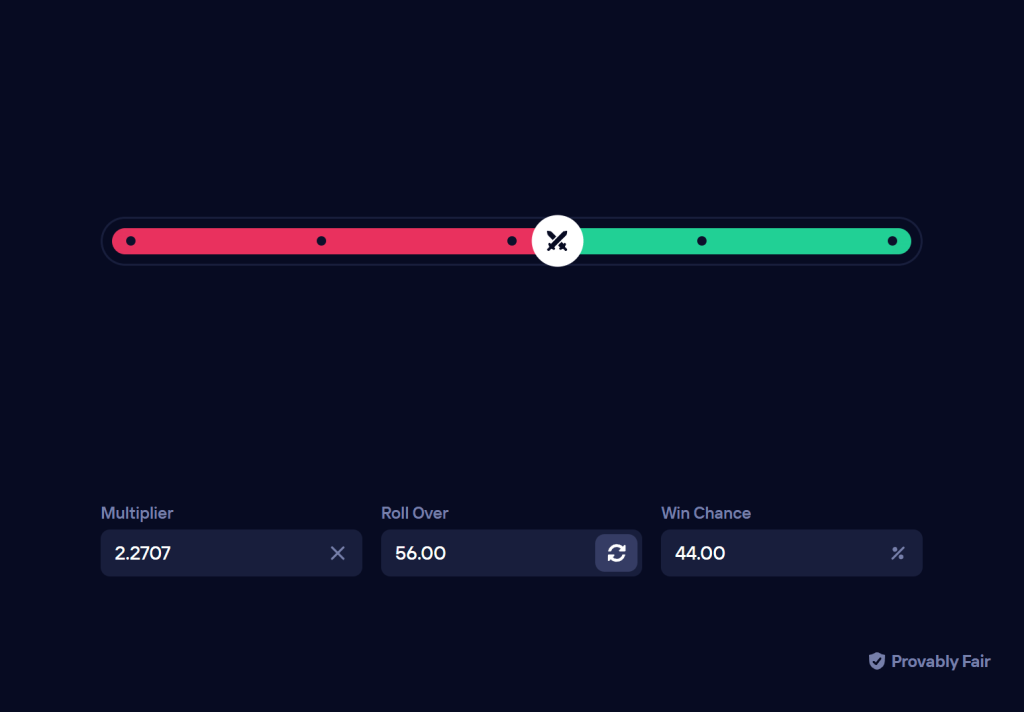
Most reputable Dogecoin casinos implement the standard provably fair protocol: a server seed, client seed, and nonce are combined via HMAC-SHA256 to generate game outcomes. The client seed can be supplied by the player, often as a hexadecimal string. Some casinos allow the use of a Dogecoin transaction ID as the client seed, leveraging the blockchain’s own entropy.
To verify a bet, the player retrieves the server seed hash (committed before play), the actual server seed (revealed after the betting session), the client seed, and the nonce. The ProvablySmart verification guide provides a step‑by‑step walkthrough. In practice, any player can:
- Copy the server seed hash from the casino’s “fairness” page before starting.
- Generate a client seed from a recent DOGE transaction ID (e.g., the deposit transaction).
- After the session, obtain the plaintext server seed and replay the algorithm locally.
This process is identical to provably fair with any other cryptocurrency, but Dogecoin’s low fees make it trivial to use a fresh client seed for each session without cost.
Payout Data: RTP and Variance Across Games
Return to Player percentages are game‑specific and independent of the currency used. However, Dogecoin’s high volatility can amplify or diminish the real‑world value of returns. The table below shows typical RTP ranges for popular game categories at Dogecoin casinos as reported in 2026 casino reviews and independent audits. Note that individual operators may differ; always check the game’s own RTP in the provably fair logs.
| Game Type | Typical RTP Range | House Edge |
|---|---|---|
| Dice (2‑sided) | 99.00% – 99.50% | 0.50% – 1.00% |
| Slots (3‑reel, video) | 96.00% – 98.00% | 2.00% – 4.00% |
| Blackjack (standard rules) | 99.30% – 99.60% | 0.40% – 0.70% |
| Roulette (single zero) | 97.30% | 2.70% |
These figures are consistent with fiat‑currency equivalents. The key difference is that a player’s bankroll in DOGE may fluctuate in fiat value between the time of deposit and withdrawal. For example, a 1% house edge on a dice game translates to a long‑term expected loss of 1% of total wagered DOGE. If DOGE appreciates 10% during the session, the net fiat result could be positive even with a small loss in DOGE terms. Conversely, depreciation can turn a winning DOGE session into a fiat loss.
On-Chain Transaction Costs: Impact on Bankroll Management
While Dogecoin transaction fees are low, they are not zero. For a player making many small deposits and withdrawals, the cumulative cost can become significant. Consider a typical scenario:
- Deposit of 1,000 DOGE (fee 0.01 DOGE).
- 500 bets at 2 DOGE each (no on‑chain fees for bets – they are handled within the casino’s database).
- Withdrawal of remaining balance, say 900 DOGE (fee 0.01 DOGE).
Total on‑chain fees: 0.02 DOGE (≈ $0.0006). Negligible. However, if the player uses a casino that requires a minimum withdrawal of 500 DOGE and makes multiple small deposits, the fees per transaction remain low but the opportunity cost of locked funds may matter. The bankroll management guide recommends setting a fixed fiat‑equivalent stop‑loss to account for DOGE price changes.
Another consideration: the casino itself may charge a withdrawal fee, separate from the network fee. This is not a blockchain cost but an operator policy. Players should check the casino’s terms – many Dogecoin casinos list zero withdrawal fees, but some impose a flat fee of 0.5 to 1 DOGE. When comparing casinos, total cost (network + casino fee) should be factored into the expected value calculation.
Verification Methodology: What to Check
To ensure that Dogecoin gambling payouts are honest, a player can perform the following checks without relying on external audits:
- Confirm the provably fair algorithm. The casino should publish the exact algorithm (e.g., HMAC‑SHA256 with specific formatting). Verify that the server seed hash is committed before play.
- Verify a sample bet. Use a local script or the verification tool described in our news section to replay the outcome of a past bet. Compare the result with the casino’s displayed outcome.
- Cross‑reference deposit/withdrawal addresses. The casino’s deposit address should be publicly listed on its site. After a withdrawal, check the transaction ID on a Dogecoin block explorer to confirm the amount and destination.
- Check the game log. Many casinos provide a downloadable history of all bets with the seeds and nonces. Download this log and verify a random sample of 10–20 bets.
These steps are detailed in the ProvablySmart verification guide. For a curated list of casinos that meet these criteria, see our casino reviews.
Conclusion
Dogecoin gambling offers measurable advantages: fast confirmations, minimal transaction costs, and a provably fair framework that any user can independently verify. The payout data – RTP and house edge – is on par with traditional fiat casinos, but the meme coin’s price volatility adds an extra layer of risk. Players who treat Dogecoin as a pure gambling unit (ignoring fiat value) can rely on the verifiable randomness of each bet. Those who track fiat equivalents should implement strict bankroll rules that account for exchange rate fluctuations. As with any cryptocurrency, the burden of verification lies with the player – but the tools are freely available.
FAQ
Is Dogecoin gambling provably fair?
Yes, if the casino uses a standard provably fair protocol. You can verify every bet by combining the server seed, client seed, and nonce. The client seed can be derived from a Dogecoin transaction ID for added transparency. Always check that the server seed hash is committed before play and that the plaintext seed is revealed after the session.
How do Dogecoin transaction fees affect gambling?
Dogecoin network fees are typically 0.01 DOGE or less per transaction, which is negligible for most players. However, casino withdrawal policies may add extra fees. Over many sessions, the total cost remains low, but it is still a factor to include in your expected value calculations. Use casinos with low or zero withdrawal fees to minimize impact.
Can I use Dogecoin for bankroll management?
Yes, but you must account for DOGE’s price volatility. A bankroll in DOGE can lose or gain fiat value independently of your gambling results. The bankroll management guide recommends setting stop‑losses in fiat terms and regularly converting excess winnings to a stable asset if you intend to preserve value.