Dice Win Chance vs Payout: Reading the Multiplier Table

the author
ProvablySmart Research Desk
date post
Aug 28, 2026
Share


In a provably fair dice game, the multiplier table is not a menu of loosely chosen odds. It is the exact expression of the house edge, and every row can be recomputed from two numbers: the win chance and the stated edge. If either number is wrong, your expected loss changes. This article explains the formula, how to read the table, and what you can verify yourself before trusting a single roll.
The Inverse Relationship Between Chance and Payout
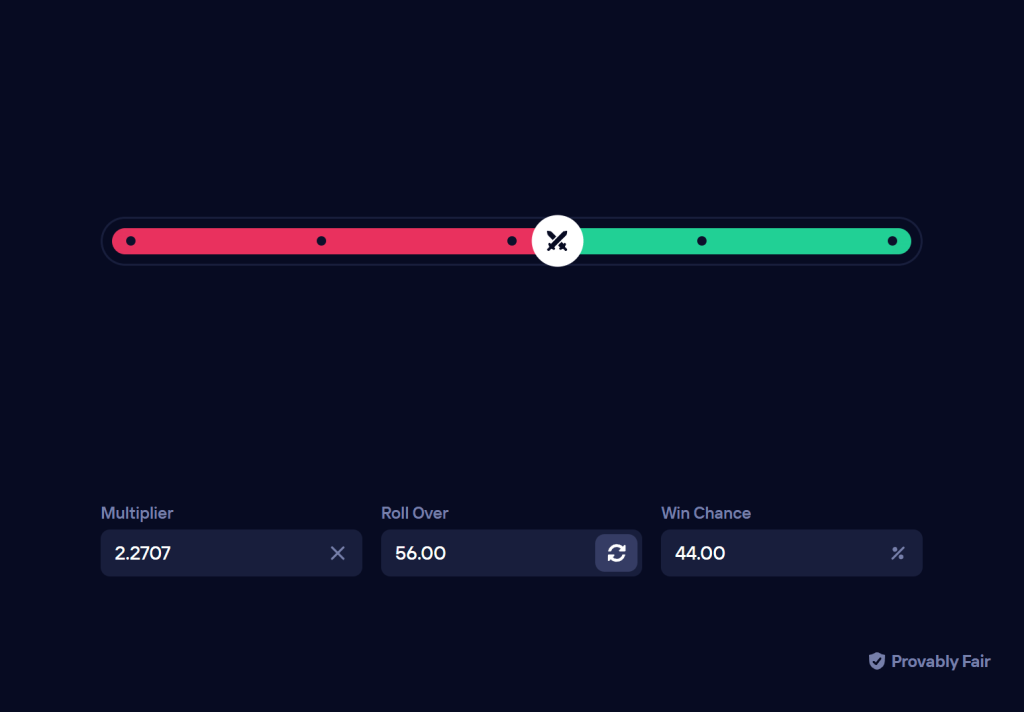
Let p be the probability of winning, expressed as a fraction (e.g., 0.50 for 50%). If the game paid out fairly, a winning bet of 1 unit should return 1/p units. A bet with 1% chance pays 100x; 10% chance pays 10x; 50% chance pays 2x. This relationship is an inverse hyperbola: as one value approaches zero, the other tends to infinity.
No licensed operator offers zero house edge for long. Let h be the house edge, also a fraction. The actual multiplier M is:
M = (1 – h) / p
Equivalently, if you want a fixed multiplier M, the win chance must be:
p = (1 – h) / M
The expected return of a bet of one unit is p * M = 1 – h. With a 1% house edge, the product of chance and multiplier is 0.99 for every row of the table. With a 2% edge, it is 0.98. This constant product is the first thing to check on any dice site.
Reading a Typical Multiplier Table
How Does This Compare to 0% House Edge Protocols?
Audited 100% RTP
Instead of standard 1.00% to 4.00% casino house margins, compare with mathematically verified 100% RTP Originals (0.00% House Edge) on Duel Casino:

Most dice sites offer a table with win chance and corresponding payout. Depending on the interface, you either set a chance (site returns multiplier) or set a multiplier (site returns chance). The table below shows how the same chance values translate into multipliers for three house edges.
| Win chance | Fair multiplier | 0.5% edge | 1% edge | 2% edge |
|---|---|---|---|---|
| 1% | 100.00 | 99.50 | 99.00 | 98.00 |
| 10% | 10.00 | 9.95 | 9.90 | 9.80 |
| 25% | 4.00 | 3.98 | 3.96 | 3.92 |
| 50% | 2.00 | 1.99 | 1.98 | 1.96 |
| 90% | 1.11 | 1.11 | 1.10 | 1.09 |
These values are rounded to two decimal places. A live table may show more digits, but the underlying value is still (1 - h) / p. If a row deviates significantly from this calculation, you are not playing the house edge advertised.
What to Check in a Published Table
Do not take the house edge figure at face value. Instead, choose three or four rows from the operator’s own table and perform the following check:
- Take the win chance
pand the displayed multiplierM. - Compute the product
p * M. - If the table is consistent, the product equals
1 - h(up to rounding). Compare this with the edge stated in the operator’s game rules.
For example, if a row shows 1% chance as 99x payout, the product is 0.99, so the house edge is 1%. If the row shows 99.5x, the product is 0.995 and the edge is 0.5%. The minute difference matters when you place thousands of bets.
Also check whether the table applies a single edge across all multipliers. Some sites use a “flat” edge, while a few use tiered pricing for very low multipliers or high risk bets. A tiered edge is not necessarily worse, but it should be disclosed separately. Our casino reviews summarize the advertised edge of major operators, but it is always safer to re-derive the edge from the operator’s own table.
Provably Fair Verification: Beyond the Table
The multiplier table is a static mapping. The actual dice roll is a separate process. In provably fair systems, a sealed server seed and a client seed are used to generate a random number, which is compared with a threshold derived from your chance setting. To verify that a bet was resolved correctly, you must know how chance maps to the threshold. Most sites use the same threshold mapping for all bets: the chance percentage is used directly to select a range from 0 to the maximum roll number. Some sites use a “floating” versus “exact” mapping, but the multiplier table is not part of the random seed verification; it is part of the payout logic.
After a seed is revealed, you can replay every bet generated under that seed. Confirm that for each bet, the chance was the value you selected, and that the payout multiplier indeed matches the table for that chance. If the replay output disagrees with your ledger, the operator either changed the table mid-seed or has a bug. Step-by-step replay procedures are in our verification guides.
Using the Table for Bankroll Management
The mathematical expectation of every bet is negative by exactly the house edge, regardless of which row of the table you choose. A 1% edge means you lose, on average, 0.01 units per unit wagered. Reading the multiplier table correctly prevents you from confusing a high multiplier with a better deal.
What the table changes is variance. At 1% chance and 99x multiplier, you win rarely but the payout is large. At 98% chance and a multiplier just above 1x, you win most of the time but each win returns very little. The table should guide your stake to bankroll ratio, not your expected value. When low chances are part of your strategy, the variance will be punishing; a 1% win chance with a 99x multiplier means 99 consecutive losses are a normal occurrence. Budget accordingly by using a disciplined bankroll management plan.
Another practical point: if a site places maximum payout caps, the multiplier table in the UI may not reflect the actual maximum multiplier for very small wagers. The table is usually accurate for bets at or below the cap. Always check the operator’s maximum payout clause in their rules before judging the table against your bankroll.
For new game variants, a quick sanity check is to compute the house edge you actually get at a few representative chance levels. For more on how operators set these boundaries, see our casino news for recent updates on dice game policies.
FAQ
How do I convert a win chance percentage into a payout multiplier?
Use the formula M = (1 – h) / p. If the house edge is 1% (h = 0.01) and the win chance is 10% (p = 0.10), then M = 0.99 / 0.10 = 9.90. The site may display 9.90 or 9.91 depending on rounding, but the derivation is deterministic.
Does the house edge change depending on the multiplier?
In most dice games the edge is flat, so the product p * M is constant across all rows. If you calculate this product for several rows and get different values, the site may be rounding in a non-trivial way or using a tiered edge. Recompute after rounding to two decimal places and see whether the deviations are within ±5% of one edge value.
How can I verify the multiplier table before playing?
Use the operator’s published win chance table and stated edge to recompute the multipliers, then test a few rows. After you play a seed cycle, use the revealed server seed to replay each bet and confirm the payout matched the table. The replay can also confirm the win condition threshold, completing the fairness loop.