Crash Auto-Cashout Settings: The Expected Value Math

the author
ProvablySmart Research Desk
date post
Aug 28, 2026

Share


Crash games allow players to set an auto-cashout multiplier, automatically closing the bet when the multiplier reaches a predetermined level. While the decision of which multiplier to choose may seem strategic, the underlying mathematics of expected value (EV) shows that, under standard crash distributions, the EV per bet is independent of the chosen cashout point. This article derives the EV formula, examines the effect of the house edge, and explains how to verify the distribution using provably fair data.
Crash Distribution Model
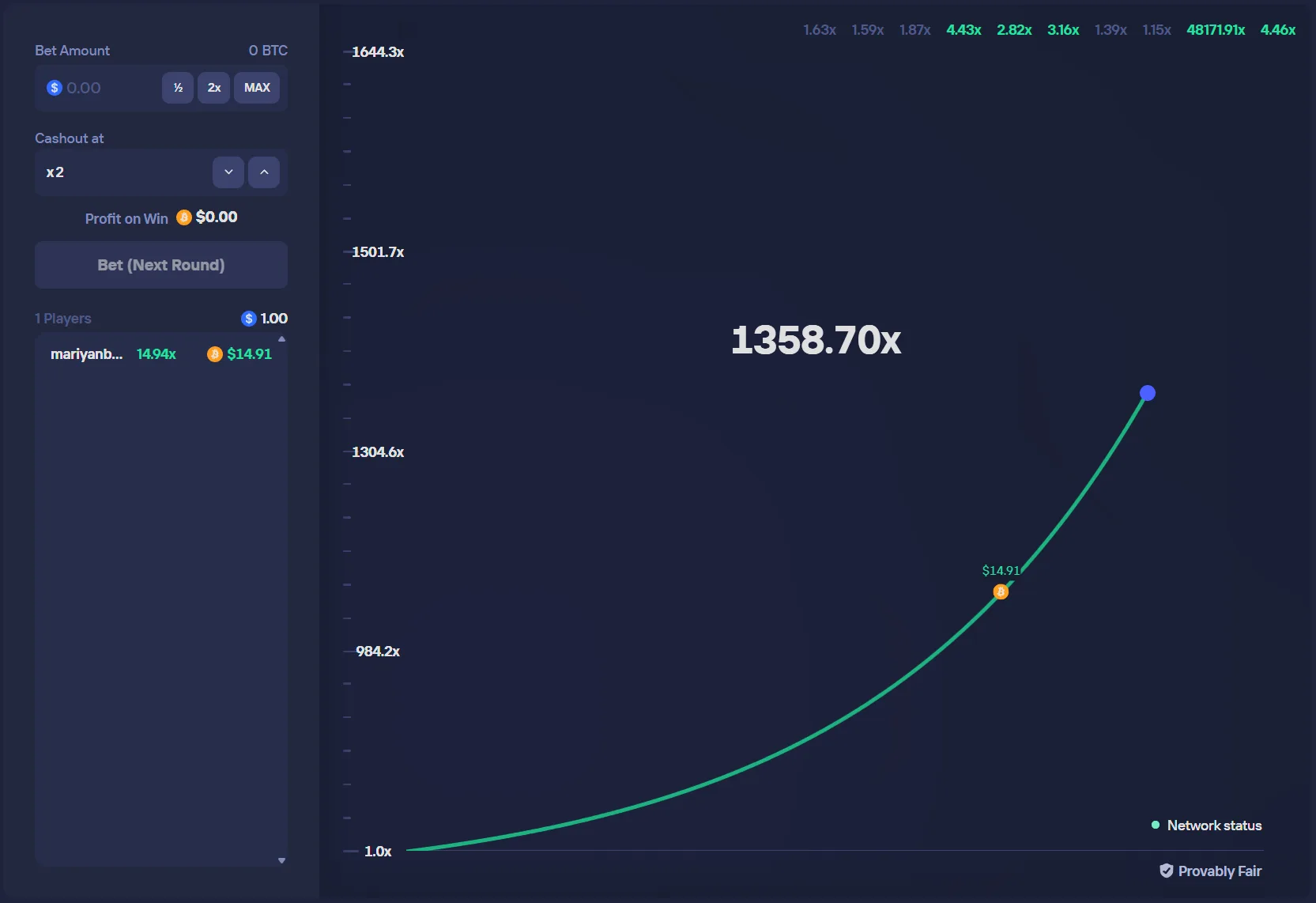
Most provably fair crash games generate a random number r uniformly distributed in [0,1) and transform it into a crash multiplier m using a function such as:
m = (1 - h) / (1 - r)
where h is the house edge (e.g., 0.01 for 1%). This transformation ensures that the probability of the multiplier exceeding any value x (≥1) is:
P(m ≥ x) = (1 - h) / x
This is the classic “fair but with house edge” distribution. The multiplier is typically capped at a maximum (e.g., 1000×) to prevent infinite values, but the probability of hitting the cap is negligible for most practical purposes. The key property is that the survival function decays as 1/x, making the expected value of the multiplier infinite (if uncapped), but the expected return of a bet finite.
Expected Value of an Auto-Cashout Bet
How Does This Compare to 0% House Edge Protocols?
Audited 100% RTP
Instead of standard 1.00% to 4.00% casino house margins, compare with mathematically verified 100% RTP Originals (0.00% House Edge) on Duel Casino:

When you set an auto-cashout at multiplier c, you receive c times your bet if the eventual crash point m ≥ c; otherwise you lose your bet. The expected return per unit bet is:
EV(c) = c × P(m ≥ c) - 1
Substituting the survival function from the model:
EV(c) = c × (1 - h) / c - 1 = -h
Thus, the expected value is constant and equal to the negative of the house edge. For a 1% house edge, every auto-cashout bet, regardless of the multiplier, has an expected loss of 1% of the stake.
Effect of the Maximum Multiplier Cap
If the crash multiplier is capped at some value M, then for c > M the probability of success is zero, and EV = -1. For c ≤ M, the formula still holds provided the cap does not distort the distribution for c < M. In practice, the cap is so high (e.g., 1000×) that its effect on the survival function for c ≤ 100 is negligible. The table below shows EV for a 1% house-edge game with a cap of 1000×.
| Auto-Cashout Multiplier (c) | P(m ≥ c) | Expected Return (per unit bet) | EV |
|---|---|---|---|
| 1.1 | 0.99/1.1 = 0.9000 | 1.1 × 0.9000 = 0.9900 | -0.0100 |
| 2 | 0.99/2 = 0.4950 | 2 × 0.4950 = 0.9900 | -0.0100 |
| 5 | 0.99/5 = 0.1980 | 5 × 0.1980 = 0.9900 | -0.0100 |
| 10 | 0.99/10 = 0.0990 | 10 × 0.0990 = 0.9900 | -0.0100 |
| 100 | 0.99/100 = 0.0099 | 100 × 0.0099 = 0.9900 | -0.0100 |
The EV is identical across all multipliers. The only difference is the probability of winning and the payout amount, which affect variance and risk of ruin, but not the expected loss per bet.
Variance and Risk of Ruin
Although EV is constant, the variance of the bet changes with c:
- Low c (e.g., 1.01): high probability of winning (~98%), but small payout. Variance is low.
- High c (e.g., 100): low probability (~0.99%), but large payout. Variance is high.
For a given bankroll, choosing a high multiplier increases the chance of a long losing streak, which can lead to ruin faster. Players who want to minimize the risk of a large drawdown should use low multipliers, while those who accept higher variance for the same expected loss can choose higher multipliers. The optimal auto-cashout setting depends on individual risk tolerance, not on EV. See our bankroll management strategies for more on variance control.
Verifying the Distribution
Players can confirm the crash distribution by checking the provably fair seeds of each round. The crash multiplier is derived from a server seed and a client seed. The implementation should provide a function that maps the random number r to the multiplier. To verify the house edge and survival function:
- Obtain the seed pairs and round number for several rounds.
- Compute the crash outcomes using the published algorithm.
- Collect a large sample of multipliers (at least 10,000) and compare the empirical survival function
P(m ≥ x)to the theoretical(1 - h)/x. - Estimate the house edge from the average of all multipliers (or from the mean return of simulated bets).
Detailed instructions for verifying a specific crash game are covered in our provably fair verification guide. If the empirical distribution deviates from the expected form, the operator may be using a different algorithm. Always check the official documentation of the casino you play at, and consult crash game site reviews for independent analyses.
Common Misconceptions
Some players believe that timing the auto-cashout (e.g., cashing out just before the crash) can improve EV. This is false: the crash point is predetermined by the random number, and the auto-cashout simply executes at a fixed multiplier. No timing strategy can change the distribution of outcomes. The only way to have positive EV is to play a game with a bonus or promotion that offsets the house edge, which should be treated as a separate event.
Another misconception is that the expected value of an auto-cashout bet changes with the multiplier because the game “feels” different. As shown mathematically, for the standard crash distribution, the EV is constant. Any deviation from this would be detectable through statistical analysis of published rounds.
FAQ
Does the auto-cashout multiplier affect the expected value of my bet?
No. In a crash game with a survival function of the form P(m ≥ x) = (1 - h)/x, the expected value is -h for every auto-cashout multiplier c (subject to the cap). Your expected loss per bet is constant regardless of whether you set a low or high cashout point.
Can I verify the house edge and distribution of a crash game?
Yes. All provably fair crash games provide the seeds and algorithm to compute each round’s multiplier. By collecting a large sample of outcomes, you can estimate the house edge and confirm that the survival function matches the claimed formula. Our provably fair verification guide explains the process step by step.
What is the best auto-cashout multiplier to minimize risk?
There is no “best” multiplier in terms of EV. The choice depends on your risk tolerance. Low multipliers (e.g., 1.01–1.1) result in a high win rate and low variance, reducing the risk of a long losing streak. High multipliers (e.g., 10–100) produce rare large wins but high variance. For a given bankroll, use a bankroll management plan to choose a multiplier that keeps the probability of ruin below your threshold.