Self-Auditing Your Wagering: A Monthly Numbers Routine

the author
ProvablySmart Research Desk
date post
Aug 28, 2026

Share


An operator’s lobby is not an accounting system. Bonuses, wagering requirements, and game contributions are tracked by server-side software that you cannot inspect directly. That is why a monthly self-audit of your wagering numbers is not about scepticism; it is about reconciliation. In 2026, provably fair tools and crypto transaction histories make most elements of this audit verifiable in principle, as long as you keep structured records.
What a monthly wagering audit covers
Run one check per calendar month. The audit should answer six questions:
- What was the total turnover by game and bet type?
- What was the net result (total payouts minus total stakes)?
- How much wagering contribution was added to each active bonus?
- Did deposits, withdrawals, fees, and cashback match the wallet records?
- Was the actual net result within a plausible range of the theoretical expected loss?
- Were provably fair server seeds and client seeds logged in a way that could be replayed?
The per-game contribution rules are central to the third question, and they vary from one operator to the next. The best place to start is the operator’s own bonus terms; many are reproduced or at least cross-referenced in our casino reviews.
Building the dataset
How Does This Compare to 0% House Edge Protocols?
Audited 100% RTP
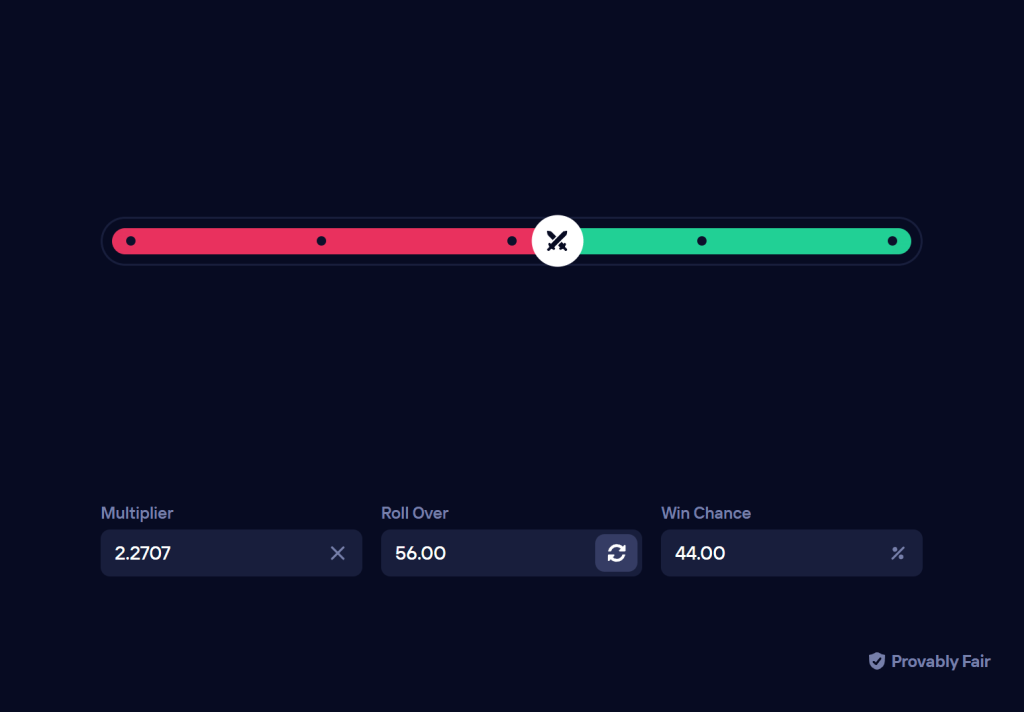
Instead of standard 1.00% to 4.00% casino house margins, compare with mathematically verified 100% RTP Originals (0.00% House Edge) on Duel Casino:

Before doing any arithmetic, export or manually log each betting session. At minimum, record the UTC timestamp, game name, bet amount, payout, crypto asset, operator transaction ID, and balance after the session. If the game uses provably fair rolls, also record the server seed hash, client seed, and nonce range for that session.
For crypto deposits and withdrawals, attach the wallet transaction hash. Compare the sum of your deposits to the sum on the operator’s transaction history. A mismatch of one cent is enough to invalidate the rest of the audit. The same applies to in-house conversions between play money and bonus balance: log the token type and the conversion rate.
You can check yourself in a few minutes: sum all deposits from your wallet, sum all deposits recorded by the operator, and verify that the timestamps around each withdrawal align with the stated processing time. If you want to automate this, our guides cover the basic scripts needed to pull transaction history from an API and to hash revealed server seeds.
Computing expected versus actual
For any game with a published RTP, the theoretical expected loss is turnover multiplied by the house edge (1 – RTP). Compare that with your actual net loss. The difference is variance, not proof of an error.
Table 1 shows an illustrative month. The values are not from any operator; they are examples for the calculation.
| Game | Turnover (USDT) | Published RTP | Expected loss | Actual result | Difference |
|---|---|---|---|---|---|
| Slot A | 5,000 | 96.2% | 190 | -276 | -86 |
| Blackjack | 4,000 | 99.4% | 24 | +18 | +42 |
| Roulette | 2,000 | 97.3% | 54 | -102 | -48 |
| Total | 11,000 | — | 268 | -360 | -92 |
The difference is -92 USDT, meaning the actual result was 92 USDT worse than the theoretical average. For one month, with 11,000 USDT turnover, this is not automatically a red flag. It only becomes a concern if the gap is negative for three or more consecutive months in the same game, or if your audit shows a shortfall far outside a reasonable confidence interval for the game type. Slots with high volatility can easily produce a negative gap equal to the monthly turnover.
Detecting misapplied wagering contributions
Bonus wagering progress is not raw turnover. Most operators multiply each bet by a contribution percentage, and the percentage changes per game type. If live blackjack contributes 50%, then a 100 USDT bet adds only 50 USDT to the wagering requirement. Your monthly audit must recalculate each bonus’s progress using the operator’s contribution table for that specific bonus, not the game’s standard terms.
Table 2 is a generic example. Always use the table published in the offer you accepted.
| Game category | Contribution to wagering |
|---|---|
| Most slots | 100% |
| Live blackjack | 50% |
| Roulette | 25% |
| Craps | 10% |
| Progressive jackpots | 0% |
If the operator’s dashboard shows a wagering progress higher than your calculation, verify whether cashback or bet-and-bonus rebates were included as wagering contributions. If it shows lower progress, check for rounding rules, game exclusions that started mid-month, or a contribution change that was published after the bonus was activated.
A simple monthly reconciliation routine
- At month end, record the casino balance and every related wallet balance.
- Export the operator’s transaction history, including bets, bonus credits, conversions, cashback, deposits, and withdrawals.
- Reconcile each deposit and withdrawal against your wallet. Mark any unaccounted amount.
- Aggregate turnover and actual results by game and by date.
- Recalculate the wagering contribution for each active bonus using that bonus’s contribution table.
- Calculate expected loss from the published RTP for each game and compare to the actual result.
- Flag any discrepancy larger than 5% of monthly turnover or 10 USDT, whichever is larger, and document the specific bet IDs and timestamps.
The output feeds directly into your bankroll management: a negative deviation that persists across three months is more informative than a single 100-bet losing session.
Verifying provably fair outcomes out of the box
Provably fair games give you the raw material for a cryptographic check. Before a seed cycle starts, the operator publishes a hash of the server seed. After the cycle ends, the operator reveals that seed. You hash it and compare it to the published hash. Then, using the client seed, the revealed server seed, and the nonce, you regenerate the game outcome and compare it to the payout.
For a monthly audit, retain the seed hash and client seed for every cycle you played, and record the first and last nonce used in that cycle. When the operator rotates the seed, verify the old one. If the hash matches and a few nonces replay to the correct payouts, the game history is materially consistent. If the operator does not publish a seed hash before the cycle, the game cannot be verified as provably fair, and your audit is limited to reconciliation of amounts.
Common discrepancies
- Wagering progress can reset because a game was excluded from the bonus’s allowed list after you played it, not because the bonus software lost data.
- Cashback is often logged as a payout, which inflates the actual net result unless you record it as a separate non-game credit.
- Live casino bets settle with a delay that crosses midnight UTC; a session that spans 23:50 to 00:20 will appear across two audit periods if you split by date.
- Contribution percentages are sometimes truncated to two decimal places on each bet; this can produce a small but persistent gap over a month of small bets.
FAQ
How much data do I need to keep?
For each month, keep an opening and closing balance, deposit/withdrawal hashes, the bonus terms you accepted, the server seed hashes for each provably fair seed cycle, and a session log of turnover and result per game. This is a few KB per month if stored as plain text; no reason to keep less.
What if my actual loss is persistently above theoretical loss?
First recalculate with the correct RTP and contribution percentages for the bonus you used. If the gap remains, verify the game was actually a provably fair game and check a sample of nonces. If the outcomes verify but the loss persists, it is variance or game selection; if the outcomes do not verify, open a dispute with bet IDs and your calculated hash. In either case, reduce stakes until you can identify the cause.
Can I verify every bet without writing code?
Yes, but it is slow. Many operators provide a web-based verifier where you input the server seed, client seed, and nonce. For monthly auditing, verify the seed rotation hashes and a random sample of 10-20 nonces per game rather than every bet. That gives you cryptographic confidence that the seed was not changed retroactively and that the game history aligns with the provable output.