Big Win Verification: What Payout Proof Should Look Like

the author
ProvablySmart Research Desk
date post
Aug 28, 2026

Share


In 2026, a big win announcement without a verifiable trail is just a marketing asset. If you wager real money in an online casino, the question is not whether somebody won; it is whether the win can be replayed, recomputed, and confirmed using data the casino cannot retroactively alter. This article defines what payout proof should look like, what a reasonable player can check in under five minutes, and which red flags indicate the proof is decorative rather than functional.
The Minimum Components of Verifiable Payout Proof
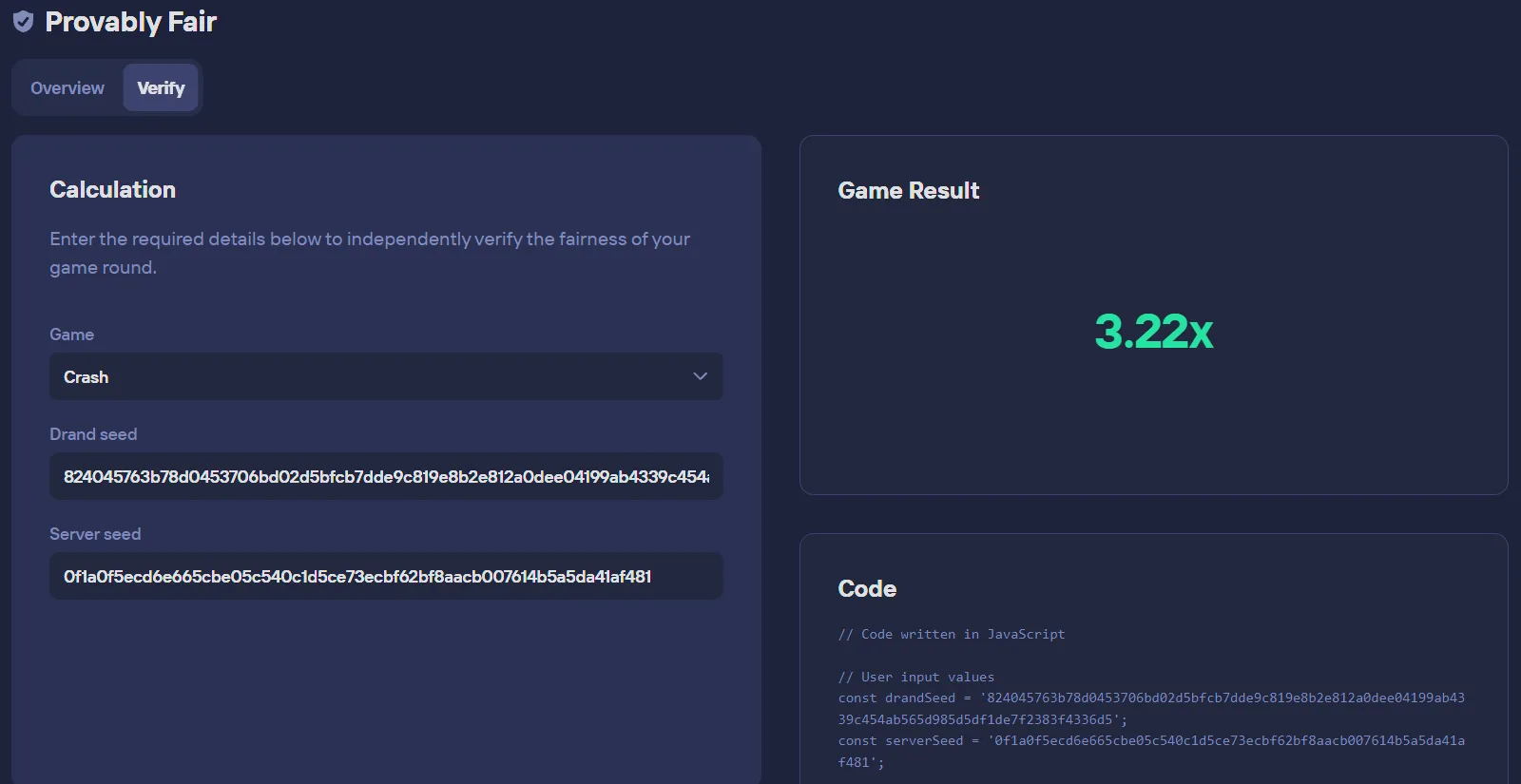
Provably fair systems are built on a deterministic chain: a server seed, a client seed, and a nonce. A big win claim becomes verifiable only when the casino publishes all three inputs after the fact, ideally with the server seed disclosed post-round so the player can reproduce the exact game result. Real proof is not the same as a screenshot.
What the data must include
- Server seed hash (pre-reveal): The SHA-256 or similar hash committed before the round began. Without this, you cannot rule out that the server seed was chosen after the outcome.
- Server seed (post-reveal): The actual seed value, published after the round. Combine it with the client seed and nonce to recompute the game outcome.
- Client seed and nonce: The player’s own input and the round counter. Both are part of the deterministic function; omitting one breaks the verification chain.
- Game result derivation: A documented formula showing how the seed data converts into cards, dice rolls, or crash multiplier. Many casinos provide utility verification tools; using them is quick and free.
- Timestamp and round ID: A unique identifier matching the casino’s internal ledger entry. This lets you cross-check against your own bet history.
If any of these five components is missing, the proof is incomplete. A screenshot that shows a balance and a celebration graphic is a photo of a screen, not a cryptographic artifact.
How to Verify a Big Win Yourself
How Does This Compare to 0% House Edge Protocols?
Audited 100% RTP
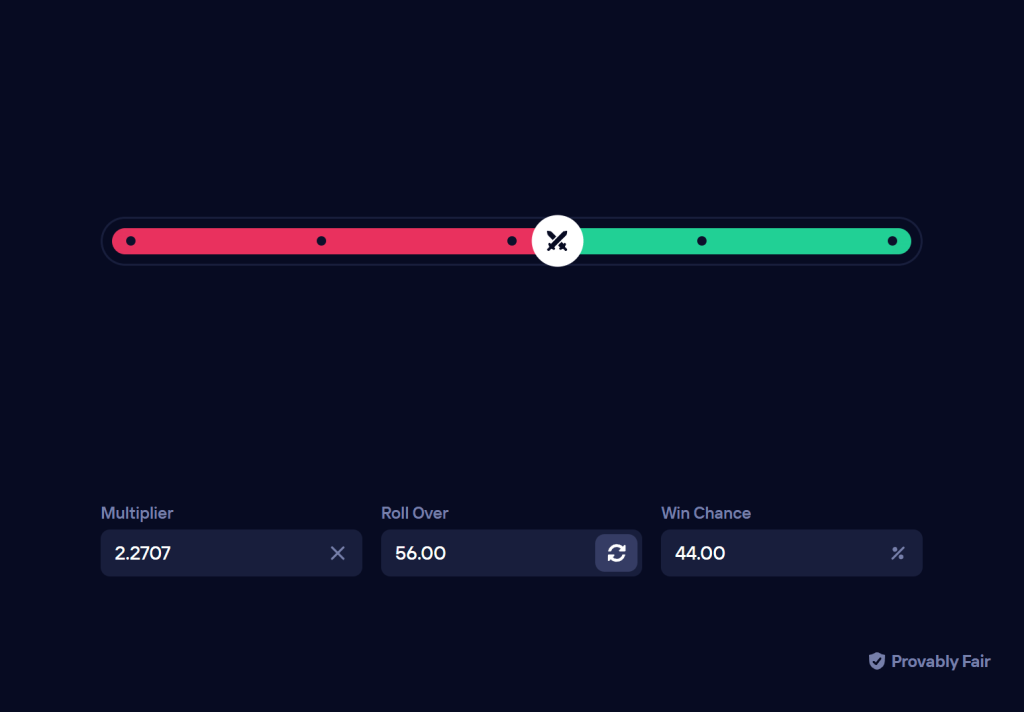
Instead of standard 1.00% to 4.00% casino house margins, compare with mathematically verified 100% RTP Originals (0.00% House Edge) on Duel Casino:

You do not need to be a programmer to verify a provably fair result if the casino provides a clear verification tool. The general workflow is consistent across reputable operators that publish their verification methodology.
Step-by-step check
- Locate the round in your bet history. The round ID must match the payout proof claim. If the proof does not reference a round ID at all, stop there.
- Check the pre-reveal hash. If the casino published a committed hash before the round, compare it to the hash of the server seed they now display. A mismatch means the server seed was swapped after the fact.
- Recompute the outcome. Enter the server seed, client seed, and nonce into the casino’s verification utility or a community-reproduced algorithm. The output must match the game result exactly.
- Confirm the multiplier. For crash-style games, the calculation involves a house edge formula (e.g., target multiplier = 1 / (1 – house_edge) with a cap). Verify the displayed payout against the mathematical expectation of the game’s RTP.
- Check for a signed or hashed record. Some casinos include a hash of the bet record itself, tying the round to a ledger. If present, verify it independently.
If the casino’s own tool outputs the same result as an independent script, that is meaningful evidence. If the tool only visualizes the same values you typed in without showing the intermediate hash steps, treat it as a black box with limited evidentiary value.
On-Chain Verification for Crypto Casinos
Crypto-native casinos have an additional layer: the possibility of publishing big win proof directly on-chain. This is not merely for show; it creates an immutability guarantee that a web server cannot offer.
What on-chain proof should look like
- A transaction to the player’s wallet containing the payout amount, with the casino’s hot wallet as the sender, recorded on a public ledger.
- A memo or metadata field referencing the round ID and the server seed hash. Not every chain supports rich metadata, but on networks that do, it makes the linkage explicit.
- The payment being traceable from the casino’s operational wallet, not from a mysterious intermediary that has no visible connection to the casino’s public address history.
When reviewing a claimed big win, ask for the transaction hash. You can check the sender address, the timestamp, and the amount yourself on any block explorer. If the casino refuses to provide a transaction hash for a crypto payout, that is a strong signal the proof is fabricated or the casino is not operating with provable reserves. For a deeper checklist, consult the casino review criteria on this site, which covers both provably fair and on-chain reserve verification.
What Payout Proof Is Not
Several popular formats look like proof but are structurally insufficient. Learn to identify them before you trust an announcement.
Screenshots of the game screen
A screenshot shows a browser state that any front-end developer can manipulate. Browser consoles, custom scripts, or a modified caching layer can produce a screen that looks identical to a winning round. Without the underlying seed inputs, a screenshot is decorative, not evidentiary.
Short video clips
Video does not establish that the round was played on the casino’s real deterministic engine. It establishes only that somebody ran something in a browser at some point. The same manipulation applies.
Anonymous testimonials with no metadata
If a casino posts a payout claim without a player tag, round ID, or client seed stake, the claim is not independently checkable. Treat it as public relations, not verification.
Partial proofs
A casino that reveals the server seed but not the client seed, or shows the pre-reveal hash but not the post-round nonce, is providing a puzzle rather than proof. Incomplete proofs are common in marketing materials because they create the impression of transparency while blocking actual replication.
Red Flags When Reviewing Big Win Claims
Beyond structural completeness, look for behavioral patterns. A single inconsistent detail can invalidate an entire claim.
- No round ID tie-in: If you cannot cross-reference the claim to a specific bet and player account, the claim is floating.
- A win that exceeds the casino’s stated maximum payout: This alone is disqualifying unless the casino publicly documents an exception policy.
- Verification hosted entirely on the casino’s own closed tool: If the tool does not produce a hash locally in your browser, you are trusting their server twice.
- Claims that are timestamped suspiciously: A payout confirmed immediately after a marketing campaign launch when no earlier history supports similar wins deserves skepticism.
- No mention of house edge or RTP: A win at a 96% RTP game should match the expected distribution for that game. Extreme anomalies are not impossible, but they are improbable; poor documentation increases the likelihood of forensic failure.
None of these red flags alone proves fraud, but a cluster of them is enough to downgrade the credibility of the announcement.
What to Check Before Trusting a Casino’s Payout Culture
Instead of judging one screenshot, evaluate the institution. A casino that consistently publishes full proof—including affected player-provided client seeds—is building a track record of verifiability. You can check this over time.
- Do they archive older big win proofs? If past claims vanish from the site, that is a maintenance failure or worse.
- Do they allow players to dispute results with a formal verification flow? This indicates that proof is integrated into their operational process, not just their media kit.
- Do they clearly document the algorithm of every game? For each game listed, there should be a written specification of how the seed data maps to outcomes.
- Do they publish a transparent history of server seed rotations? Regular, disclosed rotations are a sign of a functional commitment scheme.
Also consider your own bankroll exposure. Payout verification is about protecting against false claims, but your real protection is in the casino’s licensing status and reserve practices. See the latest operator news for regulatory updates, and read the bankroll management guide before you size any single bet above a fraction of your total balance.
Payout Proof Checklist
| Component | Present? | Why it matters |
|---|---|---|
| Round ID referencing the casino ledger | [ ] | Binds the claim to a specific verifiable event |
| Pre-reveal server seed hash | [ ] | Prevents post-round seed selection |
| Revealed server seed | [ ] | Enables recomputation of the outcome |
| Client seed and nonce | [ ] | Completes the deterministic inputs |
| Published derivation formula or utility | [ ] | Allows replay of the hash chain |
| Transaction hash (crypto payouts) | [ ] | Confirms actual transfer on a public ledger |
Use the checklist as a simple sieve. Any proof that fails three or more components is unlikely to survive independent review.
Final Thoughts on Payout Proof
Verifiable payout proof is not a luxury in 2026; it is the baseline for any casino asking you to trust its randomness with a bankroll. The technical capacity to generate such proof is cheap, the computation takes seconds, and the APIs for verification have been standard practice for years. When a casino chooses not to provide complete proof, the absence is informative itself.
If you are evaluating an operator, start with the cryptographically complete claims and ignore everything else. A casino that consistently passes the checklist above is one you can consider for play. A casino that publishes only hype screenshots is one you should exclude from your shortlist, regardless of how large the displayed win is.
FAQ
Can a big win screenshot be faked?
Yes. Screenshots can be modified using browser development tools, custom scripts, or simple image editing. A screenshot shows only what the browser rendered, not what the deterministic server engine produced. Without the server seed hash, client seed, and nonce, a screenshot has no cryptographic linkage to an actual round.
What is the most important piece of payout proof?
The pre-reveal server seed hash is the most important single component because it rules out post-round seed selection. Without it, the casino could have chosen a seed that produces a winning outcome after seeing the wager. Combined with the post-reveal server seed, client seed, nonce, and a documented derivation function, the hash forms the complete chain needed for independent verification.
How long does it take to verify a big win claim?
For a single round, under five minutes if the casino provides a functional verification tool. You need the round ID, the seeds, and the nonce, then you input them into the tool or run the algorithm manually. On-chain checks take an additional minute or two via a block explorer. The main time cost is not computation; it is obtaining all the required data from the casino, which is exactly why incomplete proofs are stubbornly common.