Bet ID Verification: Looking Up Past Rounds Step by Step

the author
ProvablySmart Research Desk
date post
Aug 28, 2026
Share


A bet ID is often treated as a receipt, but it is only as useful as the data it links to. In 2026, most crypto casino platforms expose some form of round identifier, but the level of verifiable detail varies. This guide walks through the practical steps for looking up a past round by its bet ID and confirming the result against seeds, hashes, and payout calculations. The emphasis is on what you can check yourself, not on claims a site makes about itself.
What a Bet ID Does and Does Not Prove
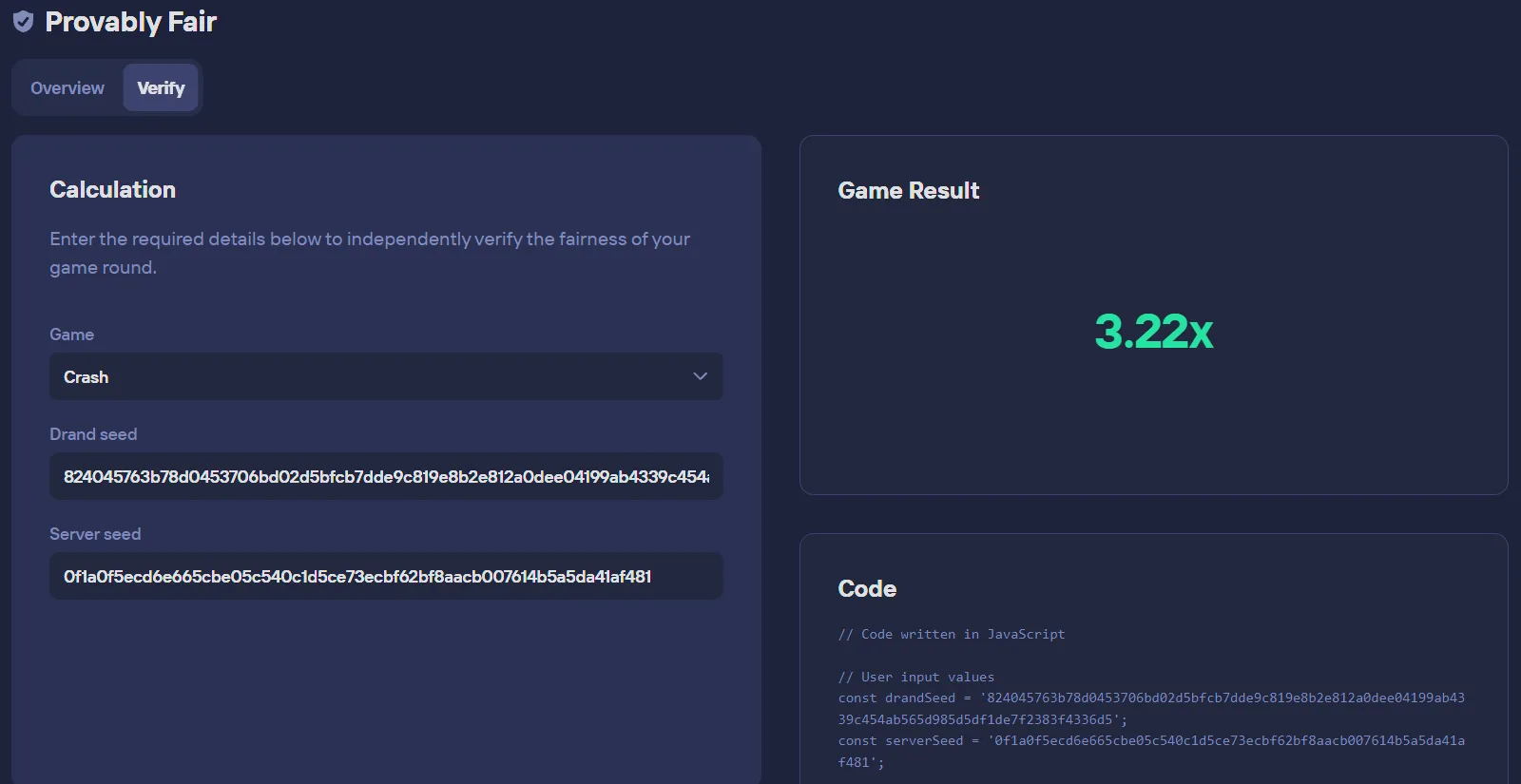
A bet ID is a reference to a specific wager placed under a specific account and round. It can help you locate the following data points in a correctly implemented history system:
- bet amount and currency
- payout amount and net result
- game multiplier or crash point
- client seed, server seed, and nonce
- the round hash or round seed
What a bet ID does not prove is fairness. The ID only points to a record. To verify that the round was not manipulated, you need the cryptographic inputs that were published before the round started, or a server seed that has since been revealed. If the platform does not expose those inputs, a bet ID is just an entry in a database.
Step-by-Step Lookup Process
How Does This Compare to 0% House Edge Protocols?
Audited 100% RTP
Instead of standard 1.00% to 4.00% casino house margins, compare with mathematically verified 100% RTP Originals (0.00% House Edge) on Duel Casino:
Use the following steps whenever you want to review a past round. The exact labels and URL structures differ between operators, so treat this as a general procedure and adjust it based on the site’s documentation.
1. Locate the Bet ID in Your History
Open your account’s bet history and select the round you want to inspect. Some platforms show a short alphanumeric ID directly in the row; others require you to open the round detail page first. You may also see a transaction hash from the underlying blockchain. A bet ID is not necessarily the same as a transaction hash, even when both appear on the same record.
If you are reviewing a live game rather than a single bet, the round itself may have a separate round ID. In that case, the individual bet ID is often shown inside the round detail view. Save both if you plan to verify later.
2. Open the Round Detail View
The detail view should include enough fields to reconstruct the exact bet. Below are the fields a serious verifier should check for a standard provably fair game:
| Field | What to Verify |
|---|---|
| Bet ID | Matches the ID in your history, not a neighboring row. |
| Client Seed | Matches the seed you set before the round. |
| Server Seed (hashed) | Matches the hash published before the round. |
| Server Seed (revealed) | Available after the round if the site uses a classic seed rotation model. |
| Nonce | Indicates how many bets were placed with this seed pair. |
| Bet Amount | Exactly what was wagered, before any bonus adjustment. |
| Payout Amount | What was credited, including stake or without stake depending on the site. |
| Multiplier / Result | The raw game result, not a rounded front-end display. |
3. Recalculate the Provably Fair Result
For most hash-based games, the result is derived from an HMAC-SHA256 function applied to the seed and nonce. A common construction is:
input = client_seed + ':' + nonce
hash  = HMAC_SHA256(server_seed, input)
number = first 8 hex chars converted to integer / 2^32
The crash or multiplier is then calculated from number using a formula published in the operator’s provably fair documentation. For dice, the number is mapped to a roll between 0 and 100. For crash, the number is mapped to an edge-adjusted multiplier.
Do not assume every platform uses the same ordering. Some sites put client_seed before server_seed, some include the round ID, and some use SHA-512 instead of SHA-256. The right approach is to read the site’s own provably fair guide and recreate the exact input string. If the result matches the displayed multiplier, the bet ID points to a consistent record. If it does not match, there is either a documentation error or the record has been altered.
4. Compare the Bet with the Round’s Shared Result
In multiplayer games, every bet in the same round should use the same server seed and the same round result. Your bet ID lookup should show a round ID or round hash that is shared across all participants. You can verify this by checking whether another bet in the same round has the same round hash and the same final multiplier. This does not prove that the round result was not biased, but it does prove that your payout was calculated from the same result as everyone else’s.
What to Check When the ID Does Not Verify
Failures in verification are not rare. The following are the most common causes and the checks you can perform:
- Rotated server seed: If the server seed was revealed and you did not save it, you cannot recalculate the old result. A responsible platform keeps the revealed seed available in history, but not all do.
- Wrong nonce: If you redeemed a bonus or used a new round counter, the nonce may be different from what the detail page shows. Confirm the exact nonce from the round detail view.
- Edge and rounding: The displayed multiplier is often rounded to two or three decimal places. Use the raw payout and the house edge formula to reconstruct the unrounded multiplier.
- Bonus / cashout logic: A cashout multiplier may include partial cashout or bonus funds. The bet ID lookup should distinguish the base bet from the cashout record.
If the site does not publish its provably fair algorithm or has changed it retroactively, a bet ID is not sufficient evidence of anything. Compare the current documentation against the archived round data. For an overview of how different operators handle this, see our casino reviews and the general provably fair guides.
Using Bet IDs for On-Chain Verification
For blockchain-based casinos, a bet ID may correspond to a transaction hash or a log emitted by a smart contract. You can check the transaction on a blockchain explorer if the operator publishes the contract address and the relevant event signature. The sequence is:
- Copy the transaction hash referenced in the bet detail page.
- Find the emitted event that contains the client seed, server seed hash, and payout.
- Compare the event data with the bet detail page, using the same HMAC calculation described above.
This method is stronger than a database lookup because it anchors the bet to an immutable ledger. However, it only works if the game contract is genuinely on-chain and if the operator does not use an off-chain oracle for the seed. If the outcome is generated off-chain and then posted on-chain, you must still trust the seed publication process.
Limitations and Practical Advice
Bet ID verification is a useful audit step, but it has limits. An ID cannot show whether the seed was selected fairly before the round unless the pre-round hash is preserved and time-stamped. A seed that is changed after the round but before reveal can pass a naive check that only compares the revealed seed to the old hash. The correct test is to check the hash that was displayed before the round, not the hash shown after the round.
For bankroll analysis, do not rely on a single bet ID. Export the full history and verify a sample of rounds at regular intervals. If a sample fails, investigate before placing further bets. For staking or tracking decisions, see our bankroll management material. For changes in verification features, monitor the operator’s changelog; our news section notes significant shifts in provably fair policies.
In general, treat bet IDs as index entries, not as proof. The proof is the combination of pre-round hashes, revealed seeds, nonces, and the documented result formula. Check each component independently, and do not assume a polished history page is the same as a verifiable one.
FAQ
Can I verify an old bet after the server seed has been rotated?
Only if the operator stored the revealed server seed and the pre-round seed hash, and makes both available in the bet detail view. If the seed was revealed and you did not save it, some platforms allow you to replay the round using the old seed from the history page. If the platform removed the revealed seed after rotation, the historical bet cannot be recalculated from public data.
Why does the payout multiplier shown in my history differ from the crash point of the round?
Several reasons exist. The historical multiplier may include a cashout level lower than the final crash point, or the payout may be displayed as net winnings instead of gross return. House edge can reduce the effective multiplier. Some operators also apply a max win cap, in which case the payout does not match the raw game result. Check the raw result field and the unrounded payout before concluding that the record is inconsistent.
Is a bet ID the same as a transaction hash?
Not necessarily. A bet ID is an internal identifier that may or may not equal the transaction hash of the blockchain operation that funded or settled the bet. On-chain games usually show both separately: one for the database record and one for the ledger transaction. If you are verifying a bet on-chain, use the transaction hash or event log, not just the bet ID.