Autobet Strategies Under the Microscope: An EV Analysis

the author
ProvablySmart Research Desk
date post
Aug 28, 2026

Share


An autobet strategy is a rule that tells a player how much to stake on the next round as a function of the previous round’s outcome. It can be a built-in client setting, a short script, or a sequence of manual actions. Because the underlying game remains the same, the effect on expected value (EV) is less interesting than many forum threads suggest. The EV of every strategy is known in advance: it is negative by the house edge, multiplied by the total amount staked. This article explains the arithmetic, what you can verify in a 2026 provably fair client, and where the real differences between strategies actually lie.
The EV Framework: Bet Sizing Cannot Change the Edge
Consider a game with probability p of winning a net profit of b units per 1 unit staked, and probability 1-p of losing the stake. The expected value per unit staked is:
EV per unit = p × b – (1 – p).
If the operator declares an RTP of R (expressed as a decimal), then the house edge is h = 1 – R, and the per-unit EV is -h. No bet-sizing sequence can change p or b. If the house edge is 1%, every unit staked across all autobet rounds has an EV of -0.01. This includes the stake on the second round of a martingale, which is funded by the first round’s loss. Summing over N rounds:
Total EV = -h × (stake1 + stake2 + … + stakeN).
Autobet does not alter any variable in that sum. It determines how many units are exposed per round, and therefore how quickly the expected loss is realized, but not the sign or per-unit magnitude of the expectation. A strategy that loses more often than it wins can have the same per-unit EV if the wins pay more; a strategy that wins often can have the same EV if the rare loss is large enough. The strategy only arranges the cash flow of a fixed negative expectation.
What You Can Audit in an Autobet Session
How Does This Compare to 0% House Edge Protocols?
Audited 100% RTP
Instead of standard 1.00% to 4.00% casino house margins, compare with mathematically verified 100% RTP Originals (0.00% House Edge) on Duel Casino:
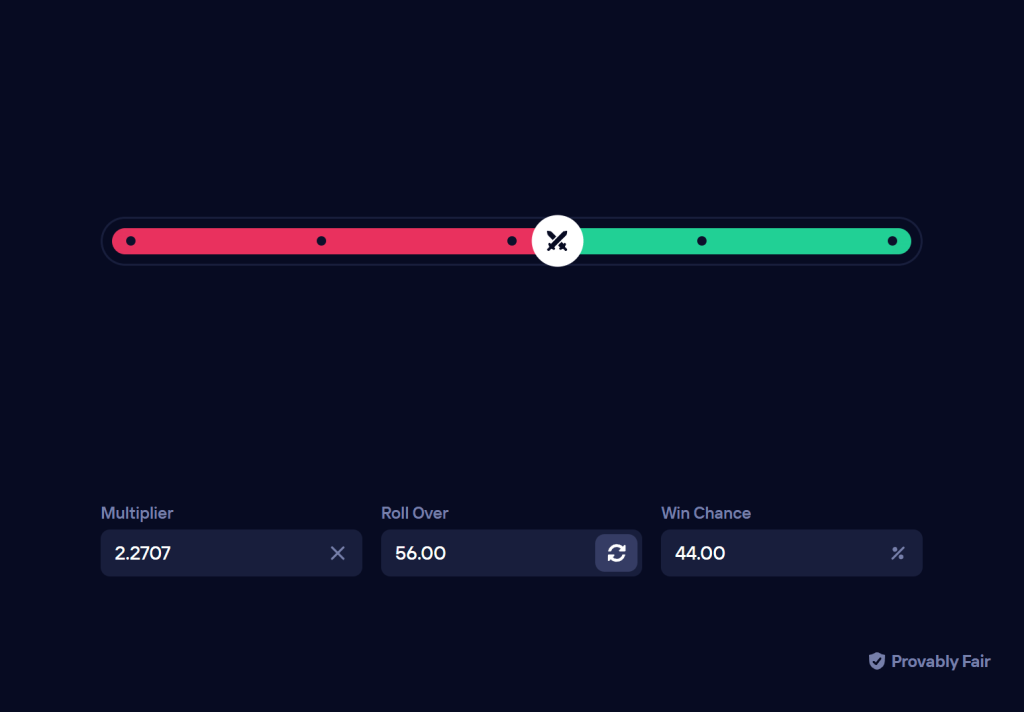

In a provably fair system, each round is generated from a combination of a server seed, a client seed, and a nonce. The server seed is usually committed to in hashed form before any bets are placed. For an autobet session, the important point is that the nonce is a deterministic part of the seed string. There is no hidden state in the autobet script that the player cannot reproduce after the server seed is revealed.
To check an autobet session yourself:
- Before starting, save the hashed server seed and the current client seed exactly as shown in the game interface.
- Record the first nonce the autobet client will use. Most clients increment the nonce by 1 for every round, so the sequence is simply nonce, nonce+1, nonce+2…
- Run the session, then stop and click the “reveal” or “verify” control to obtain the unhashed server seed.
- Confirm that the revealed server seed, when hashed, matches the commitment you saved before the session.
- For each round, compute the RNG output using the operator’s documented algorithm (typically HMAC-SHA256 over server_seed:client_seed:nonce, but not always). Compare each computed result with the displayed outcome.
If every round matches, the autobet client did not influence the randomness. If the operator refuses to reveal a server seed, or the seed is rotated mid-session without a saved commitment, that is not a provably fair implementation. What to check for a specific operator is documented in the casino reviews and in the provably fair guides, rather than assumed from marketing pages.
Comparing Autobet Strategies: Same EV, Different Risk
The table below compares common autobet strategies under an operator-declared house edge of 1%. The EV column is per unit staked; if the actual RTP differs, replace -1% with (RTP – 100%).
| Strategy | Bet sizing rule | EV per unit staked | Typical loss profile |
|---|---|---|---|
| Flat betting | Constant stake size | -1% | Slow, predictable decay. |
| Martingale | Double after a loss, reset after a win | -1% | High probability of a small win; rare but severe losing streak can erase many wins. |
| Reverse martingale (Paroli) | Double after a win, reset after a loss | -1% | Frequent small losses; occasional larger win. The larger win does not compensate for the cumulative edge. |
| D’Alembert | Increase stake by 1 unit after a loss, decrease by 1 unit after a win | -1% | Moderate swings; long symmetrical streaks can push stake size into higher territory. |
| Fibonacci | Increase stake according to Fibonacci sequence after a loss, step back after a win | -1% | Slower climb than martingale, but table limits still impose a hidden failure point. |
The EV column is identical because each strategy only changes how much money is at risk at each step. The risk profile, however, is dramatically different. Martingale, for example, is often described as “almost never loses” in shallow simulations; the same simulation shows a maximum drawdown that exceeds most bankrolls long before the expected loss becomes visible.
Where a Strategy Can Still Change Your P&L: Variance and Ruin
Even though EV is indifferent to the bet sequence, the probability of going bust during a session depends heavily on that sequence. Martingale increases the probability of ending a short session with a small profit while concentrating the total loss in a rare tail event. If the operator imposes a maximum bet, that tail event becomes a forced loss at the limit: the strategy cannot double beyond the cap. The same is true for any betting progression that relies on unlimited stakes.
Another effect is turnover. An autobet client can execute hundreds or thousands of rounds in an hour. With a 1% house edge, staking 100,000 units will produce an expected loss of 1,000 units, regardless of strategy. A flat bettor can reduce expected loss by reducing stake; a martingale cannot reduce the edge, only delay the moment at which the integrated loss catches up. The practical limits are a function of your bankroll, not the strategy’s internal logic. For setting those limits, see bankroll management.
Autobet and Operator Controls: What to Check in 2026
An autobet feature is just an API wrapper around the same RNG and the same game contract. The verifiable parts are the seed lifecycle, the nonce sequence, and the game log. Before assuming an operator’s autobet is fair, check whether the client exposes:
- The current client seed and nonce before every run.
- A hashed commit of the server seed before the first round.
- A game log with per-round nonce, bet amount, and outcome.
- An option to rotate seeds between runs, preventing a fresh run from replaying an old deterministic sequence.
- Max bet and session loss limits in the autobet configuration.
Operators differ in how much of this is visible in the UI. If a claim about zero house edge or a negative edge appears, the burden of proof is on the operator. The math above stands: a casino game that returns less than 100% of stakes has a negative EV for every strategy, no matter how many “smart” rules are layered on top. Changes in operator policy or seed handling can be tracked on the news page.
FAQ
Does martingale turn a negative-EV game positive?
No. Martingale changes the size of later bets, but each unit staked still carries the same negative expectation. The expected loss is -h times all money staked in the series. Martingale simply redistributes the probability of ending a session ahead or behind: frequent small wins and rare but large losses. Table limits convert the rare loss into a certain loss at the cap.
How can I verify an autobet client did not manipulate results?
Save the hashed server seed and client seed before the session. After the session, reveal the server seed and check that it hashes to the saved commitment. Then recompute the RNG output for each nonce in the sequence using the operator’s documented algorithm. If every recomputed result matches the displayed outcome, the autobet client did not alter the randomness.
Is any autobet strategy better in EV than flat betting?
No, not in pure game EV. For a fixed house edge, every unit staked has the same expected loss. A strategy changes variance, drawdown, and the time until expected loss becomes visible, but not the underlying edge. Reducing total stake and applying strict bankroll limits are the only levers that affect long-term results.