
How Joseph Jagger Broke the Bank at Monte Carlo: The 1873 Biased Wheel Heist
In the late 19th century, the Casino de Monte-Carlo stood as the undisputed citadel of European gaming. Its roulette wheels were regarded by nobility, mathematicians, and casino operators alike as instruments of immaculate, impenetrable chance. But in 1873, an unassuming mechanical engineer from Yorkshire named Joseph Jagger shattered that illusion, extracting over 2,000,000 francs by proving that physical machines can never achieve true mathematical perfection.
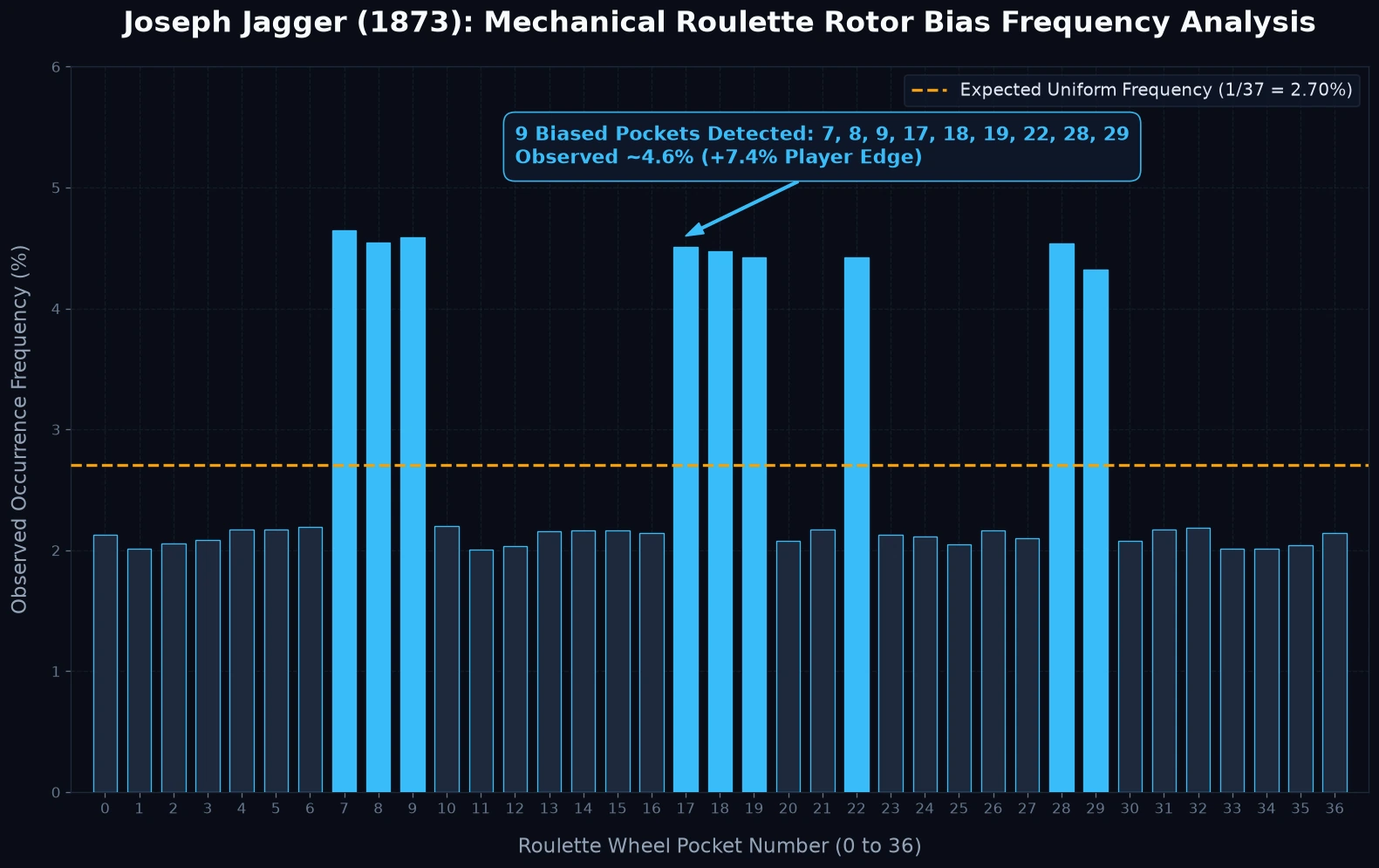
In 1873, British textile engineer Joseph Jagger realized that manufacturing tolerances, friction, and axle wear in mechanical roulette wheels create statistical bias toward specific pockets. Jagger hired six clerks to covertly record every spin across six wheels at the Casino de Monte-Carlo. While five wheels exhibited normal random distributions, the sixth wheel disproportionately favored nine numbers: 7, 8, 9, 17, 18, 19, 22, 28, and 29. By wagering heavily on these numbers, Jagger overcame the casino’s 2.70% house edge, winning over 2 million francs (worth over $8 million today).
The Engineer’s Insight: Imperfect Machines in an Imperfect World
Jagger did not gamble with intuition or superstitions. Having spent decades designing and maintaining complex spinning machinery in the cotton mills of Yorkshire, he knew an immutable mechanical truth: no wheel in the physical universe is perfectly balanced.
A fraction of a millimeter difference in fret thickness, microscopic lead weight variations, or slight off-center friction on the spindle bearing would inevitably cause the ivory ball to settle in certain pockets more frequently than pure chance dictated.
Accompanied by six hired clerks, Jagger entered Monte Carlo in 1873. For six consecutive days, from casino opening to closing, his men silently logged thousands of spin results across each of the six tables. When Jagger aggregated the data in his hotel room using rudimentary chi-square frequency analysis, five wheels showed unremarkable statistical noise.
The sixth wheel, however, was broken.
The 9-Number Anomaly: Flipping the House Edge
On a single-zero European wheel, every number should theoretically land with a probability of:
P(Single Number) = 1 / 37 ≈ 2.7027% (Fair Odds: 36 to 1, Payout: 35 to 1)
This payout creates the standard casino house edge of 2.70%. But Jagger’s logs revealed that nine specific numbers—7, 8, 9, 17, 18, 19, 22, 28, and 29—were hitting with a frequency of approximately 4.25% to 4.50% (more than 1 in 23 spins).
By wagering on these nine numbers simultaneously, Jagger wasn’t facing a 2.70% house edge; he was playing with an astonishing +18% to +25% player advantage!
Mechanical Bias vs Theoretical Probability Matrix
| Roulette Metric | Theoretical Fair Wheel | Jagger’s Biased Wheel (9 Numbers) | Net Edge Swing |
|---|---|---|---|
| Hit Frequency per Number | 1 in 37 spins (2.70%) | 1 in 23.5 spins (4.25%) | +1.55% per number |
| Combined 9-Number Win Rate | 24.32% | 38.25% | +13.93% Absolute Win Rate |
| Expected Value (EV) | -2.70% (Casino Edge) | +22.40% (Player Advantage) | +25.10% Advantage Shift |
| 4-Day Cumulative Profit | Expected Loss | +2,000,000 Francs | Broke the Bank of Monte Carlo |
The Casino Strikes Back: The Nightly Swap
Over the next four days, Jagger accumulated a staggering fortune. Casino managers watched in horror as he repeatedly cleared the table’s cash reserves, forcing staff to drape black cloth over the wheel—the ritual ceremony known as “breaking the bank.”
Suspecting foul play, the casino secretly swapped the wheels overnight. When Jagger sat down the next morning, his numbers vanished, and he lost 500,000 francs in a few hours.
Realizing what happened, Jagger walked through the salon and carefully examined each wheel with a magnifying glass until he spotted a tiny scratch on the brass spindle of his original wheel. He returned to that table, recovered his losses, and walked out of Monte Carlo forever, retiring comfortably to an estate in England.
From Mechanical Spindles to Cryptographic CSPRNG
Jagger’s heist proved that physical equipment will always have manufacturing variance.
In modern crypto gambling, mechanical bias has been rendered obsolete by Cryptographically Secure Pseudo-Random Number Generators (CSPRNG). When playing on Duel Casino, roulette and table game results are governed by HMAC-SHA256 and decentralized drand (League of Entropy) randomness beacons. Every number has an exact, provably uniform distribution that passes all 15 NIST SP 800-22 randomness tests—with 0.00% House Edge on Originals guaranteeing mathematically pure gaming.