
How the MIT Blackjack Team Beat the Casino: Claude Shannon, Math & The Kelly Criterion
In the history of gambling, casinos have almost always maintained an unbeatable mathematical edge. But in 1979, a group of students and professors from the Massachusetts Institute of Technology (MIT), Harvard, and Caltech proved that with information theory, conditional probability, and ruthless discipline, the house edge could be flipped upside down.
The MIT Blackjack Team succeeded by exploiting dependent trials in multi-deck shoes using the Hi-Lo card counting algorithm and Kelly Criterion bet sizing (
f* = (bp - q) / b). Unlike roulette or dice, cards dealt in blackjack are not replaced until shuffled, causing the deck’s composition to fluctuate. When high cards (10s and Aces) remain in abundance, player advantage climbs to +1.5% to +2.5% EV. By deploying “spotters” to count quietly and “big players” to enter when the count peaked, they turned casino gaming into a statistical arbitrage fund.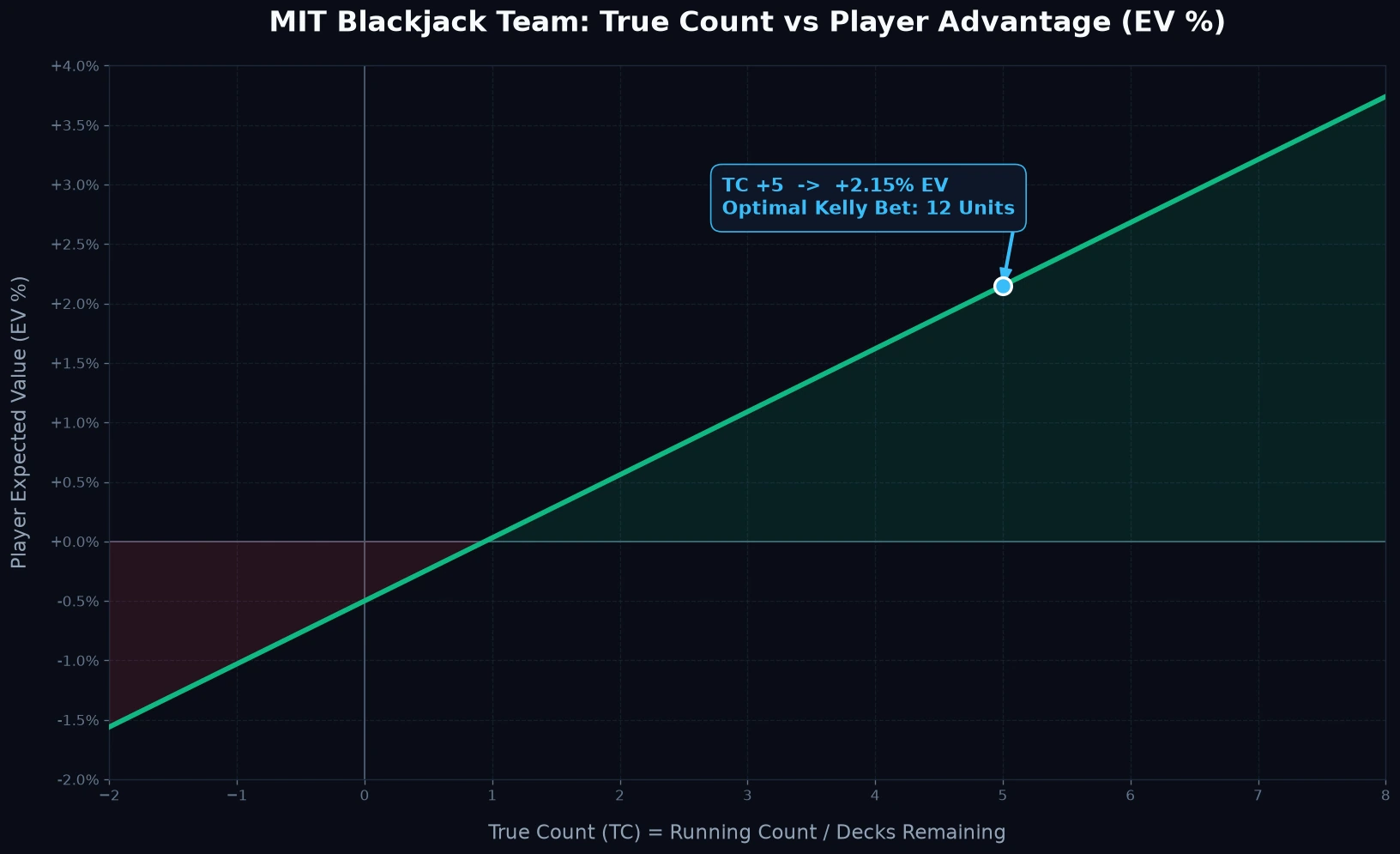
The Mathematical Genesis: Ed Thorp & Claude Shannon
The foundation of the MIT team’s success was laid two decades earlier by Edward O. Thorp, an MIT mathematics professor, and Claude Shannon, the father of Information Theory. In 1961, Thorp published Beat the Dealer, using an IBM 704 computer to calculate the first mathematically proven basic strategy and card counting system.
Thorp and Shannon realized that while roulette is an independent process (each spin has identical starting probability), blackjack is a dependent process without replacement. When small cards (2 through 6) are removed from the deck:
- The dealer is more likely to bust when hitting on 12–16.
- The player receives more blackjacks (which pay a bonus 3:2).
- Double downs and split hands succeed with higher frequency.
The Kelly Criterion: Eliminating the Risk of Ruin
Counting cards gives a player an edge, but an edge without proper money management still leads to bankruptcy. To guarantee long-term wealth growth, the MIT team relied on the Kelly Criterion, developed in 1956 by Bell Labs scientist John Larry Kelly Jr.:
f* = (b × p – q) / b
Where f* is the fraction of total bankroll to wager, b is the net payout odds, p is the probability of winning, and q = 1 - p is the probability of losing.
When the True Count was neutral or negative, the team bet nothing (or table minimums through “Spotters”). When the True Count rose above +4 (giving a +1.5% to +2.0% advantage), “Big Players” were signaled into the game, wagering thousands of dollars per hand in strict accordance with Kelly fractions.
Card Removal & Expected Value Shift Matrix
| Card Removed from Deck | Effect on Player Advantage (EV Shift) | Hi-Lo Point Value | Impact on Dealer Bust Rate |
|---|---|---|---|
| 5 (Five) | +0.67% (Best card to remove) | +1 | Dealer busts much more often |
| 4, 6 (Four & Six) | +0.52% / +0.45% | +1 | Stiff hands break dealer |
| 7, 8, 9 (Neutral Cards) | +0.30% to -0.15% | 0 | Negligible impact |
| 10, J, Q, K (Face Cards) | -0.51% (Bad when removed) | -1 | Reduces player 3:2 blackjacks |
| Ace (A) | -0.59% (Bad when removed) | -1 | Eliminates high-paying naturals |
Why Card Counting Is Extinct in Online Casinos
Casinos responded to the MIT team with facial recognition, Griffin private detectives, and Continuous Shuffling Machines (CSMs).
In online casinos, card counting is mathematically dead. Digital live tables shuffle after 50% shoe penetration, and RNG tables re-seed every single round using cryptographic CSPRNGs (effectively simulating an infinite deck).
Today, mathematical advantage play has shifted from tracking dealt cards to hunting zero house edge protocols. On Duel Casino, players don’t need a team of spotters to gain an edge: 100% RTP Originals run on a mathematically pure 0.00% house edge, delivering identical expected value to the best counted shoes without the threat of casino bans or backroom detentions.