
The Phil Ivey Edge Sorting Masterclass: $20 Million Won by Reading Card Asymmetries
In 2012, poker icon Phil Ivey and his partner Cheung Yin “Kelly” Sun walked out of two of the world’s most prestigious casinos—Crockfords Club in London and the Borgata in Atlantic City—with over $20.6 million in Baccarat winnings. They did not touch the cards, mark the deck, or employ high-tech gadgets. They simply exploited a microscopic manufacturing flaw on the back of the cards in a technique known as Edge Sorting.
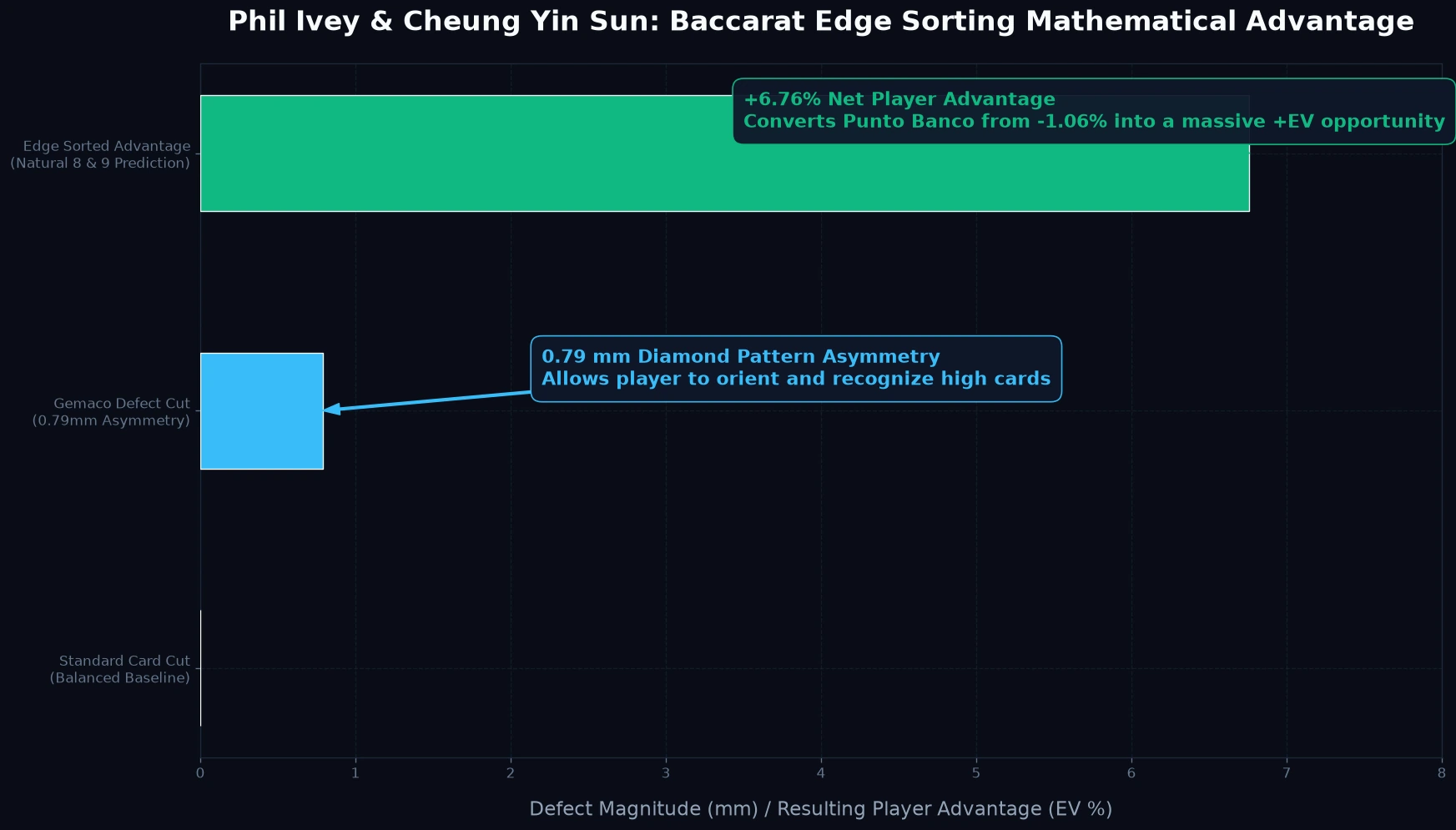
Edge sorting is an advantage-play technique where a player identifies microscopic asymmetrical manufacturing cut errors on the patterned backs of playing cards. In Baccarat (Punto Banco), knowing whether the upcoming shoe card is a high-value card (6, 7, 8, or 9) flips the standard 1.06% casino house edge into a massive +6.76% player advantage. By disguising their requests as cultural superstitions, Ivey and Sun had dealers rotate cards 180 degrees, allowing them to read the value of cards before placing their bets.
The Psychology of the Setup: Superstition as Camouflage
Casinos are terrified of card counters in blackjack, but they rolled out the red carpet for Phil Ivey in Baccarat—a game widely regarded as pure, unassailable chance.
Ivey agreed to play at Borgata and Crockfords under four specific conditions, which he framed as high-roller superstitions:
- A private salon with an initial deposit of £1,000,000 / $3,000,000.
- A dealer who spoke fluent Mandarin (allowing Kelly Sun to communicate without floor staff understanding nuances).
- An automatic card shuffler (which rotated decks consistently without hand-tumbling).
- Specific playing cards: Gemaco purple playing cards, known to feature repeating diamond patterns cut imperfectly by 1/32nd of an inch at the factory edges.
During play, Sun would politely instruct the dealer in Mandarin to turn high-value cards (7, 8, 9) 180 degrees before placing them into the discard tray, claiming it was for “good luck.” Because the automatic shuffler did not rotate cards, within one shoe, every key card in the deck was visibly oriented with its cut pattern facing one direction.
The Mathematical Edge Inversion in Baccarat
| Baccarat Bet | Standard Casino Edge | Edge-Sorted Advantage (When Card is 7, 8, or 9) | Net Advantage Swing |
|---|---|---|---|
| Player Bet | -1.24% House Edge | +6.76% Player Advantage | +8.00% Swing |
| Banker Bet | -1.06% House Edge | +5.39% Player Advantage | +6.45% Swing |
| Tie Bet | -14.36% House Edge | Ignored / Avoided | N/A |
The Legal Battle: Advantage Play vs “Cheating”
Crockfords withheld Ivey’s £7.7 million winnings, and Borgata sued for $10.1 million. The ensuing legal showdown reached the UK Supreme Court and the US Federal Courts.
Ivey’s defense was simple: “I never touched a card. I used my eyes to detect flaws in your equipment that your own casino staff agreed to manipulate.”
Ultimately, courts ruled in favor of the casinos, defining edge sorting as a breach of contract and an “illegitimate manipulation of the odds.” Yet among gambling purists and mathematicians, Ivey’s campaign remains one of the greatest feats of sharp observational advantage play in history.
From Physical Flaws to Digital Provable Fairness
The Phil Ivey case highlighted the vulnerability of physical casino equipment to human error and manufacturing asymmetries.
In modern crypto gambling, physical imperfections are impossible. When playing provably fair table games on Duel Casino, card values are generated via deterministic CSPRNG algorithms with rejection sampling. There are no misprinted card backs or dealer errors—only pure mathematical probabilities audited on-chain.