
The Martingale betting system is the most famous progression strategy in gambling history: double your wager after every loss, and reset to the base bet after every win. While players believe it guarantees profits, probability theory proves it merely trades frequent micro-wins for catastrophic, bankroll-annihilating losses. This calculator and simulator models the Martingale against authentic casino math.
Betting Progression Simulator
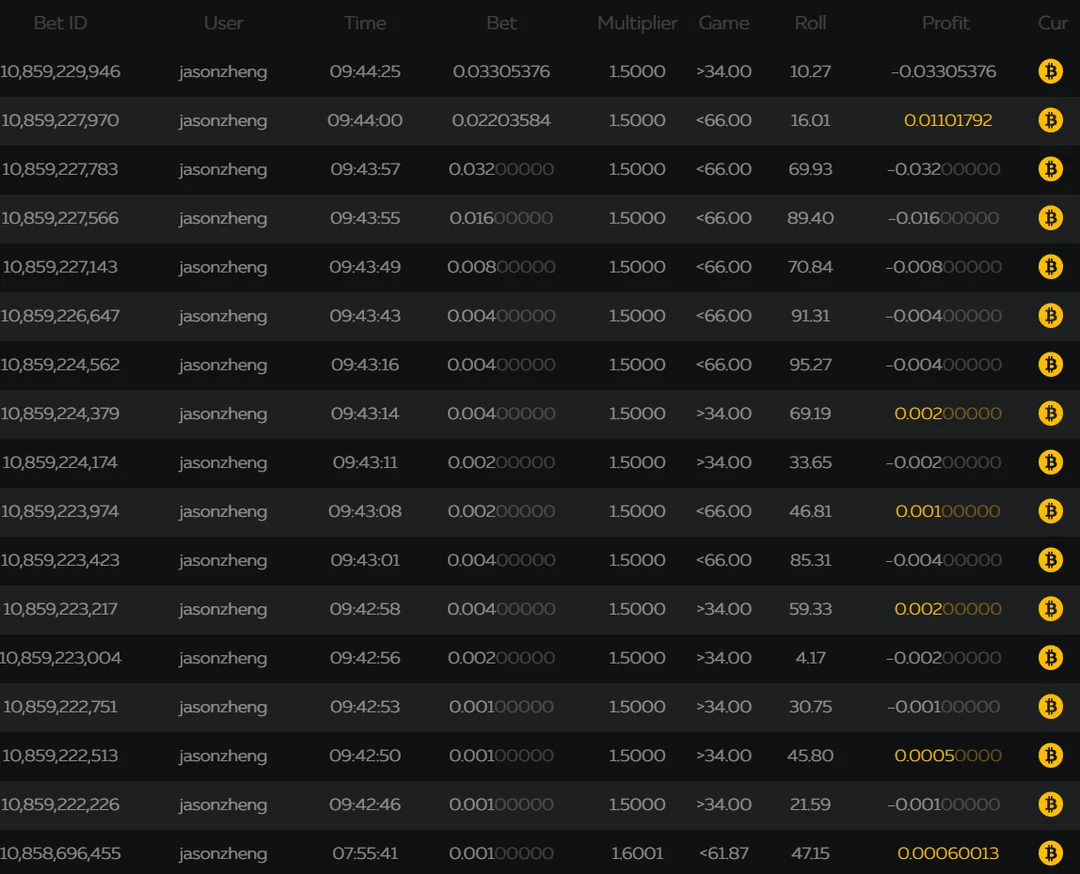

Simulate Martingale, Paroli, D’Alembert, and Fibonacci betting systems against real casino games over 100 to 10,000 rounds:
Stake Progression Simulator
The Mathematics of Martingale: Exponential Escalation
When you start with a $10 base wager and experience a losing streak, your wager escalates exponentially as $W_n = W_0 times 2^{n-1}$:
- Loss 1: Bet $10 (Total risked: $10)
- Loss 2: Bet $20 (Total risked: $30)
- Loss 3: Bet $40 (Total risked: $70)
- Loss 4: Bet $80 (Total risked: $150)
- Loss 5: Bet $160 (Total risked: $310)
- Loss 6: Bet $320 (Total risked: $630)
- Loss 7: Bet $640 (Total risked: $1,270)
- Loss 8: Bet $1,280 (Total risked: $2,550)
- Loss 9: Bet $2,560 (Total risked: $5,110)
- Loss 10: Bet $5,120 (Total risked: $10,230)
Notice that on round 10, you are risking $5,120 of your capital to win a net profit of just $10!
The 2 Fatal Flaws That Break Martingale
- Table Limits: Casinos enforce minimum and maximum wager limits (e.g., $5 min, $1,000 max). After just 8 consecutive losses, the required bet exceeds the table maximum, rendering the recovery double impossible.
- Finite Bankrolls: No gambler has an infinite balance. In European roulette, an even-money bet has a 51.35% chance of losing per spin. The probability of hitting 8 consecutive losses in a 1,000-spin session is over 91.4%!
Probability of Consecutive Losses in Even-Money Bets
| Consecutive Losses | European Roulette (48.65% win) | American Roulette (47.37% win) |
|---|---|---|
| 5 in a row | 3.58% (1 in 28) | 4.04% (1 in 25) |
| 6 in a row | 1.84% (1 in 54) | 2.13% (1 in 47) |
| 7 in a row | 0.94% (1 in 106) | 1.12% (1 in 89) |
| 8 in a row | 0.49% (1 in 206) | 0.59% (1 in 170) |
| 9 in a row | 0.25% (1 in 402) | 0.31% (1 in 322) |
| 10 in a row | 0.13% (1 in 782) | 0.16% (1 in 613) |
{
“@context”: “https://schema.org”,
“@graph”: [
{
“@type”: “WebApplication”,
“name”: “Martingale Strategy Calculator”,
“url”: “https://provablysmart.com/martingale-strategy-calculator/”,
“applicationCategory”: “UtilityApplication”,
“operatingSystem”: “All”,
“offers”: {
“@type”: “Offer”,
“price”: “0”,
“priceCurrency”: “USD”
},
“description”: “Simulate Martingale betting progression, calculate risk of ruin, and loss streak odds.”
},
{
“@type”: “FAQPage”,
“mainEntity”: [
{
“@type”: “Question”,
“name”: “Does the Martingale strategy work?”,
“acceptedAnswer”: {
“@type”: “Answer”,
“text”: “No. The Martingale system cannot overcome casino house edges. Due to table limits and finite bankrolls, losing streaks eventually cause massive, unrecoverable losses.”
}
},
{
“@type”: “Question”,
“name”: “What are the odds of losing 10 times in a row in roulette?”,
“acceptedAnswer”: {
“@type”: “Answer”,
“text”: “In European roulette, the chance of 10 consecutive losses on red/black is approximately 1 in 782 on any given sequence, but over a 1,000-spin session, experiencing such a streak is common.”
}
}
]
}
]
}