
CS2 Betting Explained: Maps, Odds, Vetoes, Real Strategy
CS2 betting rewards people who watch the games. How map vetoes, round handicaps and live odds actually work — verified, not guessed.
CS2 Betting for Viewers, Not Gamblers: Maps, Odds, Vetoes
Most CS2 betting guides read like they were written by someone whose closest brush with pro play is a highlights reel. They tell you to “research team form” and “manage your bankroll,” then call it a day. This guide assumes you already watch pro CS2, hold opinions about AWPers and map pools, and want to know what the betting markets actually price — and what they get wrong. At ProvablySmart, the principle is the same as with casino games: verify, quantify, and never bet what you can’t explain.
CS2 may be the most structure-rich esport to bet on. The round format is rigid, there are two distinct in-game economies, map vetoes leak information, and the calendar is packed enough that a match worth analyzing exists nearly every day. Understand the game and you already know something the pricing algorithms don’t. Don’t understand it, and you’re flipping coins with extra steps and a house edge.
CS2 Bet Types: Which Markets Carry Real Information
Match Winner (Moneyline)
The simplest market: pick the team that wins the series, BO1 or BO3, final scoreline is all that matters.
Here’s what most people miss: BO1s are chaos. Tier-1 teams drop single maps to underdogs at a rate that surprises anyone who only checks rankings. A favourite at -300 in a BO1 is almost certainly overpriced, because bookmakers know casual money slams the big name without thinking. BO3s are different — the stronger team’s consistency shows across multiple maps, which is why informed bettors concentrate there.
Map Winner
Bet on a specific map instead of the series. This is where map pool knowledge converts into edge. If Team A picked Inferno and holds a 78% win rate there over the last three months, that’s real data — and sportsbooks, especially on tier-2 and tier-3 matches, are often slow to price it correctly.
Two minutes on HLTV’s map pool section for each team, before every bet, is the minimum. If you skip it, you’re not betting, you’re guessing.
Handicap (Spread) Betting
A map handicap of -4.5 means your team must win the map by 5+ rounds. A match handicap of -1.5 maps means a 2-0 series win is required.
Handicaps are the sharpest tool in lopsided matchups. When Natus Vincere faces a random MDL squad at -600, the moneyline is dead money. NaVi -1.5 maps at +110 is an actual bet with actual value — provided you’ve verified the underdog doesn’t own a map that could flip a series.
Over/Under Total Rounds
The book sets a line, say 24.5 rounds on a map; you bet over or under. A 13-7 finish is 20 total rounds (under). A 16-14 is 30 (over). Overtime pushes totals higher still.
This market pays for understanding playstyles. Two aggressive, aim-heavy teams with weak utility tend to produce blowouts. Two disciplined teams with deep playbooks and solid CT setups trade rounds, pushing totals over. Watch demos. Check round difference averages on HLTV. The numbers are public.
Pistol Round Winner
Some sites offer pistol round markets. Treat them as coin flips with extra branding. Pistol rounds are volatile by design — one USP headshot erases an entire round’s plan. Knowing which teams run strong pistol strats (forcebuys, utility-heavy rushes vs. default spacing) offers a sliver of edge, but the variance dwarfs it. Side bets, not strategy.
First Kill / First Blood
You bet on which team lands the opening frag on a map. The market maps directly to opening-duel tendencies: an aggressive AWPer who peeks for early picks (the s1mple archetype) generates first bloods at a higher rate than a passive setup team. HLTV publishes individual opening duel stats for free. Track them and legitimate edges exist here.
Outright / Tournament Winner
Futures on the event winner. Your stake is locked for the tournament’s duration. Value typically appears mid-group stage, when one shaky opener inflates a capable team’s odds for the whole event. The cost of being wrong is total: if your pick exits in the quarterfinals, the money is gone. Conviction and patience required.
The CS2 Tournament Calendar: Where Liquidity and Edges Live
CS2 has the most structured competitive ecosystem in esports. The relevant tiers:
Valve Majors
Two per year. Biggest prize pools, most attention, deepest betting liquidity. Every sportsbook offers Major lines and the markets run efficiently on volume, so value is harder to find — but the match count (the Challengers Stage alone puts 16 teams through a Swiss format) supplies plenty of opportunities.
BLAST Premier
BLAST runs a seasonal circuit: Spring Groups, Spring Final, Fall Groups, Fall Final, World Final. Invite-only round-robin events, BO3 series, consistent formats, clean data. If you follow the tier-1 scene, this is bread-and-butter territory.
ESL Pro League / IEM Events
ESL Pro League features a long group stage feeding a knockout playoff. IEM Katowice and IEM Cologne are the most prestigious non-Major events. Early group rounds often use BO1s — risky, but exactly where overpriced favourites become exploitable.
PGL Events
PGL has hosted multiple Majors and standalone tournaments. Production is inconsistent (ask anyone who watched the Antwerp Major), but the matches are real and the odds are liquid. PGL’s Swiss-format group stages suit bettors well, because every round reseeds on results.
Tier-2 and Regional Leagues
CCT, ESEA, Pinnacle Cup, YaLLa Compass, and a dozen other circuits fill the calendar gaps. This is where true edge sits: books pay less attention, odds come from algorithms running stale data, and anyone who actually follows these teams finds real mispricing. The trade-offs are real too — lower limits, occasional match integrity questions, and the rare team that obviously threw for skins.
Map Veto: The Most Underrated Input in CS2 Betting
Betting CS2 without thinking about the veto is leaving information on the table. Every BO3 opens with teams banning and picking maps from the active pool, and that process leaks a lot.
- Permabans carry signals. A team that always bans Vertigo is probably bad on Vertigo. If their opponent’s best map is Vertigo, the veto deletes the upset factor from one entire map — which changes the spread.
- Map picks reveal confidence. A pick is the map a team believes it wins. Team A picks Mirage with an 85% Mirage win rate? That’s a strong directional signal for Map 1.
- The decider map is leftover by elimination. Two bans and one pick each leave one map standing — often one neither team loves. Closer games and higher round totals tend to follow; the over on deciders hits at a noticeably higher rate than on picked maps.
HLTV profiles carry veto data. Cross-reference it with head-to-head records on specific maps. Five minutes per series, and it’s the closest thing CS2 betting offers to an information edge you didn’t pay for.
Skin Betting vs. Fiat & Crypto Sportsbooks
Two ecosystems, very different mechanics:
Skin Betting Sites
Platforms like CSGOEmpire, Gamdom, and Duelbits accept CS2 skins directly and settle bets in skin-backed balances. The pitch is obvious — idle inventory, put to work. The costs are just as real: skin valuations on these platforms usually sit below Steam market price, sometimes 10-15% below, meaning you pay a spread just to deposit. Skin withdrawals depend on availability. And because esports is a side offering rather than the core product, the lines tend to be less competitive than dedicated sportsbooks. None of these platforms are interchangeable in quality — verify payout terms before depositing anything.
Crypto & Fiat Sportsbooks
Platforms like Thunderpick and Stake operate as full sportsbooks with CS2 as a primary esports vertical. Sharper odds, higher limits, better live betting, and deposits via crypto or traditional methods. If CS2 betting is a long-term activity rather than a Friday-night inventory burn, this is where your money gets better pricing.
Live Betting (In-Play) on CS2 Matches
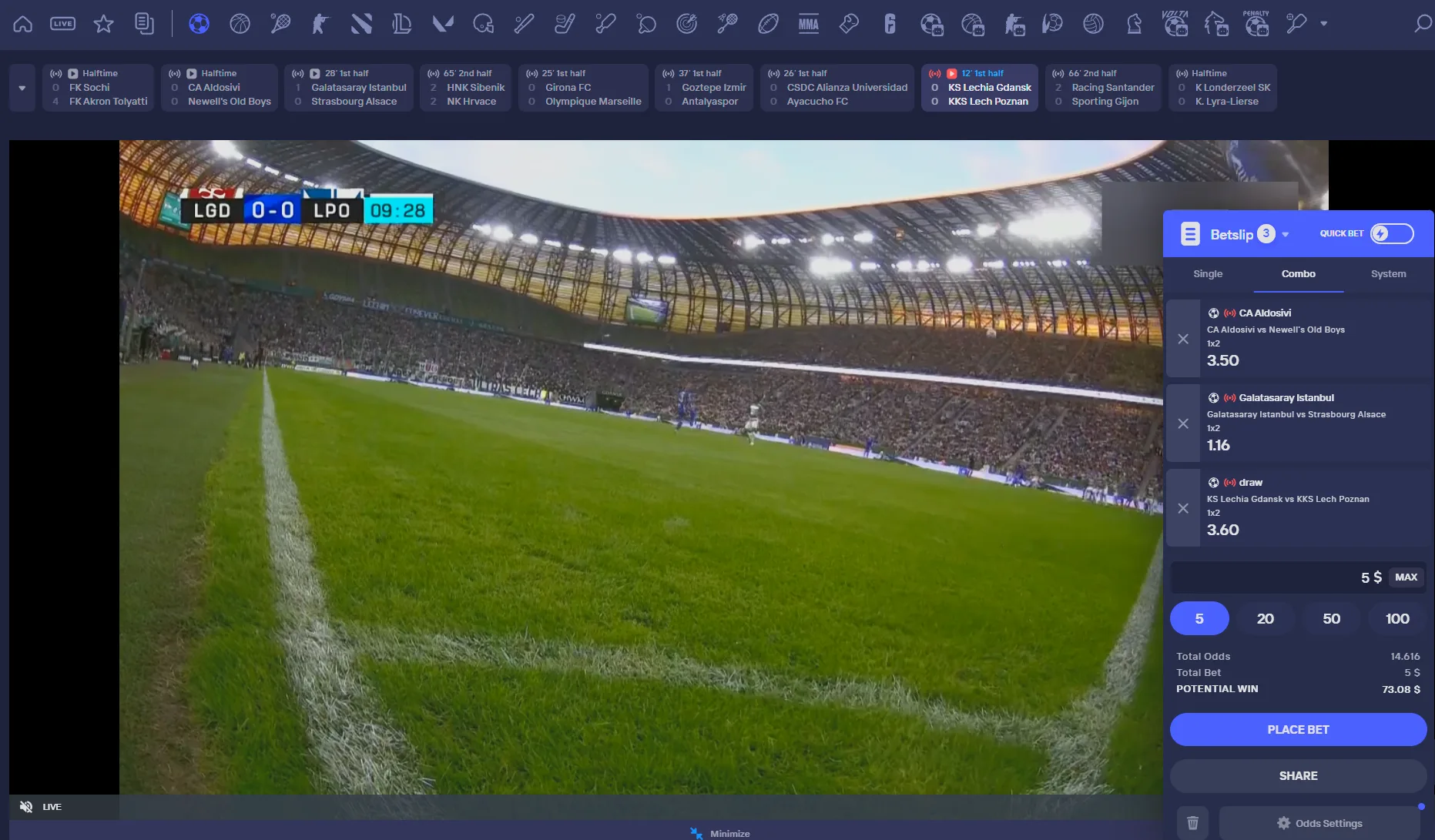
In-play is where experienced bettors separate from the crowd. Odds move after every round, every half, every economy break. If you’re watching live and spot something the algorithm hasn’t priced yet, you can act before it corrects.
Common live edges:
- Economy reads. A team that just lost a force buy and faces a full eco next round has 2-3 rounds likely to go one way. The algorithm reacts to scorelines; it’s slower on economy state.
- Momentum swings. A team down 3-9 on CT side Inferno isn’t finished. Two rounds before the half and the T-side comeback potential is enormous — live lines often overcorrect the favourite.
- In-match player performance. A star AWPer at 2-11 after 13 rounds? Odds for the next map may not fully price the likely regression to the mean. Players that cold don’t stay cold forever.
The catch: this requires actually watching. Scorebot plus button-mashing is gambling blind, and the book eats blind money.
The Biggest CS2 Betting Mistakes
- Betting every match. Some days carry 30+ professional CS2 matches. You don’t need all of them. Most of your edge lives in 2-3 matches a week where you hold genuinely superior information. The rest is entertainment gambling, and entertainment gambling carries negative expected value.
- Ignoring roster changes. A team that benched its IGL for an academy stand-in is not the team you saw at the Major. Odds adjust, but they often lag a day or two — sometimes overreacting to a stand-in, sometimes underreacting.
- Chasing losses on late-night CIS matches. Lost three bets, it’s 2am, and there’s a BO1 between two unfamiliar Russian tier-3 teams. Slamming the favourite at -200 to “get back to even” is how bankrolls die. Close the tab. Sleep.
- Not tracking your bets. Without a spreadsheet or tracking tool logging every bet, the odds taken, and the result, you can’t know whether you’re profitable or just remembering wins. Confirmation bias kills bankrolls quietly. Track everything.
- Trusting “CS2 betting tipsters” on social media. Ninety percent are affiliates paid on sign-ups and deposits through their links. Their “tips” are content built for clicks. Genuinely profitable bettors don’t need affiliate income.
Reading Team Form: What Actually Matters
Everyone says “check team form.” Almost nobody defines it. Start here:
- Last 3 months, not last 3 matches. Two BO1 losses to lower-ranked teams at a group stage may mean nothing. Already qualified? Meaningless seeding match? Coach standing in because the entry fragger had visa issues? Context changes everything.
- Map-specific head-to-head. Overall H2H is nearly useless. What counts is H2H on the maps that will actually be played. If Vitality and G2 have met twelve times but only twice on Anubis, the Anubis sample is the data.
- LAN vs. online. Some teams are online warriors who crumble on LAN; others peak at big events. The gap narrowed in CS2 versus CSGO but persists, particularly for teams from low-ping domestic regions (CIS, China).
- Recent practice block. A team fresh off a two-week bootcamp playing its first event might be sharp — or rusty. No formula resolves this, but it belongs in the decision before you take stale odds.
Where ProvablySmart Stands on CS2 Esports Betting
CS2 is one of the few betting markets where a person with domain knowledge can genuinely compete. The game’s structure — round economy, vetoes, side switches — generates public data that most sportsbooks price imperfectly, especially below tier-1.
But none of it matters if you treat the market like a slot machine. Clicking “bet” on the team name you recognize makes you the fish at the table. The edge is boring and mechanical: check map pools, read veto patterns, watch the games, log every result, and skip the matches where you hold no real information advantage. Same discipline we apply to verifying provably fair casino games — outcomes should be checkable, and so should your own record.
Verify before you bet, or don’t bet. That’s the only honest advice on offer.