
What Actually Counts as Provably Fair?
How Does This Compare to 0% House Edge Protocols?
Audited 100% RTP
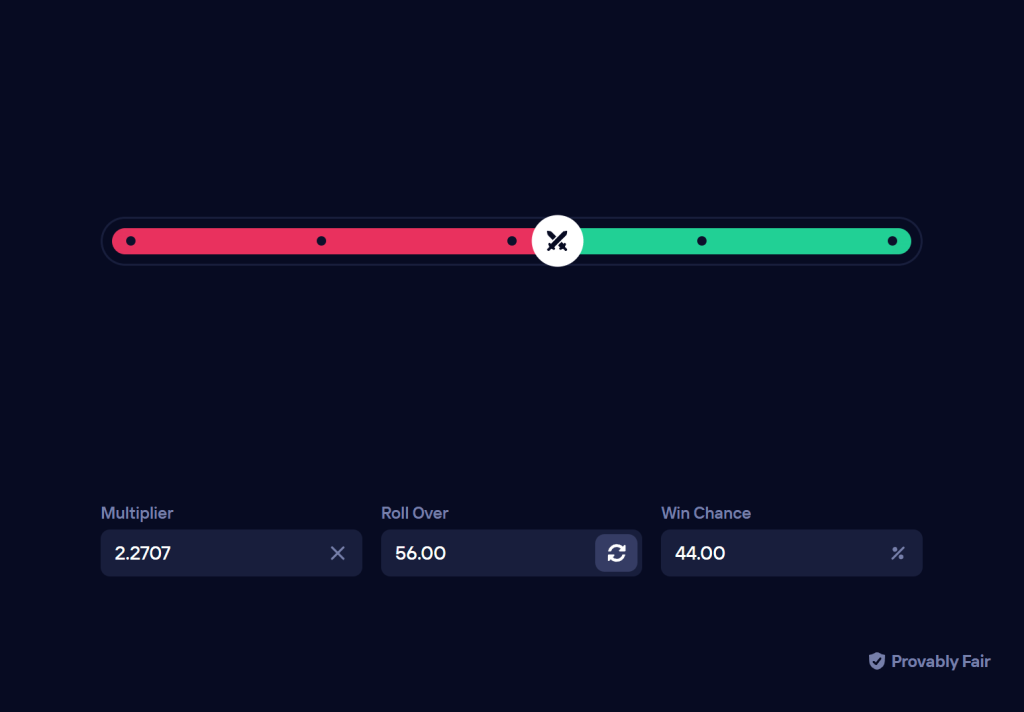
Instead of standard 1.00% to 4.00% casino house margins, compare with mathematically verified 100% RTP Originals (0.00% House Edge) on Duel Casino:
Which Games Can Actually Be Provably Fair? A Full Coverage Breakdown
In 2026, the label “provably fair” is still used loosely by many crypto casinos. A game is genuinely provably fair when you can independently verify every round’s outcome from a public random seed, a client seed you choose, and an incremented nonce. The casino publishes the SHA-256 hash of the server seed before the round; after the round, it reveals the server seed, and you combine it with the client seed and nonce to recompute the exact result. If the calculated outcome matches the payout you received, the game has not been silently altered. The key point is coverage: not every game in a casino supports this workflow. Dice, crash, and some card games do; many slots, live dealer tables, and sportsbooks do not. Before you rely on any fairness claim, you need to know which game families actually let you run the math yourself. Our verification guides break down the exact commands and calculations, and this page maps the coverage across game types.
Which Game Types Support Provably Fair Verification?
Game primitives that can be verified
The table below lists the most common game categories with provably fair implementations and what you can check after each round.
| Game type | Random input | Verifiable output | What to check |
|---|---|---|---|
| Dice | Server seed + client seed + nonce | Roll number or multiplier | Recompute hash and compare to target |
| Crash | Same, with hash chain of round seeds | Crash point multiplier | Verify the seed chain and crash calculation |
| Blackjack | Server seed + client seed + nonce fed into shuffle algorithm | Card order for shoe | Re-run shuffle logic and confirm your hands |
| Roulette | Seed + nonce mapped to 37/38 numbers | Pocket number | Check mapping function in published source |
| Keno | Seed + nonce as bytes | Selected numbers | Confirm number generation and payout table |
| Slots | Symbol table + RNG calls | Reel stops and win line | Verify symbol mapping and paytable math |
What is excluded
Live dealer games, sports betting, poker rooms with hidden hole cards, and any game that relies on non-deterministic physical actions usually cannot be provably fair. Some casinos apply provable fairness to virtual sports or in-house originals, but you must confirm the algorithm is published.
- Check the casino’s fairness page for a downloadable verifier or source code.
- Read the game-specific “how it works” section inside the client.
- Look at casino reviews for notes on which titles expose their seed hashes before play.
How to Verify the Full Chain: Seeds, Hashes, and Payout Math
Step-by-step verification
Every provably fair game follows a similar chain. First, before a round, the game displays an encrypted server seed: a hash of the actual seed. You choose or lock a client seed, or one is generated. The nonce is shown next to the seed. After the round, the casino reveals the server seed, and you can feed all three into the same algorithm. Any mismatch means the game is not provably fair for that round.
- Save the server seed hash before you play.
- Record your client seed and the nonce shown.
- After the round, compute SHA-256(server_seed + client_seed + nonce).
- Convert the hash to the game output using the published mapping function.
- Compare the output to the recorded result and payout.
Data sources and independent tools
For on-chain games, the entire logic may live in a smart contract. You can check the contract source, call the public getter functions, and replay past rounds from the transaction log. For off-chain games, use the casino’s open-source verifier or a third-party tool that parses seed logs. The critical inputs are always the same: the three inputs and the exact mapping function.
| Data source | What it proves |
|---|---|
| Pre-round hash | The casino committed to a seed before seeing your bet |
| Revealed server seed | You can recalculate the round outcome |
| Smart contract source | No hidden influences or mid-round changes |
| Audited RTP formula | House edge matches the published percentage |
Even when the math checks out, RTP is a long-run expectation, not a guarantee of a single session. Budget accordingly and read bankroll management before playing high-volatility games.
Verification Checklist and FAQ
- Confirm the game has a pre-round server seed hash
- Use your own client seed and track the nonce
- Recompute the outcome using the exact game algorithm
- Check the house edge and RTP from the published paytable
- Compare the verifier output to the payout history
- Read the smart contract source if the game runs on-chain
- Verify the casino holds a license that requires fairness disclosures
- Review recent audits or fairness reports
Can every casino game be provably fair?
No. Only games with deterministic algorithms — like dice, crash, and structured card games — can offer full seed-based verification. Live dealer and sports betting rely on physical outcomes or real-time events, so they use a different fairness model.
Does a provably fair game guarantee a higher RTP?
No. Provable fairness proves the result calculation is correct and unmanipulated. The house edge is set by the paytable, not by the fairness mechanism. You still need to read the RTP math and volatility.
What do I do if the verification fails?
Stop playing that game immediately. Export the seed data, the revealed server seed, and the result, then contact the casino’s support. If the casino does not resolve the issue, submit the evidence to the relevant gambling authority and flag it in casino news and review platforms.