Withdrawal Fees Compared: Fixed, Percentage and Network Costs

the author
ProvablySmart Research Desk
date post
Aug 28, 2026
Share


Withdrawal fee structures in crypto casinos are rarely presented as a single number. A fee you see on the withdrawal form is often the combination of a platform-set fixed charge, a percentage fee, and a network fee that changes independently of the casino. This article breaks down each component, explains how to compare them, and what you can verify yourself before depositing.
The Three Cost Layers

BTC

ETH

SOL

XRP

USDT

LTC
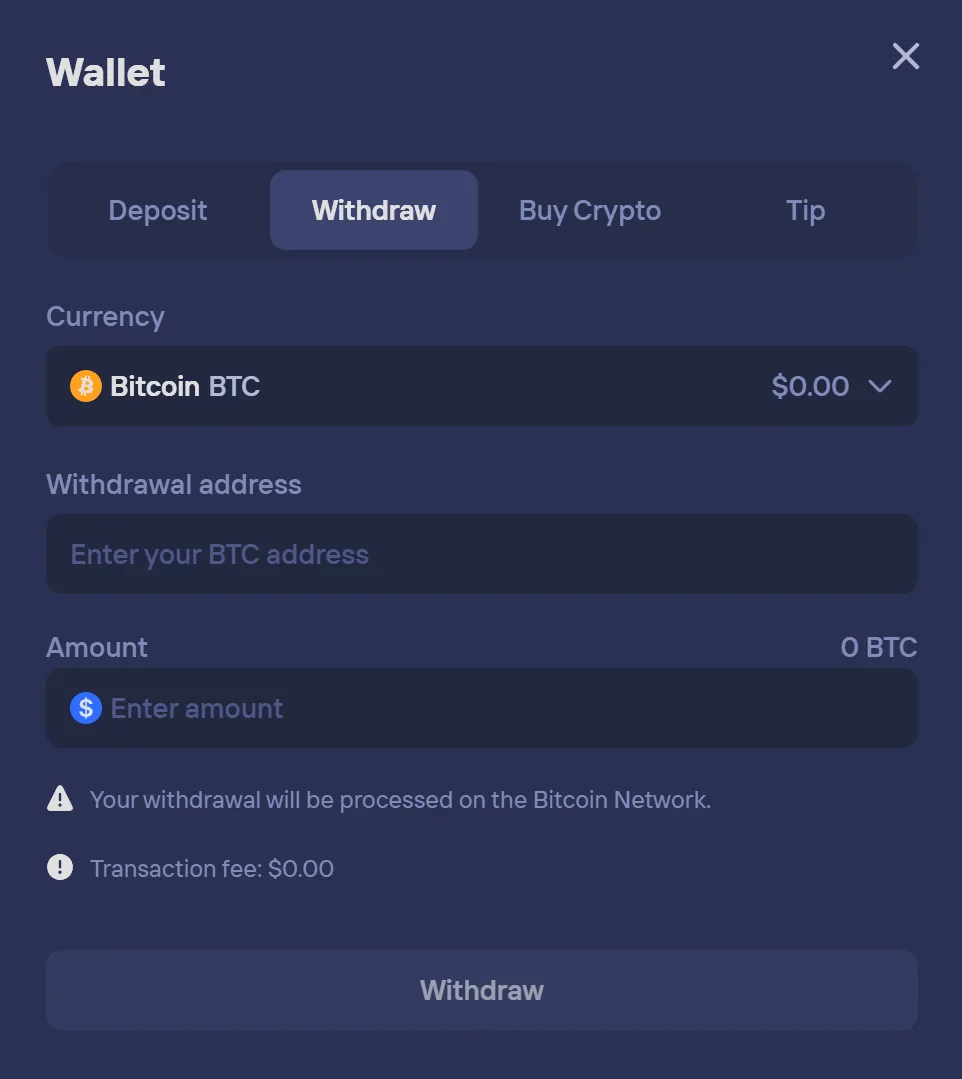
When you request a withdrawal, the total deduction can be split into up to three independent layers:
- Fixed fee – a constant amount per transaction, set by the casino.
- Percentage fee – a share of the withdrawn amount, set by the casino.
- Network fee – miner or validator fees required by the underlying blockchain.
Some casinos bundle these into one label, e.g. “withdrawal fee: 0.0002 BTC”. That single figure may be a flat charge or a rebroadcast of the current network fee. The distinction matters because network fees fluctuate and are not controlled by the casino.
| Fee type | Set by | Typical behavior | Verifiable on-chain |
|---|---|---|---|
| Fixed | Casino | Constant regardless of amount | Compare with TX outputs |
| Percentage | Casino | Linear or tiered by amount | Compute from casino terms |
| Network | Blockchain miners/validators | Variable by mempool congestion | Yes, via block explorer |
Fixed Withdrawal Fees
How Does This Compare to 0% House Edge Protocols?
Audited 100% RTP
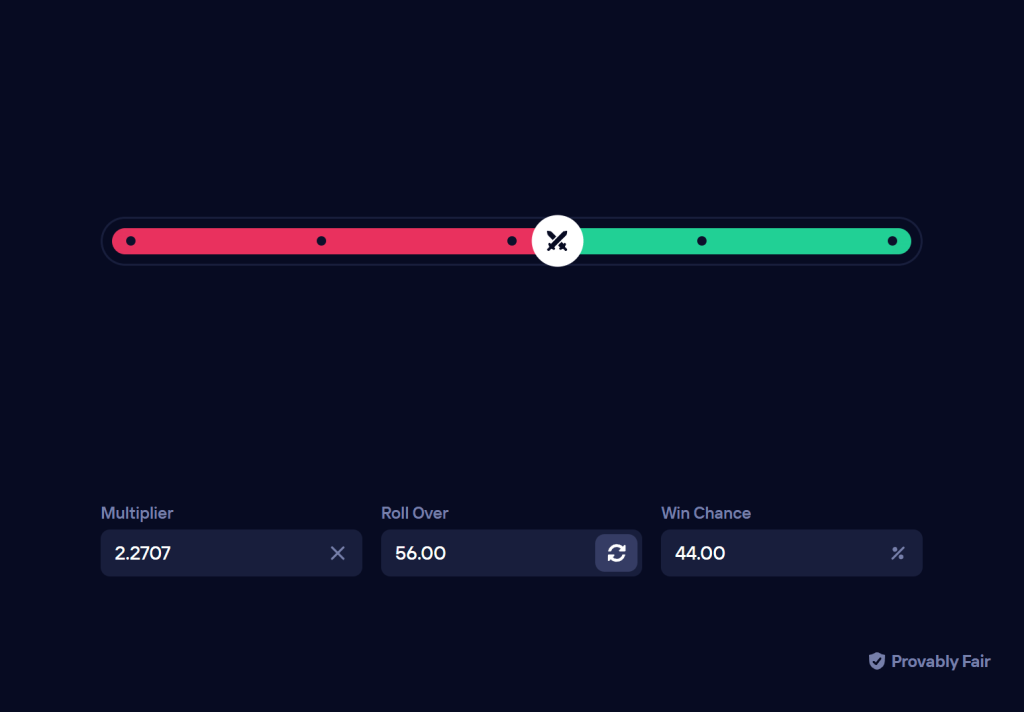
Instead of standard 1.00% to 4.00% casino house margins, compare with mathematically verified 100% RTP Originals (0.00% House Edge) on Duel Casino:

A fixed fee is the easiest to model. If a casino charges 0.0002 BTC for every Bitcoin withdrawal, your cost is constant whether you withdraw 0.001 BTC or 0.1 BTC. That penalizes small withdrawals: the fee as a percentage of your payout increases as the amount shrinks.
Examples of what to check in the casino’s terms or review pages:
- The exact amount in the settlement currency (BTC, ETH, USDT).
- Whether the fee is the same across all payout methods.
- Whether a separate fee applies to manual payouts vs. auto-payouts.
- Whether a zero-fee tier exists after reaching a certain wagered volume.
Fixed fees are often used to cover the casino’s own transaction costs, but they can exceed the current network fee. The only reliable comparison is to calculate the fee as a percentage of your intended withdrawal amount and compare it with the current network fee for the same asset.
Percentage-Based Fees
A percentage fee is a direct reduction of your payout: withdraw 1,000 USDT with a 0.5% fee and you receive 995 USDT. These are most common on fiat-to-crypto ramps, but some crypto casinos apply them to balance conversions or to withdrawals processed in an alternative currency.
Mathematical note: a percentage fee is multiplicative. It does not change with network congestion, so it is fully predictable. What is often less predictable is how the casino computes the percentage. Check whether the percentage applies to the gross withdrawal amount or to the amount after subtracting the network fee. Example: on a 1,000 USDT withdrawal with a 0.5% fee and a 1 USDT network fee, the casino might charge 5 USDT or 4.995 USDT. Both are valid, but they reflect different formulas.
Because percentage fees scale with the amount, they matter most for large cashouts. For players who regularly withdraw smaller amounts, the fixed fee usually dominates. Knowing your own withdrawal frequency is a prerequisite for comparing structures—see common bankroll management practices around session cashouts.
Network Fees and Mempool Congestion
Network fees are set by miners or validators, not by the casino. On Bitcoin, fee is paid in sat/vB; on Ethereum, in gwei; on Tron/TRC20, in energy or bandwidth plus a small TRX fee. These values change every block and can spike during congestion. A casino cannot meaningfully “eat” the network fee unless it covers it from its own funds, which some do during promotions, but that is an accounting decision, not a network property.
What you can verify independently:
- Before confirming a withdrawal, check a block explorer’s fee estimate for the same asset and priority level.
- After withdrawal, use the TXID to see the actual miner fee paid by the casino.
- Compare the fee output in the transaction with the fee deducted from your casino balance. The difference is the casino margin.
This last check is the most concrete. If your balance decreased by 2 USDT and the on-chain transaction paid 1.2 USDT to miners, the casino kept 0.8 USDT. That is not necessarily abusive—it may be a stated service fee—but it is visible, and visibility is the point.
Comparing Real Costs: A Checklist
To compare two casinos on a specific asset at a specific time:
- Choose the amount you actually intend to withdraw, not the maximum displayed.
- Read the casino’s fee schedule in the relevant currency.
- Check the current network fee estimate for that asset.
- Compute total deduction = fixed fee + percentage fee + network fee (unless the casino states it absorbs network fees).
- Compute total deduction as a percentage of your withdrawal amount.
- Repeat the same calculation for a lower amount, e.g. half or a quarter, because the ranking of casinos can invert with withdrawal size.
A common error is comparing the displayed “fee” values without knowing whether they include network costs. Our guides on payout mechanics cover this distinction in more detail, but for a quick check: ask for a tiny test withdrawal. The resulting TXID tells you the true network cost.
Expected Cost vs. House Edge
It may be useful to think of a withdrawal fee as an additional negative expected value event that occurs when you cash out. Suppose you play a game with a 1% house edge and a 99% RTP. The house edge applies to every wagered dollar. A withdrawal fee is a one-time cost, but its relative size can overwhelm a session’s expected profit if the withdrawal is small.
Example: you won 50 USDT and want to withdraw it. If the fee is a flat 2 USDT, that is 4% of your payout. To pay for that fee, you would need to wager an additional 200 USDT on a 1% house-edge game just to break even on the fee. That is not a recommendation to wager more—it is a reminder that the fee is part of the total price of playing, not an afterthought.
How to Verify Before You Deposit
Do not rely solely on the bonus page or a comparison table. What to check:
- The casino’s terms and conditions: search for “withdrawal fee”, “network fee”, “miner fee”.
- A small deposit and tiny withdrawal test: this costs only the network fee itself.
- Independent casino reviews that list fee schedules and update them; but confirm against the live terms before verifying.
- Block explorer data for any withdrawal you have made.
If a casino’s fee schedule is not available before registration or deposit, treat that as a warning. Transparent operators publish fees by asset and usually show the network fee component separately.
FAQ
Why does the withdrawal fee sometimes change after I request it?
Because network fees are dynamic. If the casino deducts a fixed amount when you request the withdrawal but sends the transaction later, the fee actually paid to miners may differ. Some casinos adjust later, some do not; check the terms to see which model they use, and verify with the TXID.
Are no-fee withdrawals really free?
Only if the casino covers network fees from its own revenue. In that case you still pay an opportunity cost, and the casino may compensate through wider spreads or lower game RTP. Verify by comparing the deducted amount with the on-chain miner fee; a zero deduction together with a non-zero miner fee means the casino is subsidizing your withdrawal.
Which fee type should I prefer?
It depends on your withdrawal size and frequency. Fixed fees are better for large, infrequent withdrawals; percentage fees can be better for small withdrawals if the rate is low. Network fees are unavoidable and asset-specific, so compare the same asset across casinos and at the same network congestion level.