
RTP Verification for Slots: What You Can and Cannot Check

the author
ProvablySmart Research Desk
date post
Aug 28, 2026

Share


RTP (return-to-player) figures are the most quoted number in slot marketing and the least verifiable by the average player. An advertised RTP of 96.2% describes a theoretical long-run average over millions of rounds, not a promise about the next 1,000 spins. As of 2026, the gap between the advertised figure and the checkable record remains the core problem in casino verification. This article separates what a skeptical reader can actually check — seeds, hashes, aggregate statistics, and the math behind them — from what still requires an operator to be honest about its own numbers.
What RTP Is, and Where the Number Comes From

RTP is the expected fraction of total wagered amounts returned to players as the number of rounds approaches infinity. If a slot has RTP = 0.96, the expected loss per unit wagered is 0.04. In principle, that value is computable from two pieces of information: the paytable (every win amount and the probability of the outcome that produces it) and the symbol-weighting of the reels. If both are published, any analyst can recompute the RTP exactly. The catch is that most operators publish the paytable but not the symbol frequencies, and almost never the internal mapping from random numbers to reel positions. The advertised number is therefore a claim, not a computation the player can reproduce.
What You Can Check: Seeds, Hashes, and Deterministic Generation
How Does This Compare to 0% House Edge Protocols?
Audited 100% RTP
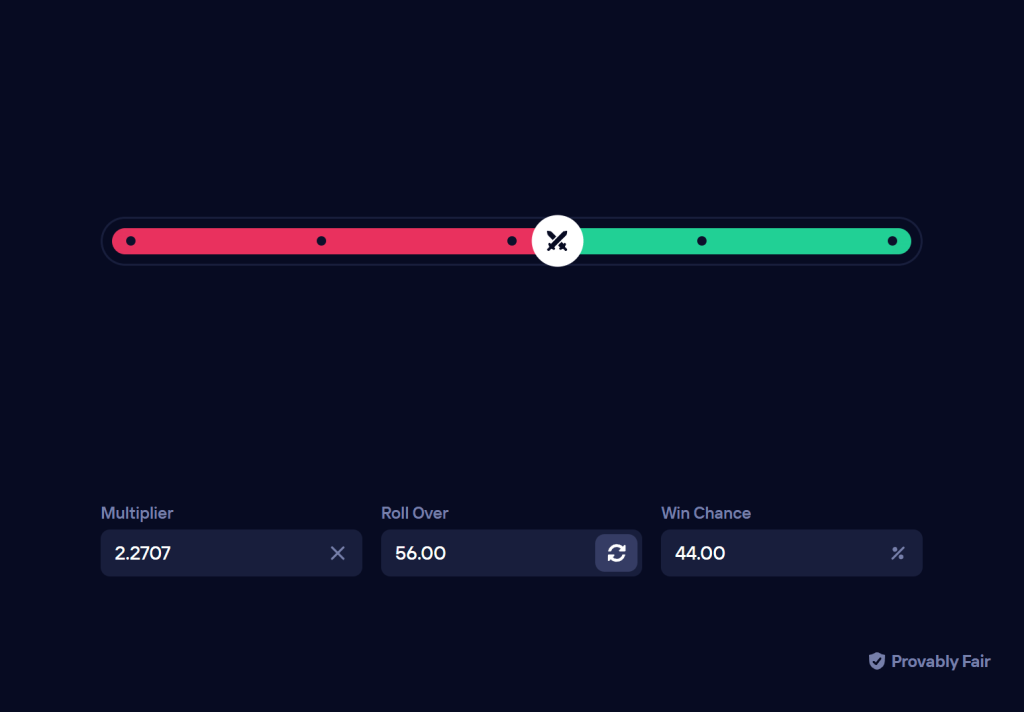
Instead of standard 1.00% to 4.00% casino house margins, compare with mathematically verified 100% RTP Originals (0.00% House Edge) on Duel Casino:

Provably fair slots typically work like this: the operator pre-commits to a server seed by publishing its SHA-256 hash; the round result is derived deterministically from the server seed, a client seed chosen by the player, and a nonce; after the round, the server seed is revealed. The player can then recompute the result using the documented derivation function and compare it to what was shown. This proves two things: the operator could not select the outcome after seeing the bet, and the player could not predict it before. Our guide to provably fair verification shows the exact hashing and recomputation steps.
What this protocol does not prove is that the random number was mapped to a payout table with the claimed RTP. If the mapping is kept hidden, the operator can define the effective symbol probabilities after the fact. To compute RTP, you need the mapping and the weights — not just a provably random number. A game is fully verifiable only when both the RNG layer and the payout mapping are disclosed.
What you can check yourself: the pre-committed hash matches the revealed seed; the derivation function is the documented one; your own round results recompute correctly; and the operator cannot retroactively change previously revealed seeds.
What You Can Check: Statistical Aggregates at Scale
Individual spin results are random, but aggregates converge. If an operator publishes total wagers and total payouts per game, the observed RTP can be tested against the advertised value using a confidence interval. This is the only statistically meaningful way to check a live game, and the math is straightforward.
Let p be the advertised RTP and B the bet size. Over N rounds, expected total payout is N·B·p. If the standard deviation of one round’s payout (in units of B) is σ, the standard error of the observed RTP is σ / √N, and the 95% confidence interval is roughly p ± 1.96·σ / √N. The value of σ is not the same as RTP: slot payout distributions are heavily skewed, so σ is commonly 2–5 times the bet even when RTP is near 96%. The table below shows what this means.
| Rounds (N) | Standard error (σ=4) | 95% CI width (±) |
|---|---|---|
| 1,000 | 0.126 | ±24.8% |
| 10,000 | 0.040 | ±7.8% |
| 100,000 | 0.013 | ±2.5% |
| 1,000,000 | 0.004 | ±0.78% |
Example: with p = 0.96, σ = 4, and N = 1,000,000, the 95% interval is 0.960 ± 0.0078. An observed RTP of 94.5% over that sample would be roughly two standard deviations below expectation — a red flag that warrants formal testing. At N = 10,000, the interval widens to ±7.8%, meaning a single player session of even 20,000 spins cannot distinguish a 93% slot from a 96% slot. This is why personal play-testing is statistically useless for RTP verification, and why only per-game aggregates over hundreds of thousands of rounds are informative. The same variance math underpins bankroll sizing, as covered in our bankroll management guide.
On-chain games offer a stronger version of this check. If every round is recorded in a smart contract or on a public ledger, you can recompute total wagers, total payouts, and per-game RTP directly from the chain. The aggregate is then independently auditable by anyone, and the only remaining question is whether the sample size is large enough to make the test sensitive.
What You Cannot Check
- You cannot verify the internal payout mapping of a closed game. If the operator does not disclose how random numbers map to symbols and paylines, the claimed RTP is uncomputable. Provable fairness of the RNG does not fix a hidden mapping.
- You cannot verify self-reported aggregate statistics. A casino that publishes a CSV of total bets and payouts can filter, cherry-pick periods, or simply misreport. Unless the aggregation comes from an auditable on-chain log or an independent auditor with access to the underlying data, it is marketing.
- You cannot verify RTP in real time. Live ‘current RTP’ meters are only meaningful if the underlying round stream is tamper-evident and the meter’s formula is documented.
- You cannot verify that the game you play today has the same RTP as the one you played last month. A paytable or reel-mapping update can move RTP by a full percentage point without changing the game’s name. Check version histories or changelogs; if the logic lives in a smart contract, check whether the contract is upgradeable.
- You cannot infer the shape of the payout distribution from RTP alone. Two 96% slots can have drastically different hit rates, volatility, and jackpot behavior. RTP is one number in a full distribution; it says nothing about how often you win or how large the wins are.
A Minimal Verification Checklist
Practical steps to minimise what is taken on trust:
- Confirm the operator publishes pre-committed server seed hashes and the derivation algorithm; our provably fair explainer lists what a proper implementation must expose.
- Verify your own past rounds recompute to the same result, and that revealed seeds match their pre-committed hashes.
- Prefer games where aggregate bet/payout data is on-chain or produced by open-source aggregators, and recompute the totals yourself where feasible.
- Treat published RTP tables as claims. Check whether the review claiming a verified RTP has actually seen the payout mapping, or is merely restating the operator’s page — many casino reviews do not cross this bar.
- Apply the confidence-interval formula before drawing conclusions from any observed RTP figure. If the sample size is a few thousand spins, the number proves almost nothing.
FAQ
Can I verify a slot’s RTP from my own spin history?
No. A typical slot with σ = 4 (in bet units) needs roughly one million spins to bring the 95% confidence interval close to ±1% around the advertised RTP. A personal session of 5,000–20,000 spins has an interval of several percentage points, which is wider than the difference between a 93% and a 96% slot. Personal play logs are not statistical evidence.
What does provably fair actually prove with respect to RTP?
It proves the round result was generated deterministically from a server seed committed before the bet, a client seed, and a nonce — so the operator could not alter that round after placement. It does not prove the mapping from the random number to the payout table is honest. If the casino does not disclose the complete mapping and symbol weights, provable fairness says nothing about whether the claimed RTP is accurate. Both layers must be open for full verification.
If a casino publishes aggregate RTP data, is that enough?
Only if the data source is itself auditable. On-chain round logs with an open-source aggregation script can be cross-checked by anyone, and that is real evidence. A dashboard or CSV on the casino’s own site is self-reported: it can be filtered, period-selected, or fabricated. Check whether you can reproduce the published totals from raw records, whether the time window and exclusions are documented, and whether an independent party has access to the underlying log. If none of that exists, the aggregate is a marketing claim with the same trust level as the RTP figure itself.