Common Provably Fair Implementation Mistakes Players Can Detect

the author
ProvablySmart Research Desk
date post
Aug 28, 2026

Share


Provably fair is a cryptographic verification mechanism that allows players to independently check whether a game’s outcome was generated fairly. In theory, any player can compute the result from a combination of a client seed, a server seed, and a nonce. In practice, however, implementation errors can break the fairness guarantee. Players who understand the underlying mathematics can detect these mistakes and avoid casinos that cut corners. This article catalogues the most frequent implementation flaws and explains how to catch them.
Mistake 1: Mismatched Seed Lengths or Hash Algorithms
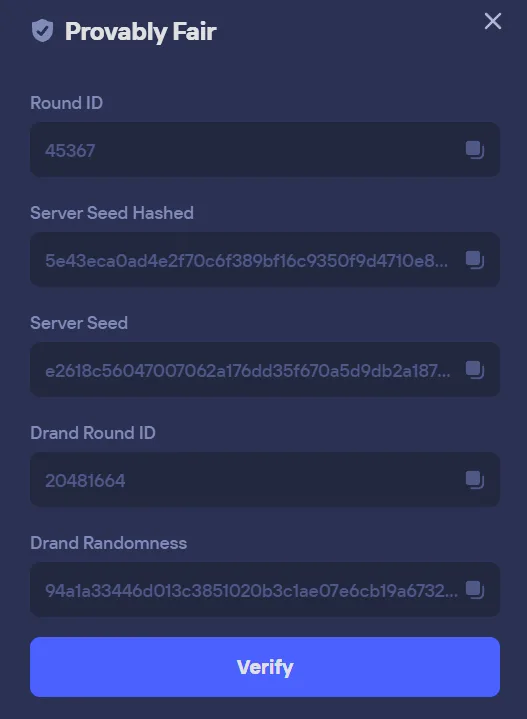
Most provably fair systems use a hash function (SHA-256, SHA-512, etc.) to combine the client seed, server seed, and nonce. The documented algorithm should specify the exact seed lengths and hash function. A common mistake is using a seed that is too short or a hash that is not the one described. For example, if the casino states that the server seed is 128 bits but the actual seed is only 64 bits, the entropy is reduced, and the system may be predictable.
Players can detect this by recording the hash of the server seed that is presented before the round and then comparing it to the seed revealed after the round. If the hash of the revealed seed does not match the previously published hash, the casino may have altered the seed mid-game. Similarly, if the casino claims to use SHA-256 but the revealed seed’s hash length is 32 bytes (standard for SHA-256), but the seed itself is not 32 bytes, the algorithm is inconsistent. Verification can be done using any standard hash tool.
Mistake 2: Insufficient Entropy in Seed Generation
How Does This Compare to 0% House Edge Protocols?
Audited 100% RTP
Instead of standard 1.00% to 4.00% casino house margins, compare with mathematically verified 100% RTP Originals (0.00% House Edge) on Duel Casino:
If the server seed is generated using a weak random number generator (e.g., Math.random() in JavaScript without cryptographic seeding), an attacker (or a player) might be able to predict future seeds after observing a handful of them. A common sign is that seeds appear to repeat or follow a simple pattern. Players can collect a sequence of server seeds (from the game history, if available) and test whether they pass common randomness tests, such as the Monobit test or the Runs test. Many casinos now include a seed_hash field in the game history; if the same seed hash appears twice, that is a red flag.
Another indicator is that the server seed is never changed between rounds. Each round should have a new nonce, but the server seed should also be rotated periodically (e.g., every 1000 bets). If the same server seed is used for thousands of rounds without a new seed hash being published, the effective entropy may be lower than expected.
Mistake 3: Nonce Mismanagement and Reuse
The nonce is a counter that must be strictly incremented for each bet under the same client seed. Some implementations accidentally reuse the nonce (e.g., due to a race condition in the database) or reset it after a server seed change. When a nonce is reused, the same seed combination yields the same game outcome, which breaks the independence of rounds. Players can detect this by checking the game history of their own account: if two bets have the same client seed, server seed, and nonce, the outcomes are identical. Even if the casino only shows the outcome, the player can compute the expected result using the stated algorithm and compare.
More subtle: the nonce might be incremented, but the casino might have a bug where the nonce is not actually used in the hash computation. Instead, the system might rely solely on the client seed and server seed, meaning that the same pair always produces the same result regardless of the nonce. This can be detected by making two bets with the same client seed and server seed but different nonces (which normally should be impossible if the client seed is fixed, but the player can change the client seed manually) and seeing if the outcomes differ. If they are identical, the nonce is ignored.
Mistake 4: Incorrect Outcome Derivation from the Hash
Even if the seeds and nonce are correct, the method of converting the hash into a game result can be flawed. Common mistakes include:
- Using only a portion of the hash (e.g., the first 4 bytes) instead of the entire hash, leading to a biased distribution.
- Applying a modulo operation without proper rejection sampling, causing a small bias toward lower numbers. For example, if the hash is treated as a 256-bit integer and then reduced modulo 10,000, numbers with residues 0–9999 are not uniform if the hash space is not divisible by 10,000.
- Using the wrong endianness or byte order when converting the hash to a number.
Players can detect these issues by collecting a large sample of game outcomes (e.g., 10,000 rounds) and comparing the observed distribution to the expected distribution. For a simple dice game, the expected frequency of each number should be 1/10,000. A chi-squared test can reveal statistically significant deviations. Many casinos publish the exact algorithm; players can implement it in a script and verify that the outcomes match.
Mistake 5: Failure to Reveal the Server Seed After Use
The core of provably fair is that the server seed is committed to before the round (via a hash) and revealed after the round. Some casinos delay the revelation indefinitely, or only reveal the seed upon request but not automatically. If the server seed is never revealed, the player cannot verify the fairness of past rounds. Players should check the game history page: after each round, the server seed should be displayed in plaintext, along with the nonce. If the casino only shows the hash but not the actual seed, or if the seed is only shown after a manual request, the verification is not truly transparent. Reputable casinos automatically reveal the seed after each round or after a batch of rounds.
Mistake 6: Censoring or Altering Game History
Even if seeds are revealed, the casino might modify the game history (e.g., delete a round that lost) or retroactively change the nonce. To prevent this, the game history should be immutable and ideally signed or stored on a blockchain. Players can check if the casino provides a verifiable log of all rounds, such as a Merkle tree or a signature for each round. If the game history is only stored in a database that the casino controls, there is a risk of manipulation. Players can verify the integrity of the history by checking that the hash of the previous round is included in the current round’s data, similar to a blockchain. If the casino does not provide a chain of hashes, the history may be malleable.
How to Perform Your Own Verification
To catch these mistakes, you need to know the exact algorithm the casino claims to use. Most casinos publish a verification guide that explains how to compute the outcome. Follow these steps:
- Record the client seed, server seed (hash before round), and nonce before the round starts (often available in the browser console or game page).
- After the round, retrieve the revealed server seed and the actual outcome.
- Compute the hash of the server seed and compare it to the pre-round hash. If they match, the seed was not changed.
- Combine the seeds and nonce as per the algorithm (e.g.,
SHA256(client_seed + server_seed + nonce)). - Convert the hash to the game result using the stated method. Compare to the actual outcome.
If the outcome does not match your computed result, the casino is either using a different algorithm or has an implementation bug. You can also check the casino reviews for reports of verification failures. For statistical checks, collect at least 10,000 outcomes and perform a chi-squared test. If the p-value is below 0.01, the distribution is likely biased.
Conclusion
Provably fair is a powerful tool, but it is only as strong as its implementation. Players who invest time in verifying the algorithm and checking for common mistakes can protect themselves from unfair games. Remember that even a minor oversight—like a missing modulo rejection or a nonce reuse—can tilt the house edge in the casino’s favor. Always verify a few rounds manually before committing significant funds, and consider using a separate bankroll management strategy to limit exposure. As the industry matures in 2026, more casinos are adopting transparent verification, but the responsibility remains on the player to check.
FAQ
Can a player really detect a biased provably fair implementation?
Yes, but it requires statistical analysis. For games with a finite number of outcomes (e.g., dice, crash), collecting a large sample (e.g., 10,000 rounds) and comparing the observed distribution to the expected distribution using a chi-squared test can reveal biases. Biases due to modulo errors, truncation, or weak entropy will show up as statistically significant deviations from the expected frequencies.
What should I do if I find that the server seed hash does not match the revealed seed?
This is a serious red flag. It means the casino either changed the seed after the round or the hash algorithm is inconsistent. Immediately stop playing and contact the casino’s support. If the issue is not resolved, report the casino to a regulatory body and consider sharing your findings on forums or in news reports. Do not continue playing until the casino proves the system is fair.
Is it possible for a casino to cheat even if the provably fair system seems correct?
Yes, if the casino controls the client seed generation (e.g., by providing a pre-generated client seed) or if the player cannot change the client seed, the casino can still manipulate outcomes by choosing a server seed that, when combined with the fixed client seed, produces a desired result. To be fully fair, the player must be able to choose their own client seed and the casino must commit to random server seeds. Check if the casino allows you to set your own client seed and whether the seed changes are enforced before each round.