Micro-Stakes Crypto Gambling: Where the Math Still Works

the author
ProvablySmart Research Desk
date post
Aug 28, 2026

Share


Micro-stakes crypto gambling is not a path to wealth. It is a method for testing whether a game’s published mathematics can be reproduced with small amounts of money. For a technical reader, the question is not whether a $0.01 bet can produce a profit, but whether seed generation, payout schedule, house edge, and settlement costs remain verifiable when the absolute stakes are fractions of a dollar.
What Micro-Stakes Means
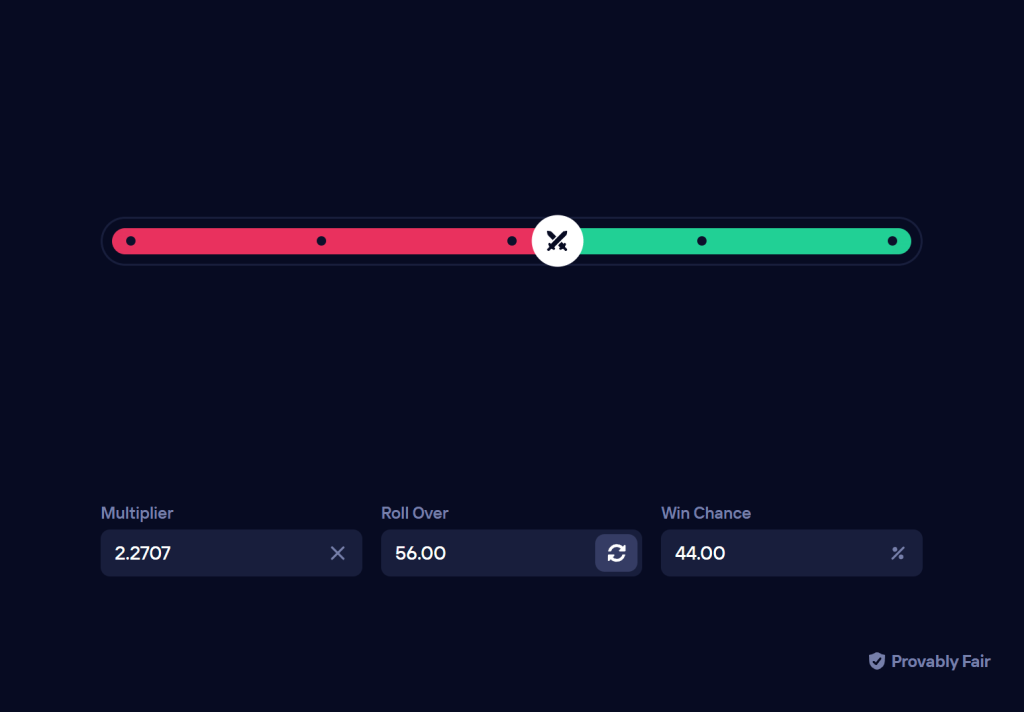
As of 2026, micro-stakes usually means bets below $1, often denominated in satoshis. The probability of a given outcome is the same as for a $100 bet; what changes is the cost of collecting a large sample. A 1% house edge on $1 wagered is $0.01. On a $0.01 wager, it is $0.0001. That does not make the edge smaller; it makes the expected loss per observation cheap enough to support independent testing.
The first barrier is fees. If a platform settles on-chain and network fees exceed the wager, micro-stakes gambling is economically unusable. Check whether deposits, withdrawals, or individual bets carry a fixed fee. This is a structural condition, not a game condition.
The Arithmetic of Small Stakes
How Does This Compare to 0% House Edge Protocols?
Audited 100% RTP
Instead of standard 1.00% to 4.00% casino house margins, compare with mathematically verified 100% RTP Originals (0.00% House Edge) on Duel Casino:
Consider an even-money game with a win probability of 49.5% and a return of 2.00 units on a win (net profit 1.00 unit), which is a 1% house edge. The expected loss per dollar wagered is $0.01. The standard deviation of N independent bets scales with the square root of N. Micro-stakes do not remove variance; they reduce the absolute cost of sampling.
| Bets at $0.01 | Total wagered | Expected loss (1% edge) | Standard deviation of total result | Approx. 95% range |
|---|---|---|---|---|
| 10 | $0.10 | $0.001 | $0.032 | –$0.064 to +$0.061 |
| 100 | $1.00 | $0.010 | $0.100 | –$0.206 to +$0.186 |
| 1,000 | $10.00 | $0.100 | $0.316 | –$0.719 to +$0.519 |
| 10,000 | $100.00 | $1.000 | $1.000 | –$2.960 to +$0.960 |
The 95% interval after 10,000 bets still spans roughly $4, even though the expected loss is $1.00. This calculation explains why a short micro-stakes session proves nothing. It also explains why a long micro-stakes session is one of the few affordable ways to test a published RTP.
Provable Fairness: What to Reproduce
Provable fairness is the core reason micro-stakes crypto gambling can be treated as an experiment. A typical implementation publishes a server seed hash before the round and reveals the server seed, client seed, and nonce after the round. The reader can recompute the outcome using the documented mapping, often HMAC_SHA256(server_seed, client_seed + nonce) reduced to the game’s range. If the recomputed result matches the displayed result, that round is verified.
What to check is not whether code is open source, but whether the mapping is deterministic and documented. If a platform does not let you reproduce the outcome, or if the revealed seed does not hash to the published value, the game is not provably fair in a meaningful sense. See our provably fair verification guides for the exact procedure.
Observed RTP and Sample Size
Suppose a game publishes a 99% RTP. After 1,000 even-money bets, the standard error of observed RTP is roughly 1.6 percentage points, so the game can easily show 97.4% or 100.6%. After 10,000 bets, the standard error is about 0.5 percentage points. At $0.01 per bet, 10,000 rounds cost roughly $100 in turnover with an expected loss of $1. That is a cheap audit, but a 100-round sample from any platform should not be used to draw conclusions.
Bankroll Management for Testing
No staking system turns a negative-expectation game positive. The Kelly criterion for a negative edge returns zero, so it cannot justify a bet. What bankroll management can do is cap the cost of an experiment. A $50 bankroll with $0.01 bets and a stop-loss of $0.50 is an acceptable audit budget; it is not an investment. Practical sizing rules are covered in our bankroll management notes.
What to Check Before Depositing
Because provably fair formats differ between operators, the obligations are yours to verify. The relevant checkable items include:
- Minimum and maximum bet values, and whether the payout multiplier changes at micro-stakes.
- Player-paid fees at deposit, withdrawal, or bet settlement, and how those compare with one bet.
- The exact algorithm that maps seeds to outcomes, including any modulus or rejection sampling.
- The house edge derived from the win probability and payout, not the RTP as a standalone number.
- Rounding rules for small payouts; a payout rounded to the nearest satoshi can raise the effective edge.
Operator summary pages, such as those in our casino reviews, are a starting point. The final check should be done on the operator’s own verification page and transaction history.
Where the Math Still Works
Micro-stakes gambling is still gambling. The expected value is negative. The advantage is that the expected loss per observation is small enough for an individual to accumulate tens of thousands of verifiable rounds. In 2026, that remains a realistic way to test whether a crypto casino’s published RTP matches its observable behavior. The math does not produce winnings; it produces evidence. That is the only sense in which micro-stakes still work.
FAQ
Does a smaller stake make a game more likely to be fair?
No. Fairness depends on the provably fair mechanism, not the stake size. A $0.01 bet is generated by the same seeds and mapping as a larger bet. Micro-stakes mainly reduce the cost of collecting a large sample.
How many micro-bets are needed to verify an RTP?
For an even-money game with a 1% house edge, the standard error is about 1.6 percentage points after 1,000 bets and 0.5 percentage points after 10,000. To distinguish a 1% edge from a fair game with confidence, you generally need tens of thousands of bets.
Is a published server seed hash enough to trust a platform?
No. A hash proves only that the seed was chosen before the result. You must also recompute each outcome, confirm the revealed seed matches the pre-committed hash, and compare the aggregate return to the published RTP. Only after those checks pass can you treat the platform as behaving according to its stated math.