Limbo Multipliers: Verifying Extreme Outcomes Without Taking Losses

the author
ProvablySmart Research Desk
date post
Aug 28, 2026

Share


The common advice for verifying a 10,000x limbo multiplier is to bet one unit and watch the payout. That is a technically valid test, but it carries a cost: every wager carries a negative expected value equal to the house edge. A different path is to verify the outcome deterministically, from the seed data alone, so no money ever leaves your bankroll. This article explains how limbo outcomes are computed and how you can audit extreme multipliers without paying for the privilege. As of 2026, most provably fair limbo games follow the same basic structure, making zero-cost verification possible.
The provably fair data path
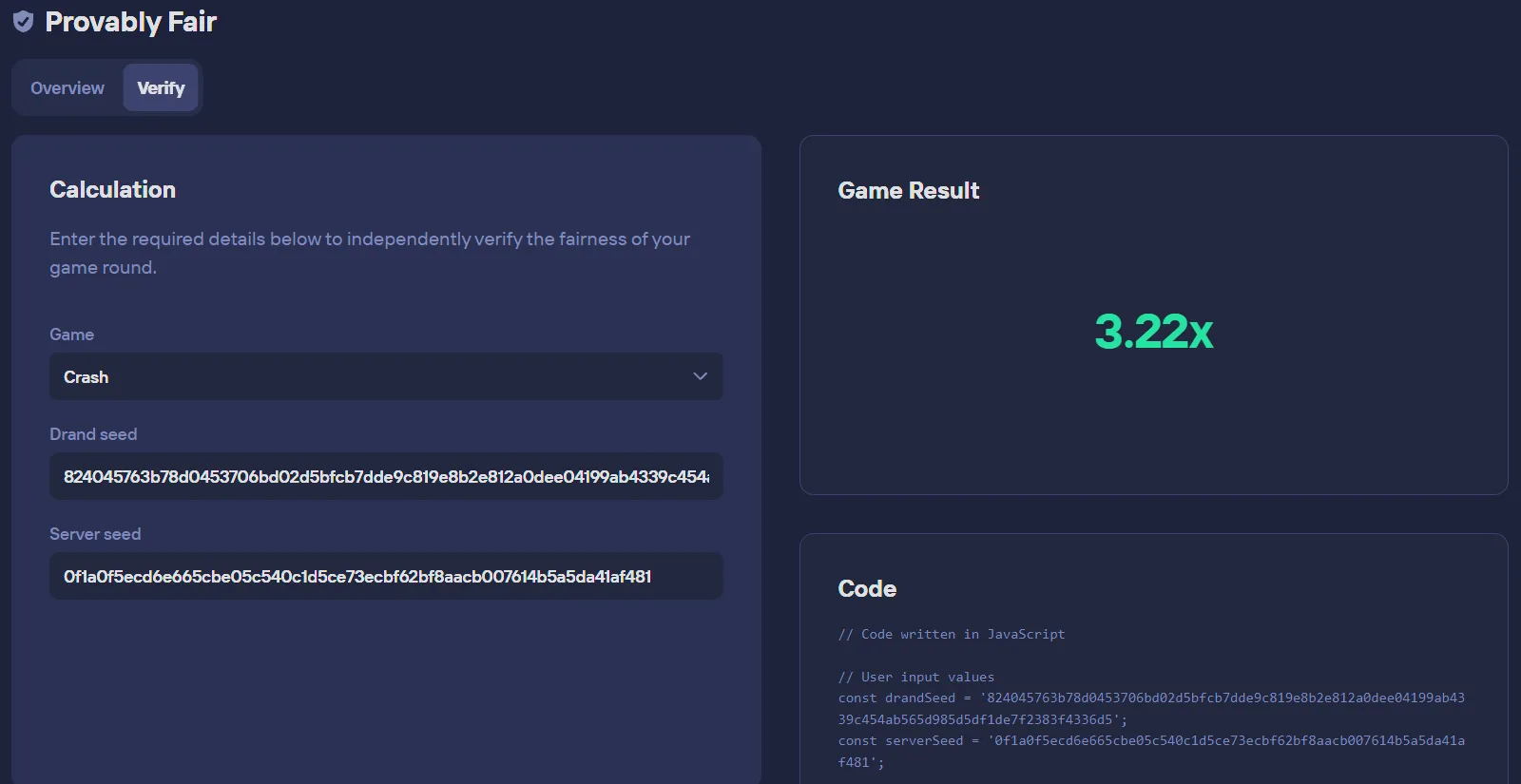
In a provably fair limbo game, each round is not a random event at the moment of the spin. It is the result of a deterministic function applied to three inputs: the server seed, the client seed, and a round-specific nonce. The operator publishes a commitment to the server seed, usually an SHA-256 hash, so the actual seed cannot be changed after the nonce sequence is exposed.
A common implementation generates a 52-bit integer from an HMAC-SHA256 digest of the concatenated seeds and nonce, normalizes it to a real number in [0,1), and transforms that number into a multiplier using the inverse CDF of an exponential distribution with an edge parameter. The exact mapping is irrelevant to the verification principle: the same inputs always produce the same multiplier. The only values you need to reproduce the result are the seeds, the nonce, and the disclosed transformation rules.
| Parameter | Meaning |
|---|---|
| Server seed | Random string held by the casino until revealed |
| Client seed | Random string supplied by the player |
| Nonce | Integer increasing by one for each round |
| Commitment | Hashed server seed proving no tampering |
All of those values become available for audit before or after the round. The key point is that verifying the seed path requires no wager. You only need historical data and a small script.
Replaying the game deterministically
How Does This Compare to 0% House Edge Protocols?
Audited 100% RTP
Instead of standard 1.00% to 4.00% casino house margins, compare with mathematically verified 100% RTP Originals (0.00% House Edge) on Duel Casino:
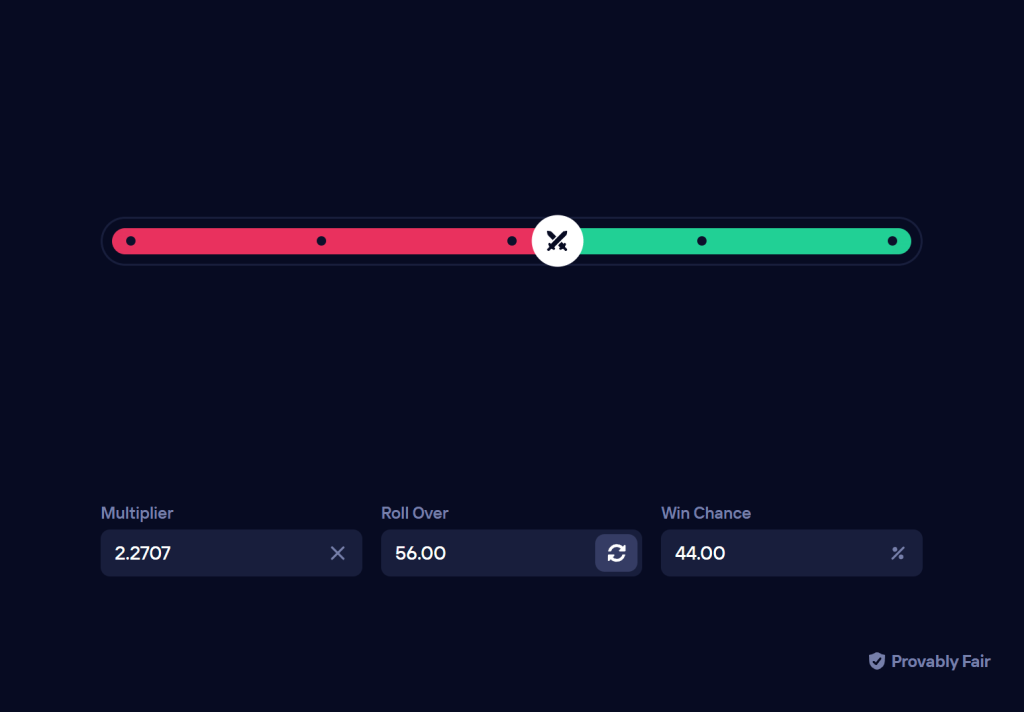

The act of replaying is straightforward. Suppose the casino reveals the server seed after a round. You take that seed, append the client seed and nonce you used, and run the documented hash-to-multiplier function. If the output is exactly the multiplier shown in the casino round history, the game behaved as published. The same calculation, applied to a never-created future round, gives you the outcome you would receive if you had placed a wager.
A minimal verification workflow, using any language with SHA-256 and HMAC support, looks like this:
digest = HMAC_SHA256(server_seed, client_seed + ':' + nonce)
value = parse_52_bits(digest) / 2^52
multiplier = edge_function(value)
For an extreme multiplier target, say 1,000,000x, the computed value is either at or beyond the maximum cap. If the algorithm correctly produces that cap, you have verified a player does not miss a jackpot payout. No bet is needed to learn this.
Extreme multiplier probabilities
The urge to place a small wager to test extreme outcomes is common because house edges seem negligible on one round. The table below shows the probability of hitting a multiplier at a typical 1 percent house edge, using the standard crash-game formula: probability = (1 – house_edge) / target.
| Target multiplier | Probability (1% house edge) | Expected return on $1 wager |
|---|---|---|
| 100x | 0.99% | $0.99 |
| 1,000x | 0.099% | $0.99 |
| 10,000x | 0.0099% | $0.99 |
| 1,000,000x | 0.0000099% | $0.99 |
Every testing wager carries an expected loss of exactly one cent per dollar at 1 percent house edge. That makes wager-based verification a costly statistical test. Running the hash function yields the same information with zero expected loss.
A zero-cost audit workflow
- Read the casino provably fair documentation and confirm which hash function, bit extraction, and multiplier mapping are used. Link the equations to the round history.
- Record the client seed and round nonce before you play. If the casino uses a static client seed, note its value.
- After each server seed rotation, verify that the previously hashed commitment matches the revealed server seed.
- Replay the last few rounds and compare the computed multipliers with the game history.
- Once the pipeline works, compute the extreme multipliers of interest without wagering.
This approach is analogous to running a provably fair verification guide for every game, but with particular attention to the tail of the multiplier distribution.
Boundaries of the verification
Verification has limits, and ignoring them can produce a false sense of certainty. First, the seed commitment only proves the casino did not change the server seed after the round started; it does not prove the initial seed was uniformly generated. A biased server seed can distort the hash stream even if the function itself is sound. You can test for bias by running the algorithm on a large batch of historical nonces, but the casino should also disclose how seeds are generated. For common provably fair software, this information is published in the latest seed protocol updates.
Second, implementation details are easy to miss. The nonce may start at zero rather than one, which shifts every result. The multiplier mapping may cap at a maximum of 10,000x, eliminating the tail beyond that point. The house edge may be applied before or after the cap. These details change the probability of extreme outcomes and the exact expected loss. Always check the operator disclosure against the live result table using a zero-cost replay.
Finally, there is the question of whether the operator will honor an extreme multiplier on a real bet after you verify it. A narrow seed audit cannot prove solvency or willingness to pay. That is why the verification workflow should also include a review of licensing, payment history, and operational track record. The casino reviews section provides relevant background checks.
Once you have confirmed the full data path, betting at high multipliers is no longer the only way to know whether they are reachable. The deterministic RNG means every extreme outcome is present in the seed stream before any money is put at risk.
FAQ
Do I need to place a real bet to verify a limbo multiplier?
No. The outcome is a deterministic function of server seed, client seed, and nonce. Once the server seed is revealed, any round can be reproduced. Placing a wager is only necessary if you want to observe the payout settlement in real time, but that is not needed for verification.
What if the casino only shows the seed hash, not the actual seed?
For history, you need the revealed seed. Most operators using provably fair algorithms reveal the previous server seed at every rotation. If the operator withholds the revealed seed, you can still verify the commitment by comparing hashes after a round, but you cannot replay rounds until the seed is actually released.
How do I know if extreme multiplier probabilities are fair?
Use the documented multiplier distribution and the house edge. For a target multiplier m at a 1% house edge, the theoretical probability is 0.99/m. Compute the expected return and compare it to the casino’s payout schedule. If the actual frequency of hits in historical data diverges from theory by more than a few standard deviations, the implementation may be biased and should be investigated.