Kelly Criterion for Casino Play: When the Math Says Do Not Bet

the author
ProvablySmart Research Desk
date post
Aug 28, 2026

Share


The Kelly criterion is often described as a bet-sizing formula that maximizes the long-term growth rate of a bankroll. In casino games, however, the most useful output of the formula is not a stake; it is the instruction to bet zero. This article explains the math behind that conclusion, shows when a positive Kelly fraction can appear inside a casino, and lists the numbers you can verify yourself using published RTP values, paytables, and bonus terms.
Kelly formula: look at the sign first
For a single bet with probability p of winning, net fractional odds b (profit per unit staked), and probability q = 1 – p of losing, the Kelly fraction f* is
f* = (bp – q) / b
This is equivalent to
f* = (p(b+1) – 1) / b
The numerator is the expected profit per unit staked, usually called the edge. If the numerator is negative, f* is negative. A negative Kelly fraction does not mean you should take the opposite side of the bet; it means you should not make the bet at any positive stake.
For European roulette even-money bet: p = 18/37, q = 19/37, b = 1, so f* = -1/37 = -2.70%. For American roulette: p = 18/38, q = 20/38, f* = -2/38 = -5.26%. In both cases the Kelly fraction equals the negative house edge. The same logic applies to most blackjack bets when the player has no counting edge, baccarat banker/player bets, craps line bets, and any slot machine with RTP below 100%.
Why small stakes are not a compromise
How Does This Compare to 0% House Edge Protocols?
Audited 100% RTP
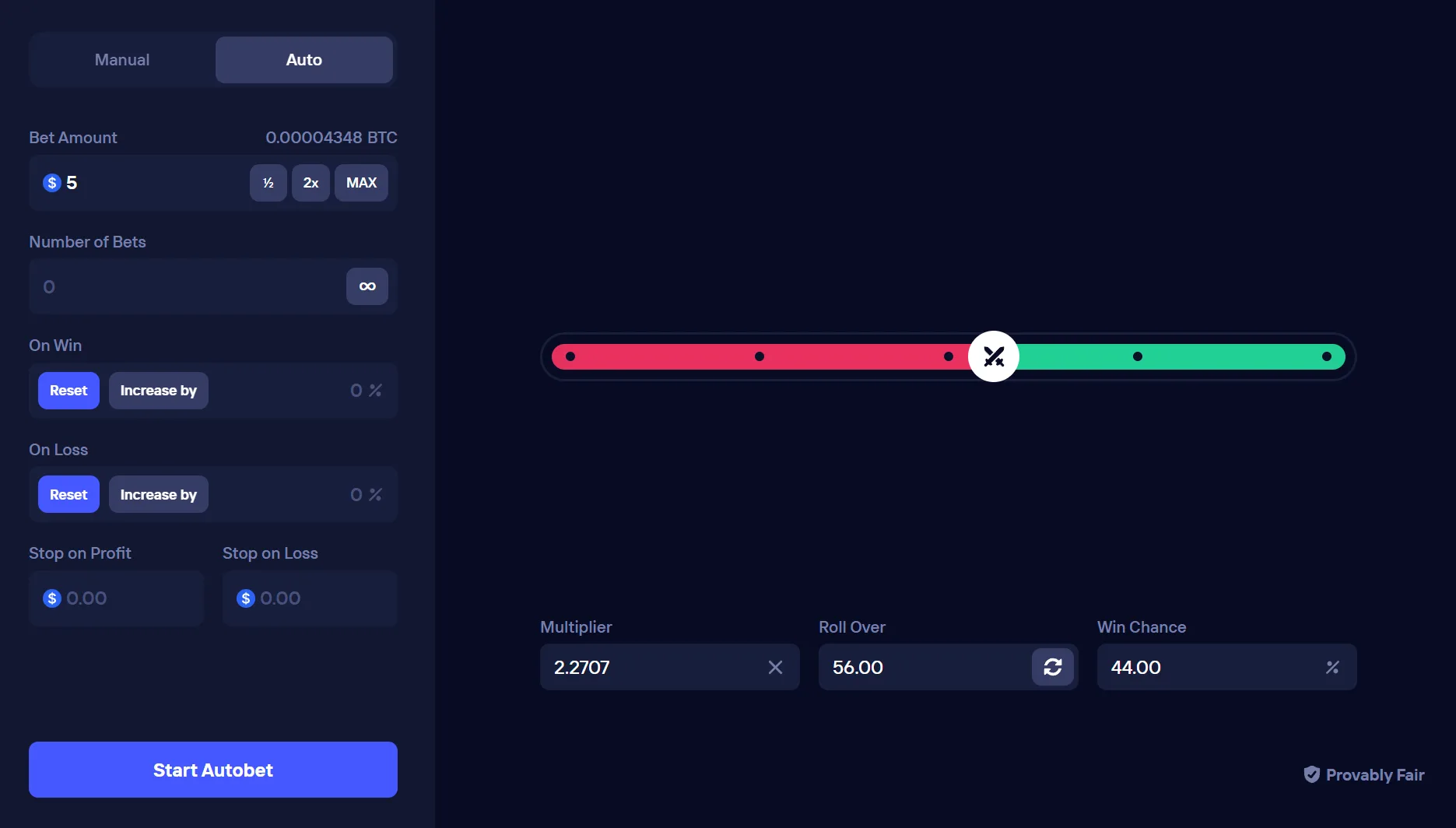
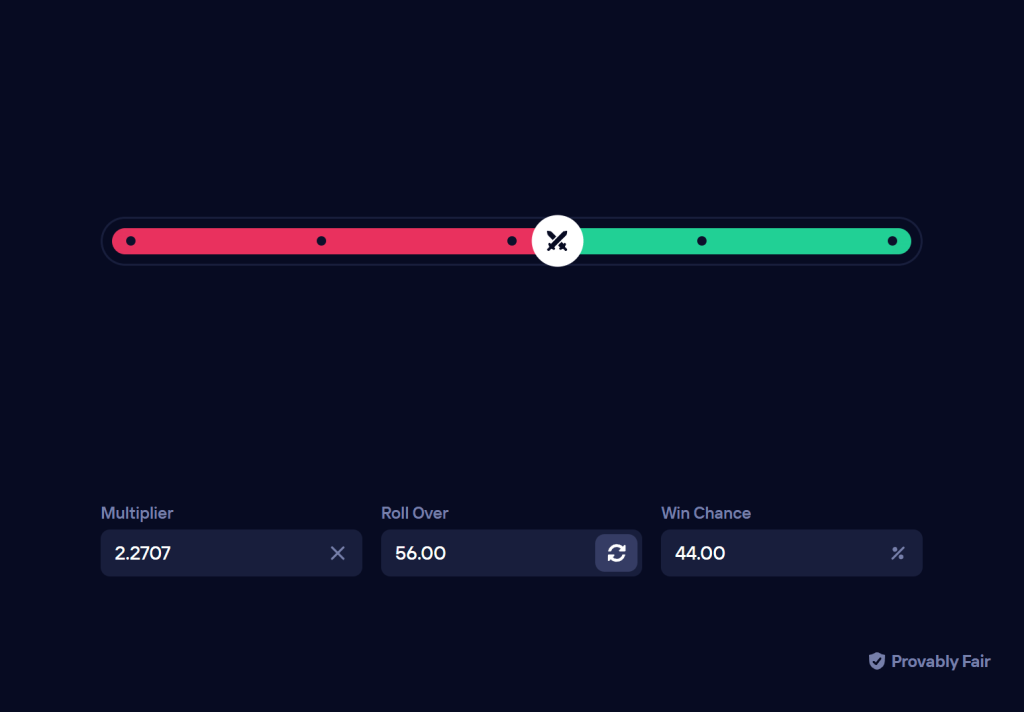
Instead of standard 1.00% to 4.00% casino house margins, compare with mathematically verified 100% RTP Originals (0.00% House Edge) on Duel Casino:

Some players think that reducing the stake is a partial application of Kelly. That is incorrect. Kelly maximizes the expected value of the log of (1 + fX), where X is the net return of the bet. The derivative of that expression at f = 0 is exactly the edge. When the edge is negative, the derivative is negative, and because the function is concave, the maximum is at f = 0. Any positive stake lowers the expected log growth rate. Variance can be entertainment, but it is not part of the Kelly objective.
Flat betting, martingale, or any other staking system changes the distribution of results, not the sign of the expectation. If each unit staked has a negative expected profit, then no staking plan can turn it into a positive Kelly wager.
Only positive edges justify a positive Kelly fraction
Kelly only returns a positive number when the edge is positive. In a casino, that can happen under specific, verifiable conditions:
- Bonuses and promotions. A cash bonus, free bet, or cashback changes the effective payout distribution. If the combined expected value is positive, the play can be modeled as a positive-edge wager.
- Card counting. With a favorable running count and sufficiently deep penetration, the player can have a positive expected value on the next blackjack hand. The edge is not constant and requires skill.
- Mispriced side bets. Some published paytables can have a theoretical return above 100%. This is rare, but because paytables are public, you can calculate it.
In each case, the edge must be computed from rules and paytables, not from belief.
How to calculate the EV of a bonus
For a cash bonus with a wagering requirement, a simple model is:
EV = bonus amount – wagering requirement x house edge
Example: $100 cash bonus with a 35x wagering requirement on slots with 96% RTP gives an expected loss of 35 x $100 x 0.04 = $140, so EV = -$40. Kelly says no bet. If the slot RTP were 97.5%, the expected loss would be $87.50 and EV would be +$12.50. In that unusual case, Kelly may suggest a stake, but you need the exact terms. Game weighting, maximum bet limits, and the timing of the bonus all change the edge. Our bonus and wagering guides explain how to convert those terms into math.
For a bonus with positive EV, the Kelly fraction is still computed with the same formula, but the edge must be estimated across the bonus structure. Many players use fractional Kelly to account for estimation error.
What you can check yourself
The inputs to Kelly are not secret. For table games, the house edge can be derived from published rules. For slots, the theoretical RTP is usually listed in the game information screen or in the casino’s audit report. Independent testing laboratories issue certificates for game integrity; find them on the casino site or in our casino reviews, and check whether the audit certificate is dated in 2026 and matches the game version you are playing.
Provably fair systems let you verify each outcome with client and server seeds. That confirms randomness, not positive expectation. A provably fair game with 96% RTP is still a negative Kelly proposition. Verification is about fairness, not about changing the sign of the edge.
If you ever do have a positive edge
Once the edge is positive, Kelly says to wager a fraction of bankroll proportional to the edge divided by the variance of the bet. For an even-money bet with a 2% player edge, full Kelly is 2% of bankroll. Half Kelly is 1%. Full Kelly maximizes expected log growth but produces severe drawdowns; half Kelly is common in practice. This only matters after you have established a positive edge. It never applies to a negative-expectation casino game.
Keep the bankroll in the formula separate from your life savings. A Kelly stake should be based on the bankroll you actually have allocated to such wagers. That principle appears in any bankroll management guide and is especially important for bonus plays where the edge can change after every stage.
No bet is a number
The Kelly criterion’s main contribution to casino play is the decision rule: if the edge is negative, the only mathematically sound stake is zero. The formula is simple enough to reproduce in a spreadsheet. Calculate the expected value before any session. If it is negative, do not bet. If it is positive, determine whether the terms are enforceable and then compute a fractional Kelly stake. That is the entire method.
For more on comparing games and interpreting published returns, see the news and analysis on this site.
FAQ
Does Kelly ever recommend betting on a casino game with a house edge?
No. In the standard Kelly formula, the recommended fraction is proportional to the player’s edge. For any game with a negative player edge, the Kelly fraction is negative, so the optimal stake is zero. Kelly only recommends a positive stake when the player has a positive expected value.
Can I use Kelly for slots with a 96% RTP?
No. A 96% RTP means a negative edge of -4%, so the Kelly fraction is negative. You can verify the RTP in the game information or audit report, but no version of Kelly turns a negative edge into a positive stake. Fractional Kelly on a negative edge only reduces the rate of loss; it does not make the bet optimal.
How do I calculate Kelly for a casino bonus?
Convert the bonus and wagering requirement into an expected value. A simple model is EV = bonus – wagering requirement x house edge. If EV is positive, compute the edge per wager and apply Kelly: f* = (p(b+1)-1)/b. If EV is negative or zero, Kelly says no bet. Always use the actual terms, including game weighting and max bet limits, because they change the edge.