Hash Verification From the Command Line: No Trust Required

the author
ProvablySmart Research Desk
date post
Aug 28, 2026
Share


Provably fair systems in crypto casinos rely on cryptographic hashing to allow players to verify each game outcome independently. The principle is straightforward: the casino commits to a seed (or seed pair) before the game starts by publishing its hash, then reveals the seed after the game ends. By computing the hash yourself on the command line, you can confirm that the published hash matches the seed—and that the outcome was not tampered with after the fact. This article explains how to perform this verification using standard Unix tools (openssl, sha256sum, curl) and, where applicable, on-chain data. No trust required—only the ability to run a few commands.
What Is Hash Verification in Crypto Gambling?
Most crypto casinos that advertise “provably fair” use a variant of the following scheme:
- Server seed – generated by the casino, kept secret until after the game.
- Client seed – provided by the player (or generated by the casino and optionally changed by the player).
- Nonce – a counter that increments with each round.
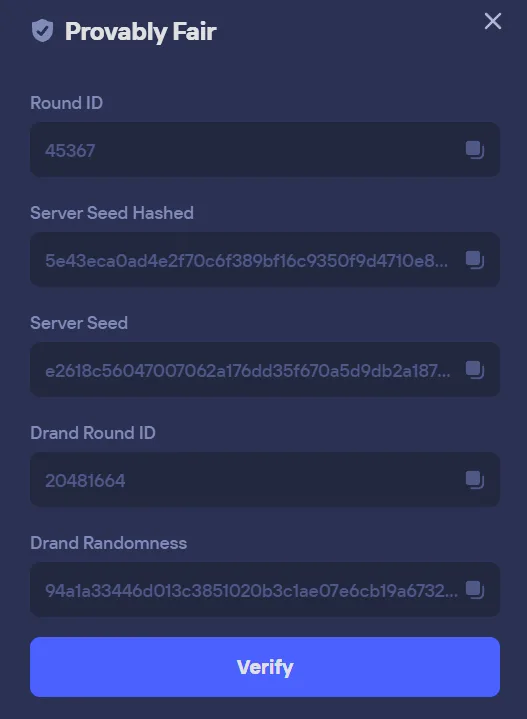
Before the game, the casino publishes the SHA-256 hash of the server seed (seed commitment). After the game, the casino reveals the server seed, and you can verify that its hash equals the published commitment. Then you combine the server seed, client seed, and nonce (often concatenated in a defined order) and hash that combination to confirm the outcome. The exact algorithm for deriving the outcome from the hash varies by game (e.g., dice, crash, blackjack), but the hash verification step is universal.
The Command Line Approach: No GUI Required
How Does This Compare to 0% House Edge Protocols?
Audited 100% RTP
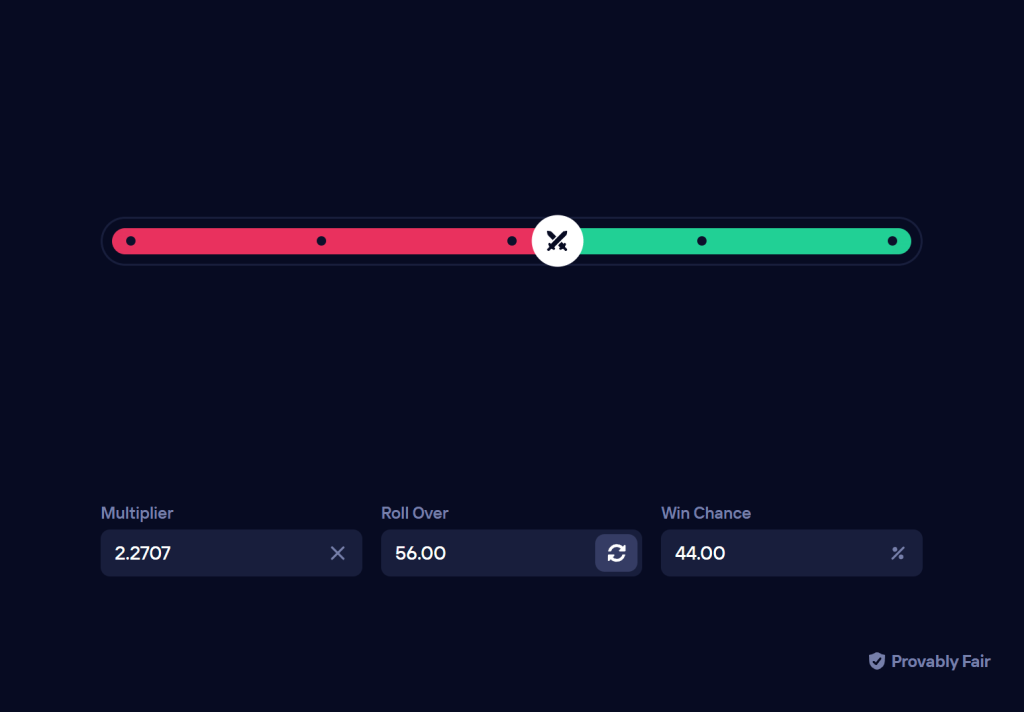
Instead of standard 1.00% to 4.00% casino house margins, compare with mathematically verified 100% RTP Originals (0.00% House Edge) on Duel Casino:

You do not need a special app or website to verify. All you need is a terminal and the published data. The examples below assume a typical SHA-256 based scheme. Adjust the hashing algorithm and concatenation order if the casino uses a different one (e.g., SHA-512, HMAC).
Example: Verifying a Server Seed Commitment
Suppose the casino publishes the following commitment on their website or in the game log:
Commitment: 5d41402abc4b2a76b9719d911017c592d1e8f3e2c8c9b4e8a0f3b8c8d9e8f7a6
After the game, the casino reveals the server seed as hello. To verify:
echo -n "hello" | openssl dgst -sha256
Output: 5d41402abc4b2a76b9719d911017c592d1e8f3e2c8c9b4e8a0f3b8c8d9e8f7a6 – matches. If it does not match, the seed was not the one committed to, and the outcome is not trustworthy.
Some casinos use a different format (e.g., include a newline or hex encoding). Always check the exact byte sequence the casino expects. Using echo -n avoids an extra newline. For hexadecimal seeds, you may need to convert first.
Verifying Multiple Game Outcomes with a Seed Chain
Many casinos rotate server seeds using a chain: the hash of the next seed is published before the current seed is revealed. You can verify the entire chain iteratively. For example, if the casino publishes a list of future seed commitments, you can pre-compute the hash of each revealed seed and check that the next commitment matches. This is straightforward with a simple shell loop:
#!/bin/bash
# seed_chain.txt: one seed per line, in order of revelation
# commitment_chain.txt: corresponding hashes, one per line
while read -r seed <&3; do
  read -r expected <&4
  computed=$(echo -n "$seed" | openssl dgst -sha256 | cut -d' ' -f2)
  if [ "$computed" != "$expected" ]; then
    echo "Mismatch at seed $seed"
  fi
done 3<seed_chain.txt 4<commitment_chain.txt
Verifying RTP and Fairness of Game Logic
Hash verification confirms that the seed was not changed after the fact, but it does not prove that the game logic is fair. You must also verify that the derived outcome matches the displayed result. For example, in a dice game with a 10,000-sided range, the hash (e.g., first 4 bytes converted to integer) should map to the roll outcome. The casino should publish the mapping algorithm. You can reproduce this mapping in your terminal using awk or python3. For instance, to compute a dice roll from a SHA-256 hash:
echo -n "server_seed:client_seed:nonce" | openssl dgst -sha256 | awk '{print "0x" substr($2,1,8)}' | xargs printf '%d' | awk '{print 1 + ($1 % 10000)}'
This is a simplified example. The exact modulo and offset depend on the game. Always check the casino’s published technical specification.
Overall RTP verification is more involved. You can simulate a large number of rounds (e.g., 1 million) using the same seed and client seed sequence, then compute the empirical return. This requires the full game logic and a script. Many casinos provide guides on provably fair verification that include such scripts. For a truly independent check, you can write your own simulation and compare the casino’s claimed RTP against your simulation results.
On-Chain Verification for Crypto Casinos
Some casinos go a step further and record the seed commitment on a blockchain (e.g., Ethereum, Bitcoin, or a sidechain). This makes tampering even harder because the commitment is immutable. To verify on-chain, you can use curl to query a blockchain explorer API (or a local node). For example, to retrieve the transaction data for an Ethereum transaction that includes a seed commitment:
curl -s "https://api.etherscan.io/api?module=proxy&action=eth_getTransactionByHash&txhash=0x...&apikey=YourApiKey" | jq '.result.input'
The input data often contains the commitment as a hex string. You can combine this with the revealed seed to verify the hash. Tools like jq and openssl make the process scriptable. If the casino records the seed on a chain with a public ledger, you can verify the commitment without needing to trust the casino’s website. This is the strongest form of hash verification available.
Limitations of Command Line Verification
While powerful, command-line verification has caveats:
- Exact data format – the casino must specify the exact byte string used for hashing (including separators, encoding, and order). A single extra character changes the hash.
- Seed rotation – you must have access to all seeds in the chain. Some casinos only reveal seeds after a certain number of rounds; you may need to wait.
- Game logic complexity – for games with multiple outcomes (e.g., blackjack, slots), the mapping from hash to outcome is more complex. Verification requires trusting the provided algorithm, unless you can independently audit the source code.
- On-chain data latency – blockchain queries may be slower than direct API calls. Use a reliable API and consider caching.
Despite these limitations, the command line offers a deterministic, auditable method that does not rely on any graphical interface or third-party service. For a list of casinos that support this kind of verification, see our casino reviews.
FAQ
What tools do I need to verify hash from the command line?
You need a terminal with openssl or sha256sum (pre-installed on most Linux and macOS systems; Windows users can use WSL or Git Bash). For on-chain verification, install curl and optionally jq for JSON parsing. No additional software is required.
How do I verify a server seed commitment if the casino uses HMAC instead of SHA-256?
Use openssl dgst with the appropriate algorithm. For HMAC-SHA256, the command is echo -n "key" | openssl dgst -sha256 -hmac "key". The casino should specify the exact HMAC parameters (key, message, output format).
Can I verify the overall RTP using command-line tools?
Only if you simulate many rounds using the same seed sequence and game logic. Write a script that iterates through nonces, reproduces the outcome for each round, and computes the total return. This is feasible for simple games (dice, crash) but may be impractical for complex games. Always check the casino’s published RTP against a large sample of your own results.