The Dice Seed Pair Lifecycle: From Generation to Reveal

the author
ProvablySmart Research Desk
date post
Aug 28, 2026
Share


Every dice roll at a verifiable casino is produced by a seed pair. The lifecycle of that pair – generation, commitment, active use, rotation, and reveal – is the entire proof system. If you understand the lifecycle, you can verify any individual roll and detect operators that deviate from the standard. This article walks through each stage from a player’s perspective, with the specific checks you can run after the server seed is revealed.
What a Seed Pair Contains
A seed pair consists of three input values, one of which is often overlooked:
- Server seed – a random string generated by the casino and kept secret while active. A commitment, usually an SHA-256 hash, is published before the first bet.
- Client seed – a string chosen by the player. If you do not set it yourself, the casino may generate it for you; a player-chosen client seed gives stronger fairness assurance.
- Nonce – an integer that increments with each roll under the same seed pair. It is the component that makes each roll distinct without rotating the seeds.
The exact mixing function (HMAC-SHA256, SHA-512, or a custom construction) varies by operator. The lifecycle does not. What matters for verification is that all three values are included in the documented algorithm.
Generation and Commitment
How Does This Compare to 0% House Edge Protocols?
Audited 100% RTP
Instead of standard 1.00% to 4.00% casino house margins, compare with mathematically verified 100% RTP Originals (0.00% House Edge) on Duel Casino:
As of 2026, the dominant family of dice fairness systems still uses hash commitments. Before any fair dice roll, the casino generates a server seed and publishes its hash. This is a commitment: once the hash is displayed, the operator is cryptographically bound to any seed that produces that hash. Because finding a SHA-256 preimage is not feasible, the published hash prevents the operator from changing the active server seed after bets are placed.
The player then sets or accepts a client seed. In a properly designed implementation, the player can change the client seed at any time without requiring the server seed to be revealed. The server seed hash remains unchanged, so the player can later confirm that the same server seed was in use throughout the session.
What to check: before you place any bets, record the server seed hash exactly as displayed. Compare it with the value shown in your account’s seed history after rotation. Pay attention to encoding – many sites display hash values in lowercase hex, and a 0x prefix produces a different hash if that prefix is not part of the original seed string.
Lifecycle States
Interface labels differ, but the lifecycle reduces to a small set of states. Understanding them tells you when a fairness commitment actually begins.
| Stage | What the player can verify |
|---|---|
| Generated, not committed | Nothing. If the site lets you bet before a hash is published, the commitment is absent. |
| Committed | The server seed hash is visible; the seed itself is secret. Record the hash and the client seed in use. |
| Active | Rolls are generated from the committed seed pair; nonce increments. Keep your own bet log if you plan to audit later. |
| Pending rotation | A new server seed has been generated and its hash published, but the old seed remains active until you activate the new one. |
| Revealed | The old server seed is shown in seed history. Compute SHA-256 and compare, then reproduce all rolls from that session. |
Nonce and Result Generation
Each roll is a deterministic function of the server seed, client seed, and nonce. The nonce usually starts at 0 or 1 and increments by one after every roll. When a new server seed is activated, the nonce resets to its initial value. If the client seed is changed without rotating the server seed, the nonce also resets, which is why the seed history must show exact timestamps.
To compute a dice result, the function produces an integer in a fixed range, often 0 to 9999 or 0 to 65535. That integer is compared to a win threshold set by the win chance. If the result is below the threshold, the player wins; otherwise the player loses. The exact conversion is documented by each operator, and the correct mapping is the only part that cannot be guessed from the lifecycle alone.
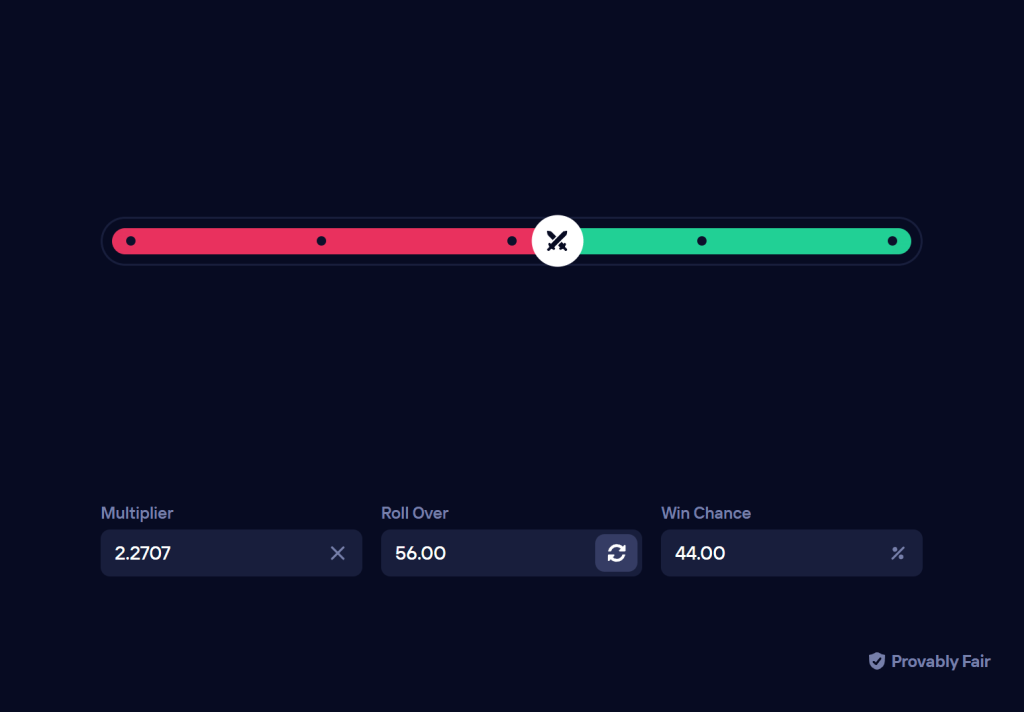
RTP math connects to the lifecycle because the mapping from seed pairs to outcomes must be uniform. If a game pays m times the stake when the win probability is p, the expected return per unit staked is m * p. A standard 1% house edge configuration uses p = 0.495 and m = 2.0, giving m * p = 0.99 and house edge = 1%. Across all seed pairs, the average result must approach this value. If an operator’s dice algorithm maps a seeded integer to a win threshold in a biased way, long-run RTP will diverge from the published value. Changing seeds cannot change that; it is a bankroll management decision, not a fairness decision.
Verification Workflow
When the server seed is revealed, run these checks:
- Hash check: calculate SHA-256 of the revealed seed and compare to the previously displayed hash.
- Seed pair check: confirm the correct client seed and nonce range are used. If automatic seed rotation occurred, verify that no rolls are missing from the history.
- Outcome reproduction: use the same algorithm and inputs to regenerate all bets in the session. If any recorded result does not match, the operator’s log is inconsistent.
- Nonce continuity: verify that nonce values in bet history are sequential and match your own records. A nonce gap means one or more rolls are missing from the log.
A practical reproduction method, with code examples and a test vector, is available in our provably fair verification guide.
Common Failure Points
- Hash mismatches caused by trailing whitespace, uppercase hex, or an extra newline at the end of the seed string. Normalize the string before hashing.
- Client seed changes that reset the nonce are often omitted from audit logs, making later reproduction ambiguous.
- Some operators show the new server seed hash and the old server seed simultaneously. That flattens the lifecycle into a single event and weakens the standard two-stage commitment.
- RTP claims should be verified as multiplier and win chance, not as a percentage with no derivation. Independent tests are covered in our casino reviews.
FAQ
Can the casino cheat if it knows the client seed?
The commitment proves the server seed was not changed after the hash was published. It does not prove the casino did not know the client seed. If you use a casino-generated client seed, the operator knows both inputs and can predict every roll in advance. The commitment prevents post-hoc seed substitution, but it does not prevent an operator from using that predicted roll data to apply limits or close a session. To get the strongest assurance, generate your own client seed, verify the server seed hash before betting, and review the full roll history after reveal.
What happens if a new client seed is used without rotating the server seed?
The nonce resets, but the server seed commitment remains valid. The same server seed continues to be used with a different client seed and a new nonce sequence. You should verify that the hash of the server seed was published before the first bet in the new nonce sequence; otherwise the fairness claim for that segment is weaker.
Does the seed lifecycle affect the house edge or RTP?
No. The house edge is set by the win chance and payout multiplier. The lifecycle only determines which deterministic result is selected. If the mapping is uniform, changing seeds or resetting nonces does not alter expected return. It does affect your ability to audit the rolls, so lifecycle integrity matters for fairness, not for RTP.