Crash Game Algorithms: Bustabit-Style vs Proprietary Implementations

the author
ProvablySmart Research Desk
date post
Aug 28, 2026

Share


Crash games have become a staple in crypto gambling, with the core mechanic being a multiplier that increases until it randomly ‘crashes’. The algorithm that determines the crash point is the critical element that separates verifiable fair games from those that require trust. This article examines the two dominant algorithmic approaches: the open Bustabit-style provably fair implementation and the various proprietary implementations used by other operators. We focus on what a technically literate player can actually verify.
Bustabit-Style Provably Fair Algorithm
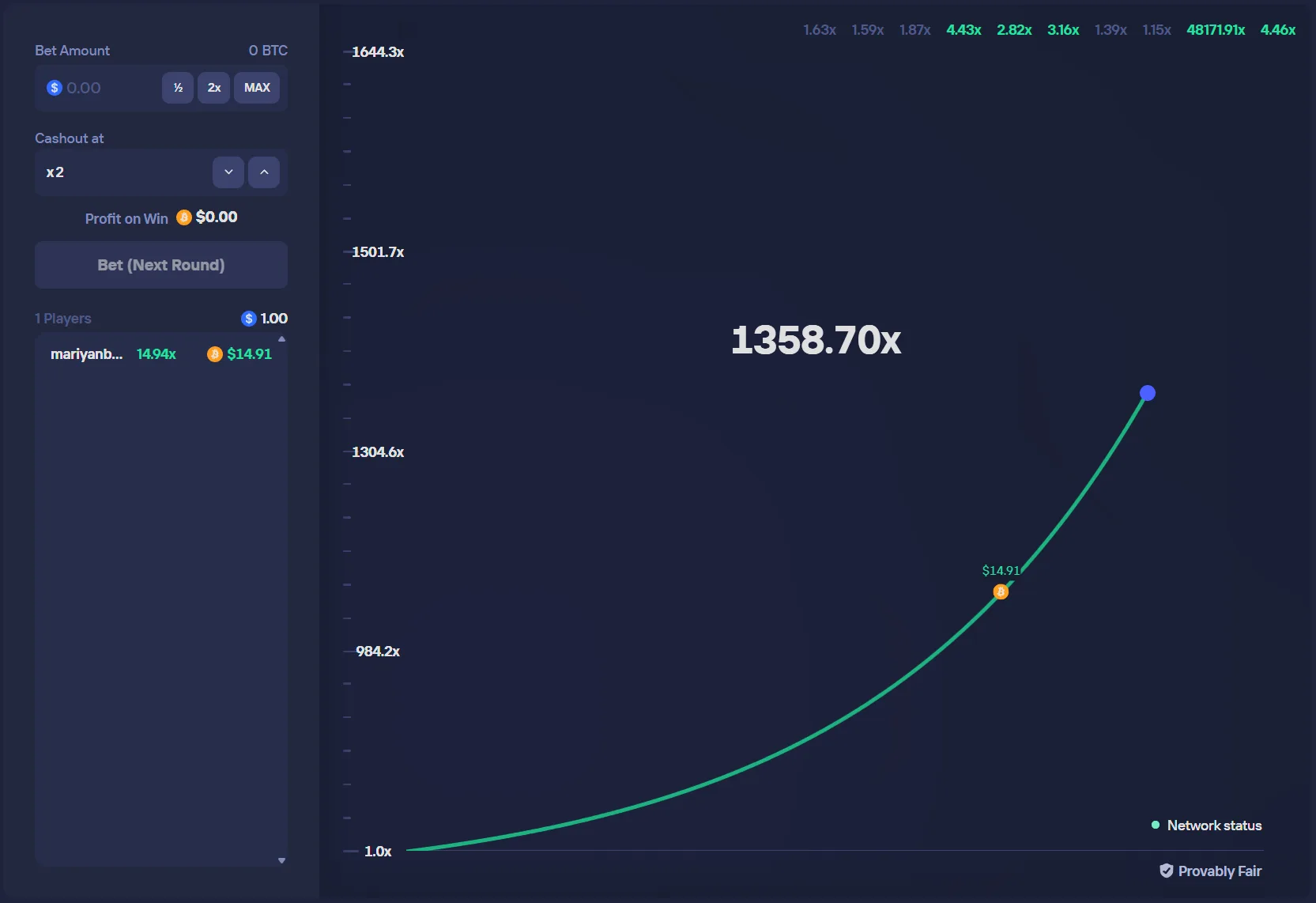
The original Bustabit (now often referred to as the ‘Bustabit-style’ algorithm) uses a client-seeded provably fair system based on a chain of SHA-256 hashes. The core idea is that each crash point is derived from a secret server seed that is revealed after the round. The algorithm is fully documented and can be independently verified by any player with access to the round data.
How the Crash Point is Calculated
The algorithm works as follows:
- Server seed chain: The operator generates a long chain of hashes (e.g., 10 million iterations). The first hash (seed 0) is used to generate the crash point for round 1. The next seed is SHA-256(seed 0), and so on. After each round, the previous seed is revealed.
- Client seed: The player can optionally set a client seed, which is combined with the server seed to produce a final hash. This prevents the operator from precomputing all crash points.
- Crash point derivation: The combined seed (server seed + client seed + nonce) is hashed. The resulting 256-bit hash is converted to a number between 0 and 1 using a floating-point conversion. The crash point is then calculated as
max(1, floor(1 / (1 - x)) * 0.01), where x is that number. This creates a distribution where the probability of a crash at multiplier M is approximately 1/M.
Verifying a Game Round
To verify a single round, a player needs:
- The server seed used for that round (revealed after the round ends).
- The client seed they used (or the default).
- The nonce (round number).
- Open-source verification code or a script to compute the crash point.
Because the server seed chain is deterministic, a player can also verify that the seed used for round N is indeed the SHA-256 of the seed used for round N+1 (which was revealed earlier). This ensures the operator did not cherry-pick which seed to reveal. The player can check the entire chain consistency. This is a strong guarantee of randomness and non-manipulation.
Proprietary Implementations
How Does This Compare to 0% House Edge Protocols?
Audited 100% RTP
Instead of standard 1.00% to 4.00% casino house margins, compare with mathematically verified 100% RTP Originals (0.00% House Edge) on Duel Casino:

Many newer crash games do not disclose their algorithm. Instead, they use a closed-source RNG, often described as a ‘proprietary random number generator’ or ‘house algorithm’. These implementations vary widely, but common characteristics include:
- Server-side RNG: The crash point is generated on the operator’s server using a seeded RNG (e.g., Mersenne Twister, ChaCha20) that is not publicly verifiable.
- No client seed: Players cannot influence the randomness. The seed may be reset periodically or derived from a hash of the server time.
- Revealed after round: Some operators reveal a ‘server seed’ or ‘hash’ after the round, but this is often a hash of the round result itself, not a pre-committed value. This allows the operator to compute the result first and then produce a hash that matches it.
- House edge manipulation: The crash point distribution can be tuned arbitrarily. For example, the operator may set a 1% house edge by adjusting the probability of early crashes (e.g., crash at 1.00x more often). This is not necessarily wrong, but without verifiability, the player cannot confirm the actual RTP.
Verification Challenges
With a proprietary implementation, the player’s verification options are limited. Even if the operator provides a ‘hash’ of the result, the player cannot verify that the hash was committed before the round started (unless a pre-commitment scheme is used). Some operators implement a ‘provably fair’ mode that is actually a variation of the Bustabit model, but many do not. The key questions a player should ask:
- Is there a public, documented algorithm?
- Can I verify that the server seed was pre-committed?
- Can I verify the result using my own client seed?
- Is the source code or a reference implementation available?
If the answer to any of these is ‘no’, the game is not provably fair in the cryptographic sense.
Key Differences at a Glance
| Feature | Bustabit-Style | Proprietary |
|---|---|---|
| Provably fair | Yes (client-seeded, hash chain) | Usually not; may have limited verifiability |
| Algorithm documented | Yes, open source | No, closed |
| Client seed optional | Yes | No |
| Pre-commitment | Yes (hash chain revealed in reverse) | Rarely |
| Verification by player | Full, with known tools | Limited, often only post-round hash |
| House edge control | Fixed by crash formula (1% typical) | Arbitrary, not transparent |
Implications for Player Verification
From a technical standpoint, the Bustabit-style algorithm is the gold standard for crash games because it allows the player to verify every round independently without trusting the operator. The chain of hashes ensures that the operator cannot reverse-engineer future rounds even if they know the client seed. The only trust needed is that the initial hash chain was generated correctly – but that can be verified after the chain is exhausted (e.g., after 10 million rounds, the operator reveals the last seed, and players can check that its hash matches the first seed).
Proprietary implementations, even if they appear fair, cannot offer the same level of assurance. A player who values verifiability should prioritize games that use a documented, open-source algorithm. However, some operators may implement a hybrid approach: using a known algorithm but with a custom RNG for the crash point distribution. In those cases, the player still needs to trust the RNG, even if the seed is verifiable. Always check the operator’s documentation and guides on provably fair verification to understand what you can actually check.
Choosing What to Play
If you are a technical player who wants to verify every round, stick with Bustabit-style implementations. Many casinos now offer crash games, but not all are transparent. Use resources like casino reviews to see which operators disclose their algorithm. For those who are less concerned about cryptographic verification, proprietary games can still be fine, but understand that you are trusting the operator’s integrity. Always manage your bankroll accordingly, as the house edge is not always transparent. For the latest on provably fair standards, check news on algorithm updates.
FAQ
How can I verify a Bustabit-style crash game round?
You need the server seed (revealed after the round), your client seed, the round nonce, and the documented algorithm. You can then compute the crash point locally using a script or a verification tool. Many casinos provide a ‘verify’ button that does this automatically, but you can also use open-source code to double-check. The key is to ensure the server seed matches the hash chain by checking that the seed for round N is the SHA-256 hash of the seed for round N+1.
Are proprietary crash games always unfair?
Not necessarily. A proprietary algorithm can be designed to be fair (e.g., using a cryptographically secure RNG with a pre-committed seed). However, without a public, verifiable algorithm, players cannot independently confirm that the operator did not manipulate the outcome. The burden of proof is on the operator to provide a verifiable scheme. If the operator does not disclose the algorithm or provide a way to verify pre-commitment, the game is not provably fair in the cryptographic sense.
What is the typical house edge in a crash game?
In the classic Bustabit-style algorithm, the house edge is approximately 1%, derived from the crash point formula (the expected value of the multiplier is 0.99). For proprietary implementations, the house edge can be anything the operator chooses, and it is often not disclosed. You can estimate it by observing the distribution of crash points over many rounds, but this requires a large sample and assumes the algorithm is consistent. Always check the operator’s terms or ask for a public audit.