
Casino Lottery and Raffle Tickets: Expected Value Analysis

the author
ProvablySmart Research Desk
date post
Aug 28, 2026

Share


Casino lottery and raffle tickets occupy a strange position in gambling mathematics. The per-unit price is small, the headline prize is large, and the probability of winning is correspondingly tiny. The expected value (EV) calculation, however, is no different from any other bet: sum every possible outcome multiplied by its probability and subtract the ticket price. What makes lottery tickets harder to evaluate is that two critical inputs — how many tickets are sold and what percentage of the pool is actually paid out — are not always disclosed. This article walks through the math, the edge, and the points a technical reader can verify in 2026. For a broader view of which operators publish verifiable draw data, our casino reviews are a better starting point than any headline claim.
Fixed-Prize vs Pari-Mutuel Draws

Casino lottery and raffle tickets usually fall into one of two payout structures. The default EV calculation depends on which structure is in use, and it is not always obvious from the marketing page.
Fixed-Prize Tickets
A fixed-prize lottery ticket pays a set amount for a set event, independent of sales. If the ticket price is c and the jackpot is J, the expected payout from the jackpot is J multiplied by the probability that your ticket matches the winning selection. For a draw that selects one winner uniformly from N sold tickets, that probability is 1/N, and EV is J/N – c. If J is less than cN, the operator keeps the difference and EV is negative. If J is greater than cN, the operator added value beyond the collected stakes for that draw. That can happen with a seeded jackpot, but it is the exception, not the rule.
Pari-Mutuel Raffles
A raffle generally takes all entry fees, deducts an operating commission, and pays the remaining pool to winners. Let p be the ticket price, N the number of tickets sold, and m the operator commission rate. The prize pool is Np(1-m). For a single-winner raffle, the expected payout per ticket is pool/N = p(1-m). EV per ticket is therefore p(1-m) – p = -pm. In other words, the average player loss is exactly the operator commission. Individual outcomes are still extremely variable; EV is a long-run average, not a prediction for one drawn ticket.
This parity breaks when the operator adds a seed amount S to the pool, for example to guarantee a minimum jackpot. The pool becomes Np(1-m) + S, and EV per ticket becomes S/N – pm. The condition for a non-negative EV ticket is S > pmN. The same logic applies to tiered raffles where the prize pool is divided among multiple winners. For each tier, compute the tier’s share of the pool and multiply by the probability of winning that tier.
Calculating Expected Value: The Inputs
How Does This Compare to 0% House Edge Protocols?
Audited 100% RTP
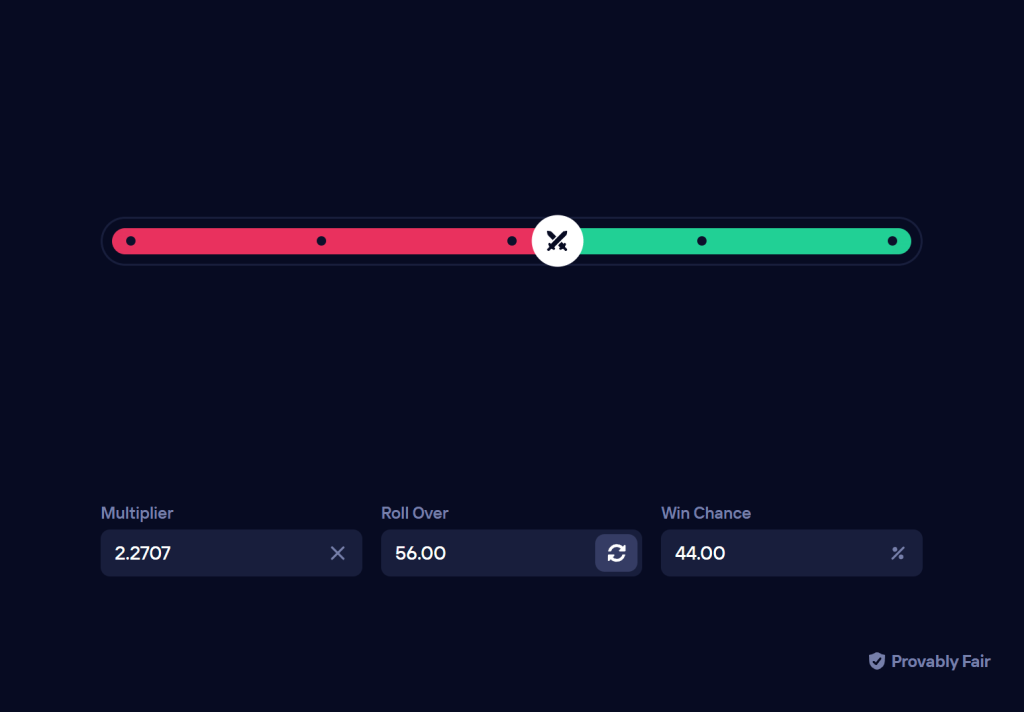
Instead of standard 1.00% to 4.00% casino house margins, compare with mathematically verified 100% RTP Originals (0.00% House Edge) on Duel Casino:

The following variables determine EV, and each should be checked in the operator’s published rules.
| Input | Symbol | Effect on EV |
|---|---|---|
| Ticket price | c | Subtracted once per ticket |
| Jackpot or face value | J | Defines the expectation from a winning ticket |
| Tickets sold | N | Sets winning probability in uniform draws |
| Operator commission | m | Reduces pool by m × gross sales |
| Seed contribution | S | Operator-funded addition that can offset commission |
| Split rule | — | Divides fixed jackpot by number of winning tickets |
For a fixed-prize jackpot shared by all winners, the EV calculation must include the probability that k winners exist. If every ticket has an independent chance of matching, the probability of generating k winners can be modeled as a binomial distribution, but casino raffles often use distinct ticket numbers rather than independent player choices. In that case, each ticket is unique and only one winner can exist per number. Check the draw mechanism before applying any probability model.
For routine decisions, an approximate EV is enough: take the published jackpot, divide by the expected ticket count, subtract the ticket price, and then subtract an additional penalty for duplicate-number risk. For explicit guidance on treating lottery tickets as a portion of a broader bankroll, see our bankroll management guide.
The House Edge in Lottery Products
It is a common mistake to treat a casino lottery ticket as a low-stakes, high-payout side bet with acceptable edge. The actual edge can be substantially worse than slots. In slots, the return-to-player (RTP) is usually published. In lottery products, the effective RTP is the prize pool divided by gross revenue. If a raffle charges €2 per ticket and pays €80 from 100 tickets, the pool is €80, revenue is €200, and RTP is 40% — a 60% house edge. That is not a hypothetical operator claim; it is a calculation you can do from the same public numbers.
What to check is the payout table and total ticket count. If the operator publishes neither, the only honest statement is that the EV cannot be calculated from public data. In that case, treat the ticket as a pure donation with a tiny chance of a prize.
What You Can Verify
In 2026, provable fairness is a standard marketing phrase for crypto casinos. The claim is useful only when the full protocol is public. The following list is the minimum verification set for any casino lottery or raffle.
- Seed hash commitment. Check that the operator publishes a hash of the draw seed before the drawing window closes. After the draw, recompute the hash from the revealed seed and confirm it matches.
- Public entropy sources. A single seed chosen by the operator is not sufficient. Verify that the final seed combines several public inputs, such as a block hash, a transaction hash, and a client seed.
- Winner-selection algorithm. The mapping from seed to winning ticket must be fully specified. If the mapping is not documented, you cannot reproduce the result. For a step-by-step example of a hash-based selection protocol, refer to our guides section.
- Ticket ledger. Raffle EV depends on the number of tickets sold. If the operator does not display a cumulative ticket count or a block-validated ledger, the jackpot figure cannot be audited.
- Split and rollover clauses. A rollover raises EV only when the added amount is real and not offset by a higher operating commission. A split clause lowers EV for every player who shares a winning number.
Positive EV Does Not Mean Positive Variance
An EV of +0.40 per ticket can still carry a 99.999% chance of losing the full ticket price. Expected value is a mean over all outcomes, not a typical outcome. In casino terms, a positive-EV lottery with one huge prize is still a lottery: after one thousand €5 tickets, an EV of +0.40 per ticket gives an expected profit of €400, but the probability of actually seeing that profit is close to the probability of winning the jackpot. For a technical audience, the relevant comparison is certainty-equivalent wealth, not raw EV.
The correct framing is that lottery tickets are entertainment spend. The EV analysis tells you how much of each ticket price the operator retains; the variance analysis tells you that the outcome is dominated by rare tail events. Both belong in any full assessment.
Conclusion
Casino lottery and raffle tickets are not a separate species of gambling. They are high-variance, high-edge bets with an unusually opaque payoff structure. The same math that evaluates a blackjack wager applies: compute expected payout ratios, subtract the cost, and verify the mechanics. When the operator hides the ticket count, the commission, or the seed, the responsible conclusion is to pass. When the verification set is public, you can calculate your expected loss precisely. Updated regulatory and operational changes affecting casino lotteries continue to appear in our news feed.
FAQ
How do I compute the expected value of a raffle ticket?
Start with the total prize pool divided by the number of tickets, subtract the ticket price, and then adjust for any prize-sharing clauses. In a single-winner raffle with a prize pool equal to ticket sales after commission, EV equals the negative of the operator commission: if the commission is 15%, EV is -0.15 times the ticket price.
Can a casino lottery ticket have positive expected value?
Yes, if the operator has added a guaranteed seed large enough to exceed the commission on all ticket sales. The condition is S > mpN, where S is the seed, m is the commission, p is the ticket price, and N is the number of tickets sold. Positive EV does not mean positive median outcome; the probability of winning remains extremely low.
What is the most important thing to check before buying a lottery ticket in a crypto casino?
Whether the operator publishes the full verification set: pre-committed seed hash, public entropy inputs, the seed-to-ticket mapping, the cumulative ticket count, and the payout rules. If any piece is missing, the EV calculation is not reproducible, and the ticket should be treated as a zero-information bet.